A fracture needs surgery when the broken bone is badly displaced, unstable, open, involving a joint, affecting blood supply or nerves, not healing properly, or unlikely to stay aligned with only a cast or splint. Some fractures heal well with plaster, brace, or non-surgical treatment, but others require surgical fixation with plates, screws, rods, pins, or external support to restore alignment and function.
At Shirdi Sai Hospital, New BEL Road, fracture treatment is planned after clinical examination and imaging. The goal is not to operate on every fracture. The goal is to choose the safest treatment that helps the bone heal in the correct position and allows the patient to regain movement, strength, and daily function.
Fracture Surgery vs Cast at a Glance
| Factor | Cast, splint or brace may be considered | Surgical fixation may be considered |
| Bone alignment | Bone remains in an acceptable position | Bone fragments remain significantly displaced |
| Stability | Fracture can stay aligned during healing | Fracture keeps shifting or cannot remain aligned |
| Skin | Skin remains intact | An open wound communicates with the fracture |
| Joint involvement | Joint surface remains acceptably aligned | Fracture disrupts the joint surface significantly |
| Number of fragments | Pattern remains stable | Multiple fragments make the fracture unstable |
| Nerves and circulation | No concerning neurovascular injury | Nerve or blood-vessel injury needs urgent assessment |
| Follow-up X-rays | Position remains satisfactory | Alignment deteriorates during follow-up |
| Treatment goal | Protect the bone while natural healing progresses | Restore and maintain alignment mechanically |
This table provides a general comparison. An X-ray, physical examination and sometimes additional imaging determine the treatment plan.
Does Every Fracture Need Surgery?
No. Many fractures heal with non-surgical treatment.
The orthopaedic doctor may use a splint initially, particularly when swelling is significant. A cast or brace may then support the injured bone while healing progresses.
Non-surgical management may work when:
- the fracture remains stable
- the bone fragments maintain acceptable alignment
- the fracture does not create an urgent problem with the skin
- nearby nerves and blood vessels remain unaffected
- the joint surface remains adequately aligned
- a cast or brace can maintain the required position
- follow-up X-rays show that the fracture has not shifted
Some displaced fractures can also undergo closed reduction. During closed reduction, the doctor realigns the bone without surgically exposing the fracture and then supports it with appropriate immobilisation.
The key question is not simply, “Is the bone broken?”
The more useful question is:
Can this fracture heal in a suitable position without surgical fixation?
When Does a Fracture Need Surgery?
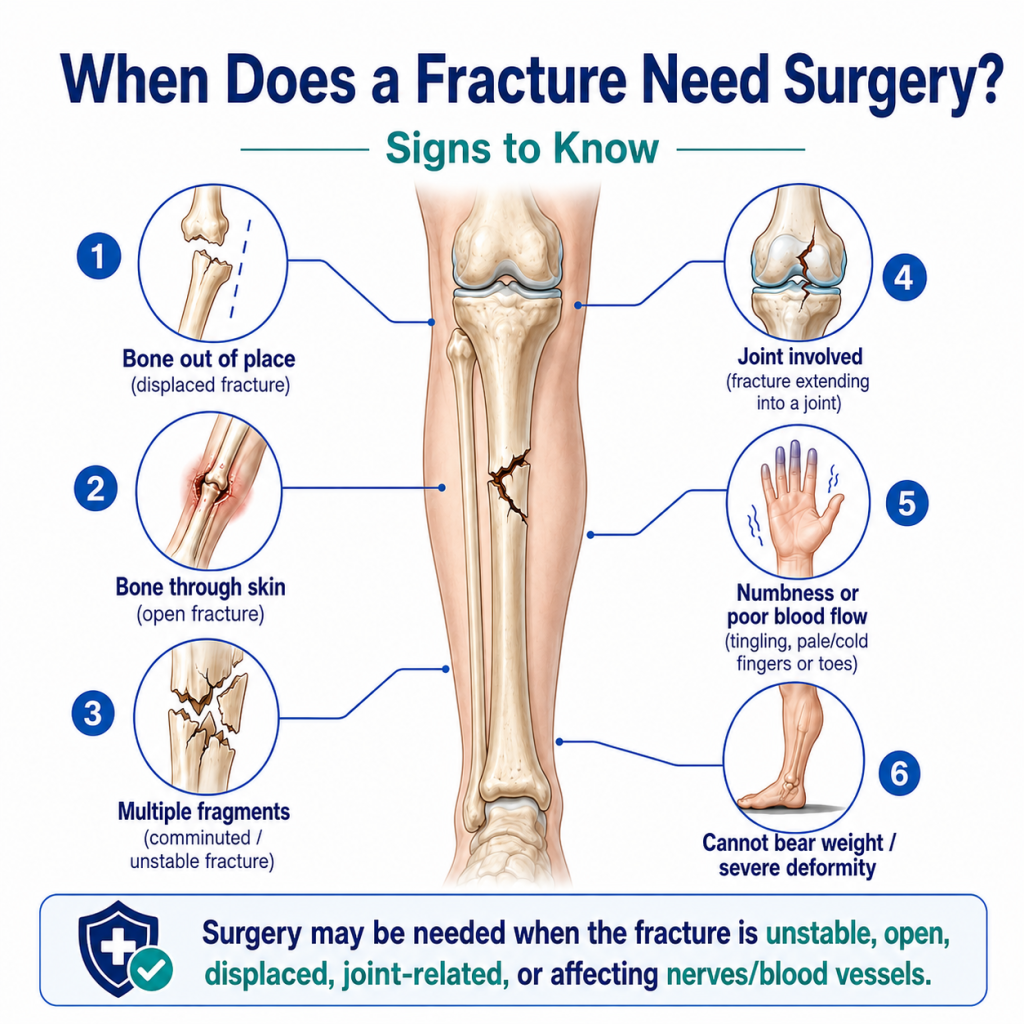
An orthopaedic surgeon may consider surgery when the fracture’s position, stability or associated injuries make non-surgical treatment unreliable or unsafe.
Common reasons include:
- a significantly displaced fracture
- an unstable fracture
- an open fracture
- a fracture that extends into a joint
- multiple bone fragments that cannot remain stable
- damage to nearby nerves or blood vessels
- severe soft-tissue injury
- a fracture that cannot maintain alignment in a cast
- repeated movement of the fracture on follow-up X-rays
- selected hip or long-bone fractures
- failure of the fracture to heal as expected
- healing in an unacceptable position that affects function
A displaced fracture does not automatically require surgery. The exact amount and direction of displacement, affected bone, patient age and expected function all influence the decision.
Likewise, severe pain alone does not prove that a patient needs an operation.
How Do Doctors Decide Between a Cast and Fixation?
Doctors make this decision by combining examination findings with imaging.
1. Which bone has fractured?
Different bones behave differently after a fracture.
A stable finger fracture does not follow the same treatment pathway as a hip fracture, ankle fracture, wrist fracture or fracture of the thigh bone.
The location also affects how much force the bone experiences during movement and weight-bearing.
2. Has the fracture moved out of position?
Doctors describe a fracture as displaced when the broken fragments no longer remain in their normal anatomical relationship.
The amount of displacement matters.
Some fractures may respond to reduction and casting. Others may remain too unstable after reduction and require fixation.
Mayo Clinic notes that displaced fractures may require surgery when doctors need to restore and stabilise alignment.
3. Is the fracture stable?
Stability asks a different question from displacement.
A doctor may successfully realign a fracture, but the bone can still move again inside the cast.
If follow-up X-rays show repeated loss of alignment, the treating surgeon may reconsider the treatment plan.
This distinction matters because a fracture can look satisfactory immediately after reduction but still prove unstable during follow-up.
4. Does the fracture enter a joint?
A fracture that extends into a joint can disrupt the smooth joint surface.
The orthopaedic surgeon looks at:
- the amount of displacement
- any gap or step in the joint surface
- joint stability
- associated ligament damage
- the patient’s age and functional needs
Some joint fractures need accurate reduction to help preserve joint mechanics.
However, not every fracture near a joint requires surgery.
5. Has the fracture affected the skin?
An open fracture occurs when a wound creates communication between the fracture and the outside environment.
The wound may be small or extensive. The bone does not always need to visibly protrude through the skin.
Open fractures need urgent assessment because contamination and infection can complicate treatment.
Mayo Clinic advises immediate medical treatment when a broken bone pierces the skin because of infection risk.
6. Are nerves or blood vessels affected?
Doctors assess circulation and nerve function because a fracture can injure structures surrounding the bone.
Concerning signs include:
- numbness
- unusual tingling
- loss of sensation
- weakness
- inability to move fingers or toes normally
- pale or blue skin
- unusually cold fingers or toes
- reduced or absent circulation beyond the injury
These findings require urgent medical assessment.
7. What do follow-up X-rays show?
The first X-ray does not always provide the final answer.
Some fractures receive a cast first and then undergo repeat imaging.
Follow-up X-rays help the doctor check:
- whether alignment remains acceptable
- whether the fracture has shifted
- whether healing has started
- whether the chosen treatment remains appropriate
For example, Mayo Clinic notes that bones can move even after reduction and immobilisation, which may change the need for surgery.
What Types of Fractures More Commonly Need Surgical Evaluation?
Certain fracture patterns raise the likelihood that an orthopaedic surgeon will consider fixation.
Open fractures
Open fractures need urgent medical care.
Treatment may involve wound cleaning, antibiotics, fracture stabilisation and surgical management depending on the injury.
Do not push exposed bone back into a wound or attempt to straighten the limb at home.
Unstable fractures
An unstable fracture cannot reliably maintain its position during healing.
The fracture may shift even after reduction and casting.
The orthopaedic surgeon may consider fixation when repeated movement threatens alignment or function.
Significantly displaced fractures
Some displaced fractures can undergo closed reduction and casting.
Others need surgery when doctors cannot restore acceptable alignment without opening the fracture or when the corrected position cannot remain stable.
Comminuted fractures
A comminuted fracture contains several bone fragments.
Some comminuted fractures remain sufficiently stable for non-surgical treatment. Others require fixation because the fragments cannot maintain suitable alignment.
The number of fragments alone does not determine treatment.
Fractures involving a joint
Doctors pay particular attention to fractures that disrupt the joint surface.
Significant displacement within a joint may affect movement and joint mechanics if the fracture heals in a poor position.
The treatment decision depends on the joint, fracture pattern and degree of displacement.
Selected hip fractures
Many hip fractures in older adults require surgical assessment because the fracture can substantially affect mobility.
The exact operation, if required, depends on fracture location, displacement, bone quality, previous mobility and overall medical condition.
Fractures with nerve or blood-vessel injury
A fracture that compromises circulation or nerve function needs urgent assessment.
The treating team may need to restore alignment, address the associated injury and stabilise the fracture.
What Is Fracture Fixation?
Fracture fixation means using a mechanical method to hold broken bone fragments in an appropriate position while healing occurs.
The surgeon chooses the fixation method according to the bone, fracture pattern, soft tissues and treatment objectives.
Possible methods include:
- plates and screws
- rods or intramedullary nails
- pins
- wires
- external fixation
The presence of an implant does not make the bone heal by itself. The implant provides stability while biological bone healing takes place.
Johns Hopkins describes plates, screws, nails and other fixation methods for fractures that require surgical stabilisation.
What Does ORIF Mean?
ORIF stands for open reduction and internal fixation.
Open reduction means the surgeon accesses the fracture directly and restores the position of the bone fragments.
Internal fixation means the surgeon uses an implant such as a plate, screw, nail, pin or wire to maintain the corrected position.
An orthopaedic surgeon may consider ORIF for selected displaced, unstable or joint-involving fractures.
Not every fracture that needs surgery requires the same technique.
What Is External Fixation?
External fixation uses pins or wires placed into the bone and connected to a frame outside the body.
Surgeons may consider external fixation when:
- significant swelling or soft-tissue damage exists
- an open injury needs ongoing wound care
- the fracture needs temporary stabilisation
- the injury pattern makes external support appropriate
Sometimes external fixation serves as temporary treatment before another procedure. In other situations, it may form part of the definitive treatment.
Can a Displaced Fracture Heal Without Surgery?
Sometimes.
The word “displaced” describes the position of the bone fragments. It does not automatically tell doctors which treatment the patient needs.
The orthopaedic doctor considers:
- how far the fragments have moved
- whether rotation or shortening exists
- which bone has fractured
- whether the fracture affects a joint
- whether closed reduction can restore alignment
- whether a cast can maintain that alignment
- the patient’s age
- bone quality
- functional requirements
A displaced fracture that responds well to reduction and remains stable may not need internal fixation.
A fracture that repeatedly loses alignment may require a different approach.
Can a Fracture Shift Inside a Cast?
Yes.
A cast restricts movement, but swelling changes during the early stages after injury. Some fracture patterns also remain inherently unstable.
The treating doctor may schedule repeat X-rays to make sure the fragments have not shifted.
Contact the treating team if:
- the cast becomes very loose
- pain increases significantly
- swelling worsens
- fingers or toes become numb
- fingers or toes appear pale or blue
- the cast cracks or becomes damaged
- the patient develops new difficulty moving the fingers or toes
Do not remove, trim or alter the cast without medical guidance.
Does Surgery Make a Fracture Heal Faster?
Not necessarily.
Surgery provides alignment and stability when the fracture requires it. Biological healing still takes time.
Recovery depends on factors such as:
- affected bone
- fracture severity
- blood supply
- age
- bone quality
- smoking
- diabetes and other medical conditions
- associated injuries
- infection
- rehabilitation
- whether the patient follows weight-bearing restrictions
A patient should not choose surgery simply because they assume it will produce faster healing.
The purpose of fixation is to provide the stability and alignment that the specific fracture needs.
What Are the Limitations and Risks of Fracture Surgery?
Every operation has potential risks.
Depending on the fracture and procedure, these may include:
- infection
- bleeding
- wound problems
- stiffness
- delayed bone healing
- failure of the fracture to unite
- nerve or blood-vessel injury
- implant-related problems
- blood clots
- anaesthesia-related complications
- need for another procedure in selected cases
The presence of surgical risk does not mean surgery should always be avoided.
Instead, the orthopaedic surgeon weighs the risks of surgery against the problems that could arise if an unstable or poorly aligned fracture receives non-surgical treatment.
What Happens If a Fracture Heals in the Wrong Position?
Doctors call healing in an incorrect position a malunion.
The effect depends on the bone and degree of deformity.
A significant malunion may contribute to:
- altered movement
- loss of joint motion
- limb shortening
- abnormal rotation
- reduced strength
- changes in walking
- difficulty performing specific activities
Not every small alignment difference causes a meaningful problem.
The orthopaedic doctor evaluates alignment together with symptoms and function.
What If the Fracture Does Not Heal?
Doctors use the terms delayed union and nonunion when a fracture takes longer than expected to heal or fails to unite.
Possible contributing factors include:
- severe injury
- poor blood supply
- infection
- instability
- smoking
- certain medical conditions
- significant soft-tissue damage
The doctor may use repeat imaging and clinical examination to determine whether healing continues.
Treatment depends on the reason for poor healing and may involve changes to immobilisation, fixation or another procedure in selected patients.
How Long Does Recovery Take After a Fracture?
There is no universal fracture-healing timeline.
Different bones and fracture patterns heal at different rates. A patient’s age, bone health, injury severity, treatment and rehabilitation also influence recovery.
Bone healing and complete functional recovery are not always the same thing.
Even after imaging shows progress, the patient may still need time to regain:
- joint movement
- muscle strength
- balance
- confidence
- walking ability
- sport-specific function
The treating orthopaedic team should guide weight-bearing and return to activity according to the individual fracture.
When Should a Suspected Fracture Receive Emergency Assessment?
Seek urgent medical attention after an injury if there is:
- bone visible through the skin
- an open wound over a suspected fracture
- significant deformity
- uncontrolled bleeding
- severe pain after major trauma
- numbness or loss of sensation
- fingers or toes becoming pale, blue or cold
- inability to move the affected limb
- inability to stand or bear weight after a significant injury
- increasing tight swelling with severe pain
- suspected fracture after a serious road traffic accident
Do not massage, forcibly straighten or attempt to set a suspected fracture at home.
For significant trauma or warning signs, use an appropriate emergency service rather than waiting for a routine appointment.
How Shirdi Sai Hospital Evaluates Fractures on New BEL Road
Shirdi Sai Hospital’s live Orthopedics service includes fracture evaluation, casting, bracing and surgical intervention when necessary.
Fracture assessment may involve:
- understanding how the injury occurred
- examining swelling and deformity
- checking the skin
- checking circulation and sensation
- assessing movement where safe
- reviewing X-rays
- considering additional imaging for selected injuries
- deciding whether the fracture remains stable enough for non-surgical treatment
- planning fixation when the fracture requires surgical stabilisation
- guiding follow-up and rehabilitation
Patients with an existing X-ray or scan can bring previous reports for the orthopaedic team to review.
For more information about the department, see the hospital’s Orthopedics services. Shirdi Sai Hospital Orthopedics
Patients who specifically need information about fracture assessment and fixation pathways can also review the hospital’s fracture treatment information for New BEL Road. Fracture treatment in New BEL Road
Questions to Ask the Orthopaedic Doctor
If a doctor has diagnosed a fracture, useful questions include:
- Is my fracture stable or unstable?
- Has the bone moved out of position?
- Does the fracture enter a joint?
- Can reduction and casting maintain the alignment?
- Why do you recommend surgery or non-surgical treatment in my case?
- Will I need another X-ray after the cast?
- When can I put weight on the injured limb?
- What changes in the cast should I report?
- If surgery becomes necessary, what type of fixation may suit this fracture?
- What rehabilitation will I need?
These questions can help patients understand the reasoning behind the treatment plan instead of judging the decision only by the appearance of the X-ray.
When to See an Orthopaedic Doctor
Arrange an orthopaedic assessment when:
- pain and swelling follow a fall or injury
- an X-ray has confirmed a fracture
- the injured limb looks abnormal
- you cannot use the limb normally
- you need to know whether a cast or surgery is appropriate
- an existing cast has become loose or uncomfortable
- a follow-up X-ray shows movement of the fracture
- pain or function is not improving as expected
- you want a review of a fracture-treatment plan
For severe trauma, an open wound, circulation changes, marked deformity or other emergency signs, seek urgent assessment.
Shirdi Sai Hospital provides an Emergency Medicine pathway for acute injuries and trauma. Emergency Medicine at Shirdi Sai Hospital
Frequently Asked Questions
Does every fracture need surgery?
No. Many stable and suitably aligned fractures can heal with a splint, cast or brace. Surgery becomes more likely when the fracture remains unstable, significantly displaced, open, joint-involving or unable to maintain an acceptable position without fixation.
How do doctors decide between a cast and surgery?
Doctors review the affected bone, fracture pattern, displacement, stability, joint involvement, soft-tissue injury, nerve and blood-vessel function, patient factors and imaging. They also consider whether a cast can maintain alignment throughout healing.
Does every displaced fracture need surgery?
No. Some displaced fractures can undergo closed reduction and remain stable in a cast. Surgery may become necessary when doctors cannot restore adequate alignment without an operation or when the fracture moves again after reduction.
Can a fracture move after doctors put on a cast?
Yes. Certain unstable fractures can shift while swelling changes or healing begins. Doctors may use follow-up X-rays to confirm that the fracture remains aligned.
What fractures are more likely to need fixation?
Open, unstable, significantly displaced, joint-involving and some comminuted fractures more commonly require surgical evaluation. Fractures associated with nerve or blood-vessel injury also need urgent assessment.
Does fracture surgery make the bone heal faster?
Not necessarily. Fixation provides stability and alignment when the fracture needs them, but biological bone healing still takes time. Recovery varies according to the injury, bone, patient health and rehabilitation.
When should I go to the hospital immediately after a fracture?
Seek urgent care for an open wound, exposed bone, major deformity, uncontrolled bleeding, numbness, loss of movement, severe swelling, or fingers or toes becoming pale, blue or cold. Significant trauma also warrants prompt assessment.
Take the Next Step
The choice between a cast and surgical fixation depends on more than the fact that a bone has broken. Doctors look at alignment, stability, joint involvement, surrounding tissues, circulation, nerve function and whether the fracture can remain in a safe position during healing.
Many fractures heal without surgery. Others need fixation because a cast cannot provide enough stability.
Patients with a confirmed or suspected fracture can arrange an orthopaedic consultation at Shirdi Sai Hospital on New BEL Road for clinical assessment and treatment planning. Contact and appointment pathway
Seek urgent medical care instead of waiting for a scheduled consultation when the injury involves an open wound, severe deformity, significant trauma, uncontrolled bleeding, numbness or circulation changes.

Leave a Reply