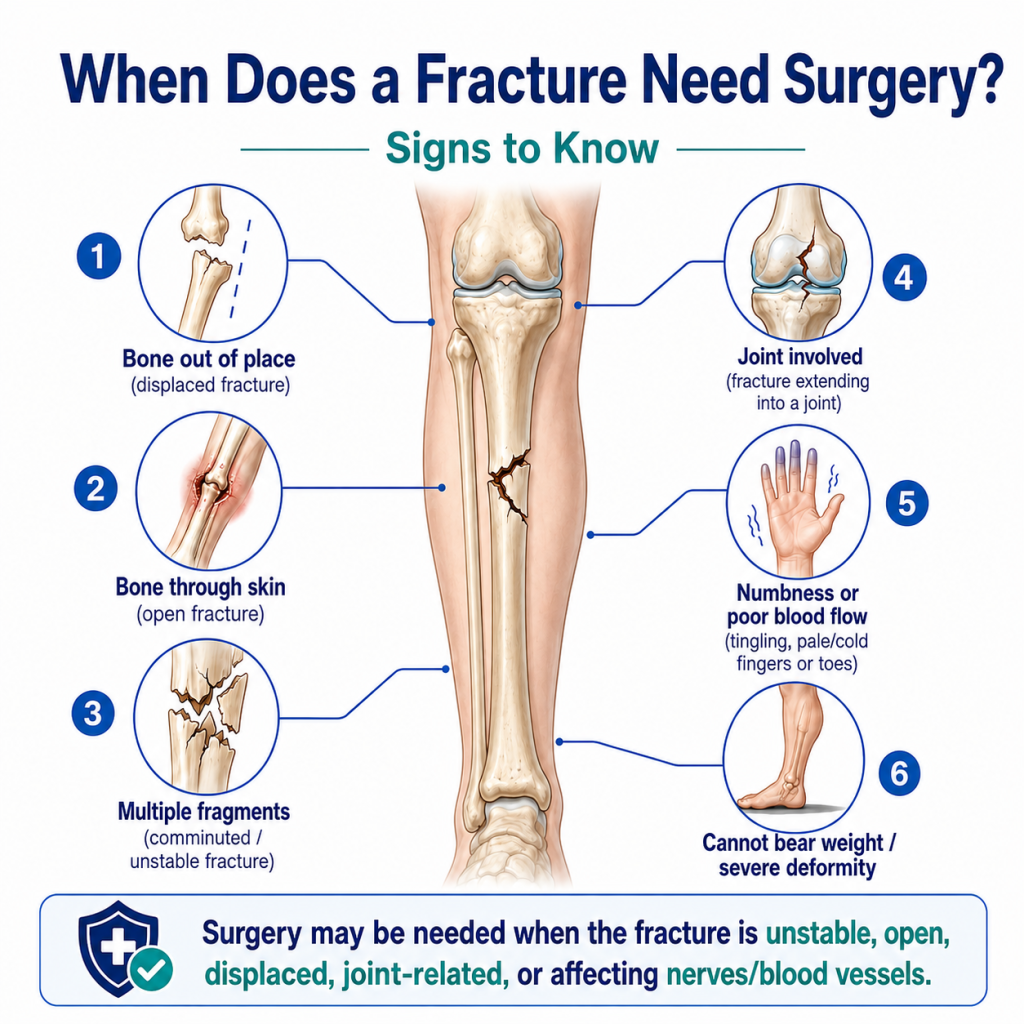
A fracture needs surgery when the broken bone is badly displaced, unstable, open, involving a joint, affecting blood supply or nerves, not healing properly, or unlikely to stay aligned with only a cast or splint. Some fractures heal well with plaster, brace, or non-surgical treatment, but others require surgical fixation with plates, screws, rods, pins, or external support to restore alignment and function.
At Shirdi Sai Hospital, New BEL Road, fracture treatment is planned after clinical examination and imaging. The goal is not to operate on every fracture. The goal is to choose the safest treatment that helps the bone heal in the correct position and allows the patient to regain movement, strength, and daily function.
What Is a Fracture?
A fracture means a broken bone. The break may be small, partial, complete, displaced, open, or broken into multiple pieces. The severity depends on the force of injury, the bone involved, the patient’s age, bone strength, and whether nearby joints, nerves, blood vessels, skin, or muscles are affected.
Common causes of fractures include:
- falls
- road traffic accidents
- sports injuries
- direct blows
- twisting injuries
- osteoporosis-related weak bones
- repetitive stress injuries
- workplace injuries
Not every fracture looks dramatic. Some patients can still move the injured part, even with a fracture. That is why pain, swelling, deformity, inability to bear weight, or difficulty using the limb should be evaluated early.
Does Every Fracture Need Surgery?
No. Many fractures do not need surgery. If the bone pieces are well aligned, stable, and expected to heal properly, treatment may include a splint, plaster cast, brace, rest, medicines, and follow-up X-rays.
Non-surgical fracture treatment may be suitable when:
- the broken bone is not displaced
- the fracture is stable
- joint alignment is not affected
- the bone can heal safely in a cast or brace
- there is no open wound
- there is no nerve or blood vessel injury
- the patient can follow immobilization and follow-up advice
However, some fractures cannot heal correctly unless the bones are realigned and stabilized surgically. This decision should be made by an orthopedic specialist after reviewing the X-ray or scan.
When Does a Fracture Need Surgery?
Fracture surgery may be needed when the bone position, stability, or injury severity makes non-surgical healing unsafe or unreliable.
Common reasons include:
- displaced fracture
- open fracture
- unstable fracture
- fracture involving a joint
- fracture with multiple bone fragments
- fracture with nerve or blood vessel injury
- fracture that cannot be held in a cast
- fracture with severe soft tissue injury
- hip fracture in elderly patients
- fracture that is not healing properly
- fracture that healed in the wrong position
- repeated loss of alignment on follow-up X-rays
Surgery is not chosen only because the fracture is painful. Pain is common in fractures. Surgery is considered when alignment, stability, healing, or function is at risk.
Signs That a Broken Bone May Need Surgery
A fracture may need surgical evaluation if the injury shows warning signs.
Important signs include:
- visible deformity
- bone seen through the skin
- severe swelling
- severe pain after injury
- inability to move the limb
- inability to stand or walk after injury
- numbness or tingling
- fingers or toes becoming cold, pale, or blue
- wound near the fracture site
- severe pain with tight swelling
- repeated fracture displacement
- fracture near a joint
- fracture after high-energy trauma
These symptoms do not automatically mean surgery is certain, but they do mean urgent orthopedic evaluation is important.
Fracture Surgery vs Cast: Main Difference
| Factor | Cast or Splint Treatment | Fracture Surgery |
|---|---|---|
| Used when | Fracture is stable and well aligned | Fracture is unstable, displaced, open, or complex |
| Main purpose | Immobilizes bone externally | Realigns and stabilizes bone internally or externally |
| Tools used | Plaster, splint, brace | Plates, screws, rods, pins, external fixator |
| Hospital stay | Often shorter or outpatient | Depends on fracture and procedure |
| Follow-up | X-rays to confirm alignment and healing | X-rays, wound care, implant and rehab follow-up |
| Recovery | Depends on fracture type | Depends on surgery, bone healing, and rehabilitation |
| Risk if wrong choice | Malalignment, stiffness, delayed healing | Surgical risks if not medically suitable |
This comparison helps patients understand why treatment choice is based on fracture stability, not only pain level.
Types of Fractures That Often Need Surgery
Some fracture patterns are more likely to need surgical management.
Open Fractures
An open fracture means the broken bone is associated with a wound in the skin. This is serious because infection risk is higher. Open fractures often need urgent cleaning, antibiotics, stabilization, and surgical care.
Warning signs include:
- wound near the broken bone
- bone visible through skin
- heavy bleeding
- severe contamination with mud or road debris
- severe pain and swelling after trauma
Open fractures should be treated as urgent.
Displaced Fractures
A displaced fracture means the bone pieces have moved out of their normal alignment. If the bones cannot be aligned and held with a cast, surgery may be needed.
Possible signs include:
- limb looks bent or abnormal
- shortening of the injured limb
- severe swelling
- abnormal movement
- pain with deformity
Proper alignment is important because bones that heal in the wrong position can affect movement, strength, and function.
Unstable Fractures
An unstable fracture may move even after being placed in a cast. If the bone cannot stay in the correct position, surgery may be advised to hold it securely.
Examples include:
- fractures with multiple fragments
- certain long bone fractures
- fractures with ligament injury
- fractures that shift on follow-up X-rays
Joint Fractures
Fractures that extend into a joint may require surgery if the joint surface is not aligned properly. Joint alignment matters because uneven healing can lead to stiffness, pain, and early arthritis.
Common joint areas include:
- ankle
- wrist
- elbow
- knee
- shoulder
- hip
A fracture near a joint should be assessed carefully with imaging.
Hip Fractures
Hip fractures, especially in elderly patients, often need surgical management because long bed rest can lead to complications such as weakness, chest infection, clots, pressure sores, and loss of mobility.
Treatment depends on fracture type, age, bone quality, mobility level, and medical condition.
Fractures With Nerve or Blood Vessel Injury
If a fracture affects nerves or blood vessels, urgent care is required. Signs may include:
- numbness
- tingling
- weakness
- loss of movement
- cold fingers or toes
- pale or bluish skin
- absent pulse in the limb
These symptoms need immediate medical attention.
Fractures That Do Not Heal Properly
Some fractures heal slowly or fail to heal. This is called delayed union or non-union. Surgery may be considered when healing is not progressing properly.
Risk factors include:
- smoking
- diabetes
- poor blood supply
- infection
- severe fracture
- poor immobilization
- repeated movement at fracture site
- poor nutrition
- certain medical conditions
What Types of Bone Breaks Usually Require Surgery?
The need for surgery depends on the exact fracture, but the following types commonly need orthopedic surgical evaluation:
- open fractures
- severely displaced fractures
- comminuted fractures
- unstable fractures
- joint surface fractures
- hip fractures
- fractures with dislocation
- fractures with nerve or blood vessel injury
- some ankle fractures
- some wrist fractures
- some forearm fractures in adults
- some thigh bone and leg bone fractures
- fractures that fail to heal
- fractures that heal in poor alignment
The final decision depends on X-ray findings, patient health, age, function needs, and surgeon assessment.
How Orthopedic Doctors Decide Whether Surgery Is Needed
A fracture treatment plan is based on clinical examination and imaging.
The orthopedic doctor checks:
- which bone is broken
- where the fracture is located
- whether the bone pieces are aligned
- whether the fracture enters a joint
- whether the fracture is stable
- whether the skin is open
- whether nerves or blood vessels are affected
- the patient’s age
- activity level
- bone quality
- diabetes, blood pressure, or other medical conditions
- whether the patient can safely undergo surgery
- whether the fracture can be held with a cast
In some cases, the doctor may advise a cast first and review healing with repeat X-rays. In other cases, early surgery may be safer.
Tests Used Before Fracture Surgery
The required tests depend on the fracture and patient condition.
Common evaluations may include:
- X-ray
- CT scan for complex fractures or joint fractures
- blood tests
- ECG when needed
- anesthesia fitness assessment
- blood sugar and blood pressure review
- infection evaluation in open wounds
- neurovascular assessment
- pre-surgery medical clearance in elderly or high-risk patients
Imaging helps doctors understand the fracture pattern. Pre-surgery evaluation helps reduce avoidable risk.
What Happens During Fracture Surgery?
Fracture surgery aims to bring the broken bone pieces into proper alignment and hold them stable while the bone heals.
Depending on the fracture, the surgeon may use:
- plates and screws
- rods or nails
- pins or wires
- external fixator
- joint-specific implants
- bone graft in selected cases
The common surgical principle is reduction and fixation. Reduction means correcting the position of the bone. Fixation means holding it stable.
Not every patient needs the same implant. The choice depends on fracture type, bone involved, age, bone quality, soft tissue condition, and recovery plan.
What Is ORIF in Fracture Surgery?
ORIF means Open Reduction and Internal Fixation.
- Open reduction means the surgeon exposes the fracture area and aligns the bone.
- Internal fixation means plates, screws, rods, or pins are used to hold the bone.
ORIF may be used in displaced, unstable, complex, or joint-related fractures when accurate alignment is important.
What Is External Fixation?
External fixation uses pins or screws placed into bone above and below the fracture. These are connected to an external frame outside the body.
It may be used when:
- there is severe soft tissue injury
- swelling is significant
- the fracture is open
- temporary stabilization is needed before another surgery
- the fracture pattern needs external support
External fixation is especially useful when the skin, muscles, or wound around the fracture need ongoing care.
Recovery After Fracture Surgery
Recovery depends on fracture type, surgery type, age, bone health, rehabilitation, and associated injuries.
Recovery may include:
- pain control
- wound care
- medicines as prescribed
- limb elevation
- movement restrictions
- follow-up X-rays
- physiotherapy
- gradual weight bearing
- implant monitoring
- return-to-work guidance
- follow-up for stiffness or weakness
Pain often improves before the bone is strong enough for full activity. Patients should not return to lifting, running, sports, or heavy work without doctor clearance.
Fracture Healing: What Patients Should Know
Fracture healing is a biological process. Surgery helps align and stabilize the bone, but the body still needs time to heal.
Healing depends on:
- type of fracture
- blood supply
- age
- nutrition
- diabetes control
- smoking status
- infection risk
- bone quality
- follow-up compliance
- physiotherapy and movement plan
Healthy nutrition, doctor-guided activity, and follow-up care support recovery.
What Can Go Wrong If Surgery Is Delayed?
Delaying care for a fracture that needs surgery can increase risk.
Possible problems include:
- bone healing in wrong position
- non-union
- delayed union
- joint stiffness
- chronic pain
- deformity
- nerve or blood vessel damage worsening
- infection in open fractures
- poor function
- more complex surgery later
Not every fracture is urgent, but fractures with deformity, open wound, severe swelling, numbness, reduced circulation, fever, or inability to bear weight need timely evaluation.
How to Choose a Qualified Orthopedic Surgeon
Patients often search for how to choose an orthopedic surgeon for fracture treatment. The right surgeon should evaluate the fracture carefully and explain the treatment options clearly.
Look for:
- orthopedic training and experience
- ability to explain X-ray findings
- clear discussion of surgery vs non-surgery options
- structured follow-up plan
- rehabilitation guidance
- patient safety focus
- emergency support if needed
- hospital facility for imaging and surgery
Avoid choosing treatment based only on fear, cost, or online opinions. Fracture care should be based on diagnosis.
Why Patients Choose Shirdi Sai Hospital for Fracture Care
At Shirdi Sai Hospital, New BEL Road, fracture care is evaluated through the Orthopedics department with attention to the type of fracture, alignment, stability, swelling, pain level, and patient safety. The hospital’s Orthopedics department supports diagnosis and treatment of fractures, joint conditions, sports injuries, musculoskeletal problems, and rehabilitation needs.
Patients may choose Shirdi Sai Hospital because:
- Orthopedics services are available on New BEL Road
- fracture care includes evaluation, imaging guidance, and treatment planning
- surgical and non-surgical options are considered based on fracture type
- emergency care is available for sudden injuries
- rehabilitation guidance supports recovery and mobility
- patients can be assessed for associated injuries after falls or accidents
- the hospital is accessible for patients from Devasandra, Mathikere, RMV 2nd Stage, Sanjaynagar, Hebbal, and nearby areas
If you are unsure whether your fracture needs a cast, brace, or surgery, you can consult the Orthopedics department at Shirdi Sai Hospital.
When to Visit the Hospital Immediately
Go to the hospital immediately if there is:
- bone visible through skin
- severe deformity
- severe swelling
- numbness or tingling
- cold or blue fingers or toes
- heavy bleeding
- severe pain after injury
- inability to stand or walk
- suspected hip fracture
- injury after road traffic accident
- fracture with fever or wound infection
- child with severe limb deformity
- elderly person unable to move after fall
If the injury is severe, do not massage, force movement, or try to “set” the bone at home.
First Aid Before Reaching the Hospital
Until medical care is available:
- keep the injured part still
- avoid putting weight on the injured limb
- apply a clean cloth over any open wound
- use a splint only if trained or if safe support is available
- apply cold pack wrapped in cloth for swelling
- keep the limb elevated if possible
- do not push visible bone back inside
- do not massage the injured area
- do not eat or drink heavily if surgery may be needed
Emergency evaluation is the priority in severe injuries.
Frequently Asked Questions
When does a fracture need surgery?
A fracture may need surgery when the bone is displaced, unstable, open, involving a joint, affecting nerves or blood vessels, broken into multiple pieces, or unlikely to stay aligned with a cast.
What are the signs that a broken bone needs surgery?
Warning signs include visible deformity, open wound, severe swelling, numbness, cold fingers or toes, inability to bear weight, severe pain, or a fracture near a joint.
Can all fractures heal without surgery?
No. Many stable fractures heal with cast or splint treatment, but unstable, displaced, open, joint-related, or complex fractures may need surgery.
What types of fractures usually require surgery?
Open fractures, displaced fractures, unstable fractures, comminuted fractures, joint fractures, hip fractures, fractures with dislocation, and fractures with nerve or blood vessel injury often need surgical evaluation.
Is fracture surgery risky?
Every surgery has risks such as infection, bleeding, stiffness, anesthesia risk, and delayed healing. However, when surgery is required, delaying it may cause worse alignment, poor function, or complications.
How do doctors decide if fracture surgery is needed?
Doctors assess the X-ray or scan, fracture location, alignment, stability, soft tissue injury, nerve and blood vessel status, patient age, bone quality, and overall health before deciding treatment.
Does pain mean a fracture needs surgery?
No. Pain is common in fractures. Surgery is considered when alignment, stability, joint involvement, circulation, nerve function, or healing is at risk.
Conclusion
A fracture does not always need surgery. Many stable fractures heal with a cast, splint, or brace. Surgery becomes important when the bone is displaced, unstable, open, near a joint, affecting blood vessels or nerves, or unlikely to heal correctly without fixation.
At Shirdi Sai Hospital, New BEL Road, fracture treatment is planned after proper orthopedic evaluation and imaging. If you have a suspected fracture, severe swelling, deformity, open wound, numbness, or inability to bear weight, timely consultation can help prevent complications and support better recovery.
OPD Consultation starts from ₹500.