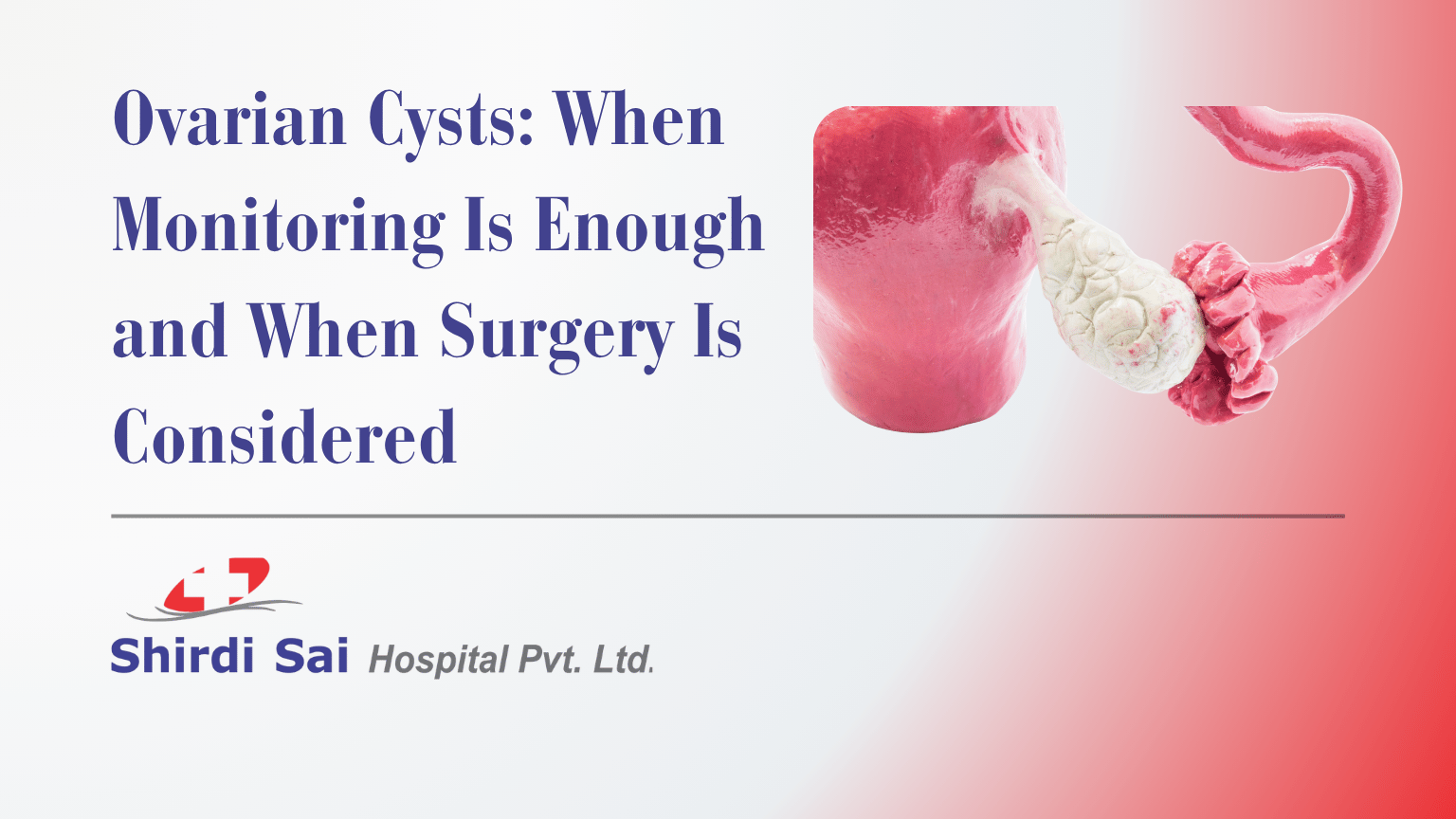
Not every ovarian cyst needs surgery. Some can be monitored, particularly when ultrasound findings are reassuring and symptoms are limited. Others need further investigation or a surgical discussion because of their appearance, persistence, symptoms or the patient’s clinical circumstances.
However, size alone does not decide treatment. Age, menopausal status, pregnancy considerations and scan features all matter. At Shirdi Sai Hospital on New BEL Road, patients can request a gynaecology consultation to review the report and understand the appropriate next step.
If an ovarian cyst report has left you unsure about the next step, arrange a gynaecology review and bring the scan.
What is an ovarian cyst?
An ovarian cyst is a fluid-filled sac in or on an ovary. Some cysts form as part of the menstrual cycle and may resolve without an operation.
Other ovarian cysts or masses have a different origin and may persist. The scan description helps the clinician decide how to assess them.
The word “cyst” is not a diagnosis of cancer. It also does not tell you whether follow-up is unnecessary.
Is an ovarian cyst the same as PCOS?
No. The condition commonly called polycystic ovary syndrome, or PCOS, is hormonal and metabolic. Its new name, introduced in 2026, is polyendocrine metabolic ovarian syndrome, or PMOS. The small follicles described in polycystic ovaries are not interchangeable with a separate ovarian cyst needing its own assessment.
A person can have an ovarian cyst without PCOS. A PCOS diagnosis also does not mean that every new cyst can be attributed to that condition.
For a fuller comparison, read our guide on how PCOS and ovarian cysts differ.
This distinction helps prevent two common mistakes: assuming a single cyst proves PCOS, or assuming a concerning ovarian finding needs no review because PCOS was diagnosed earlier.
The clinician interprets the history, examination and relevant tests rather than using one report word in isolation.
What does ultrasound tell the doctor?
Ultrasound can describe the cyst’s location, size, internal structure and relationship to nearby tissues. A simple fluid-filled appearance is different from a mass with solid or complex components.
The report may mention whether one or both ovaries are involved and whether there are other findings. These details can affect the next step.
A transvaginal scan may give useful detail where appropriate. The team should explain the examination and obtain consent. If this scan does not suit your circumstances, the team can discuss an alternative.
Do not interpret one isolated measurement without the rest of the report. Ask which features are reassuring and which require further assessment.
When can monitoring be appropriate?
Monitoring may be appropriate when the clinical assessment and imaging suggest a low-risk finding and there is no urgent complication.
The plan can involve repeat ultrasound to check whether the cyst resolves, remains stable or changes. The interval depends on the specific findings and the patient’s circumstances.
Some small simple cysts may not need the same follow-up as a larger, persistent or complex finding. Recommendations also differ before and after menopause.
Monitoring should be an explicit plan. Before leaving, confirm who will review the result, whether you need another scan and which symptoms require an earlier appointment.
Do not assume that “watch and wait” means the report can be forgotten.
What makes surgery more likely?
The gynaecologist may discuss surgery if the cyst causes significant symptoms, persists, grows or has concerning features.
The patient’s age, menopausal status, fertility plans, medical fitness and overall risk assessment also influence the recommendation.
Some patients need specialist referral rather than routine cyst surgery. If a mass appears suspicious, the pathway should provide the appropriate expertise and planning.
A general online rule such as “every cyst above this size needs removal” cannot safely replace that assessment. Equally, a smaller measurement does not automatically make a cyst harmless.
Ask the clinician to explain the reason for surgery in your case rather than only the operation name.
Does pelvic pain prove that the cyst is responsible?
No. A cyst can be an incidental finding while pain has another cause. Pelvic pain may arise from the uterus, urinary tract, bowel or other structures.
The doctor reviews the pain pattern, examination and scan together. If the symptoms do not fit the cyst, the clinician may investigate another cause.
This matters because removing an incidental cyst may not resolve unrelated pain. Therefore, ask which symptoms the operation could realistically improve.
Our guide to pelvic pain in women explains the wider symptom assessment. After diagnosis, the next question is whether monitoring or treatment suits the finding.
Which additional tests may be considered?
The team may recommend a pregnancy test, blood tests or further imaging depending on the situation. The clinician may also use a tumour-marker blood test in selected cases to help assess risk.
A marker result is not a stand-alone cancer diagnosis. Some noncancerous conditions can affect certain results, while interpretation also depends on menopausal status and imaging.
Therefore, not everyone needs the same group of tests. The clinician should explain what each investigation is intended to clarify.
Bring older reports if available. A comparison can help establish whether the finding is new, resolving or persistent.
Do not delay urgent care while arranging every report or test yourself.
How does menopause change the assessment?
After menopause, the clinician assesses a cyst differently from a cycle-related cyst in a younger person.
After assessing risk, the clinician may still recommend monitoring for some simple cysts after menopause. Others need further investigation or surgery.
The exact follow-up plan depends on current guidance and the specific scan and clinical findings. Therefore, do not apply a rule for cysts before menopause to a finding after menopause.
Tell the clinician when periods stopped, whether you use hormonal medicines and whether there are new symptoms such as persistent abdominal swelling, reduced appetite or pelvic discomfort.
These details help decide the appropriate evaluation.
What happens during cyst surgery?
The procedure depends on the diagnosis and treatment plan. A cystectomy removes the cyst while aiming to preserve ovarian tissue where appropriate. In some situations, the surgeon may recommend removing an ovary.
The surgeon may use keyhole surgery or an open operation. The safest route depends on the mass, its suspected nature and other clinical considerations.
Ask what operation is proposed, what could change the plan and whether tissue will be sent for laboratory examination.
An operation should not be presented as a routine cosmetic removal of a lump. It needs an explanation of benefits, alternatives and relevant risks.
Can the ovary always be preserved?
The surgeon cannot guarantee ovary preservation before assessment and surgery. Preserving healthy ovarian tissue may be an important goal, but the cyst’s characteristics and safety considerations affect what is possible.
Before deciding on surgery, tell the gynaecologist about pregnancy plans or fertility concerns. Previous ovarian surgery, other reproductive factors and the proposed procedure belong in that discussion.
A cyst operation does not automatically improve fertility, and retaining an ovary does not guarantee a particular pregnancy outcome.
If removal of one or both ovaries is a possibility, ask about the reproductive and hormonal implications before consenting to a planned operation.
What are the risks and limits of surgery?
Possible risks include bleeding, infection, injury to nearby organs, anaesthetic complications and the need to change the surgical approach.
Symptoms can persist if another condition contributes. Some cyst types can recur, and follow-up depends on the laboratory findings and overall diagnosis.
The surgeon should explain which risks are most relevant and whether the proposed procedure addresses pain, uncertainty about the mass or another concern.
Do not choose an operation only because a website describes it as scar-free, painless or guaranteed to preserve fertility. Those descriptions do not reflect an individual risk assessment.
Can medicines make every cyst disappear?
No. Management depends on the cyst type. A medicine used for menstrual or hormonal symptoms is not a universal treatment for every ovarian mass.
Do not start hormonal tablets or supplements on the assumption that all cysts share the same cause. The clinician needs to explain whether medication has a role and what it is expected to do.
Some cysts resolve over time without an operation, but that does not prove a particular medicine caused the change.
If the plan is monitoring, follow the agreed review schedule rather than replacing it with repeated self-treatment.
What should you bring to the consultation?
Bring the ultrasound report and images, earlier scans, relevant blood tests and a medicine list. Include information about previous pelvic surgery and any family history of ovarian or breast cancer.
Also note when symptoms began and whether they change during the menstrual cycle. Note any persistent bloating, reduced appetite, urinary pressure or increasing discomfort.
Useful questions include:
- What type of cyst does the scan suggest?
- Are there features that need further investigation?
- Is monitoring reasonable, and who will arrange follow-up?
- What would change the recommendation to surgery?
- How might treatment affect ovarian tissue or fertility plans?
- When and how will the team explain my results?
Which symptoms need urgent care?
Sudden severe pelvic or lower abdominal pain, particularly with nausea or vomiting, needs urgent assessment. The clinician must consider problems such as a twisted ovary or a ruptured cyst.
Pain with fainting, severe weakness, fever, heavy bleeding or rapid deterioration also needs urgent care.
If pregnancy is possible, tell the clinician. A known cyst should not lead anyone to overlook pregnancy-related causes of pain.
Do not wait for a scheduled repeat scan when symptoms become acute. The immediate clinical situation takes priority over the routine monitoring plan.
Ovarian cyst review at Shirdi Sai Hospital
Our Obstetrics and Gynaecology department assesses ovarian cysts and other women’s-health concerns at our New BEL Road hospital.
For a planned appointment, contact Shirdi Sai Hospital with your reports. Confirm the relevant clinician and appointment availability before travelling.
If your periods have also changed, read about common causes of irregular periods. A cyst report alone does not explain every menstrual change.
Shirdi Sai Hospital is a 100-bed hospital on New BEL Road, established in 2004. When you contact us, our team can guide you to the relevant department and explain appointment arrangements.
Frequently asked questions
Does every ovarian cyst need surgery?
No. Some can be observed after a reassuring assessment. Others require investigation or treatment.
Is cyst size the only deciding factor?
No. Appearance, symptoms, persistence, menopausal status and clinical risk also matter.
Does a single ovarian cyst mean PCOS?
No. They are different findings and need different diagnostic reasoning.
Can I have a cyst without symptoms?
Yes. For example, a scan for another problem may reveal a cyst.
Does a blood tumour marker diagnose cancer?
Not by itself. The clinician interprets it alongside the scan and your history.
Can surgery always preserve the ovary?
No guarantee is possible. Discuss the intended operation and circumstances that might change it.
Should sudden severe pain wait for the next scan?
No. Seek urgent medical assessment, especially if pain occurs with vomiting, faintness or deterioration.