Kidney stone treatment is not the same for every patient. RIRS, ESWL, and PCNL are three different treatment options used for kidney stones, and the right choice depends on stone size, stone location, hardness, symptoms, blockage, infection risk, kidney function, and the patient’s overall health. ESWL is usually considered for selected smaller stones, RIRS is commonly used for stones that need laser treatment through the urinary passage, and PCNL is usually preferred for larger or complex stones.
At Shirdi Sai Hospital, New BEL Road, kidney stone patients are evaluated based on symptoms, scan findings, urine reports, stone position, and medical condition before treatment is planned. This guide explains the difference between RIRS, ESWL, and PCNL in simple language so patients can understand what each option means and when medical evaluation becomes important.
What Are RIRS, ESWL and PCNL?
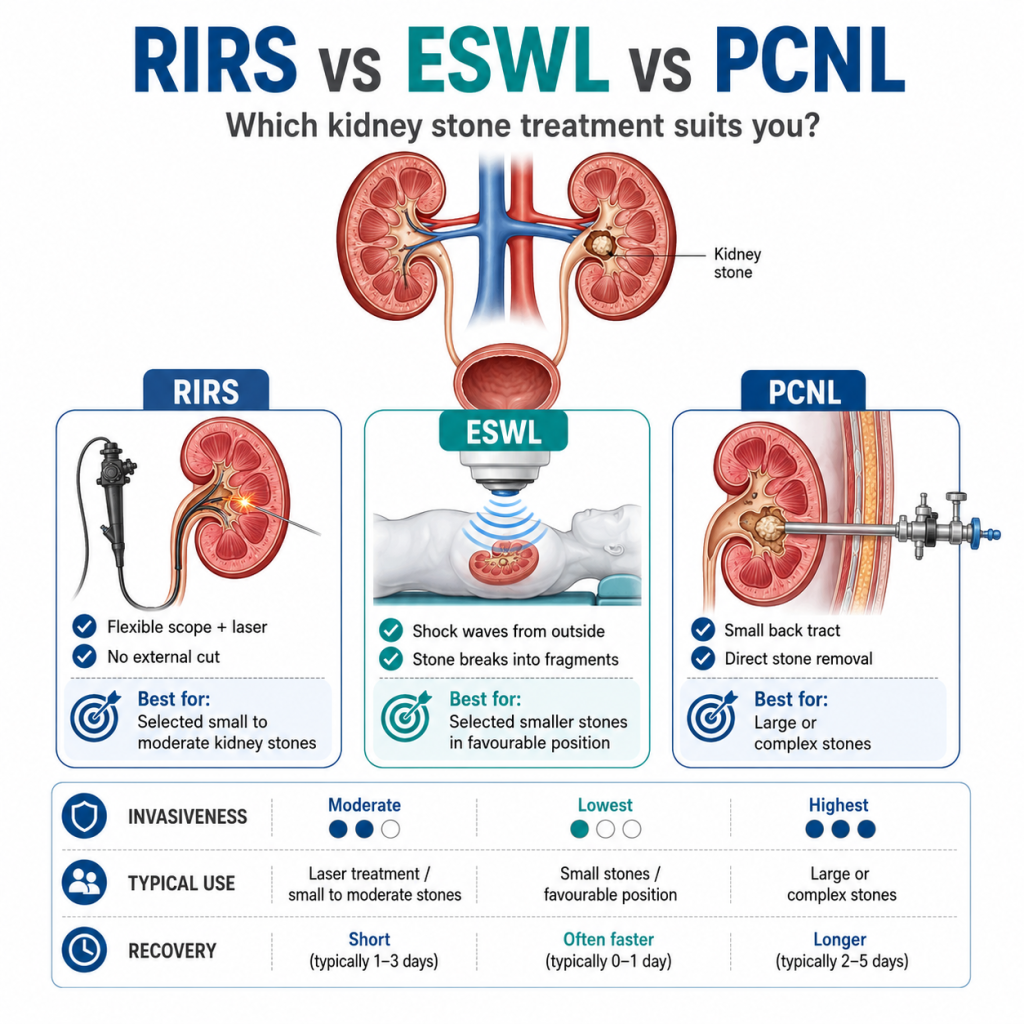
RIRS, ESWL, and PCNL are treatment methods used to remove or break kidney stones. Each method works differently.
| Treatment | Full Form | How It Works |
|---|---|---|
| RIRS | Retrograde Intrarenal Surgery | A flexible scope passes through the urinary passage to reach the kidney stone, and laser energy breaks the stone |
| ESWL | Extracorporeal Shock Wave Lithotripsy | Shock waves from outside the body break the stone into smaller fragments |
| PCNL | Percutaneous Nephrolithotomy | A small tract is made through the back to reach and remove large kidney stones |
The decision is not based only on which treatment sounds easier. A urologist considers stone size, location, hardness, infection, kidney swelling, previous treatments, and patient safety.
Why the Type of Kidney Stone Treatment Matters
Choosing the right stone treatment matters because each method has different benefits, limitations, recovery needs, and success factors.
A small stone in a favourable location may not need the same approach as a large stone filling part of the kidney. A soft stone may respond differently from a hard stone. A stone causing infection or kidney blockage needs faster medical attention than a silent stone found during a scan.
Important factors include:
- stone size
- stone location
- stone hardness
- number of stones
- kidney swelling
- urine infection
- pain severity
- previous stone treatment
- patient age and health condition
- bleeding risk
- kidney function
This is why the same treatment cannot be recommended for every kidney stone patient.
RIRS: What It Means and Who May Need It
RIRS stands for Retrograde Intrarenal Surgery. In this procedure, a thin flexible instrument is passed through the urinary passage into the kidney. A laser is then used to break the stone into smaller pieces.
RIRS does not usually require a cut on the back because the stone is approached through the natural urinary passage.
RIRS may be considered when:
- the stone is inside the kidney
- the stone is not very large
- the stone location is suitable for flexible scope access
- ESWL is less suitable or has failed
- the patient needs laser-based stone treatment
- there are multiple small stones in selected cases
- the stone is difficult to pass naturally
RIRS is commonly discussed for kidney stones where minimally invasive laser treatment is suitable. However, it may not be ideal for very large stone burden, certain anatomical issues, or some infected obstructed cases unless medically stabilized first.
Benefits of RIRS
RIRS has several patient-friendly advantages when the case is suitable.
- No external cut in most cases: The stone is reached through the urinary passage.
- Laser-based treatment: The stone can be fragmented using laser energy.
- Useful for selected kidney stones: It is especially helpful when stone position allows flexible scope access.
- Shorter recovery in many cases: Many patients return to routine activities faster than with more invasive surgery, depending on the case.
- Can treat stones not suitable for ESWL: Some stones that are hard or unfavourably located may need RIRS.
Limitations of RIRS
RIRS is not perfect for every stone.
Limitations may include:
- may not be preferred for very large stones
- may require a stent temporarily
- may need staged treatment in some cases
- stone-free outcome depends on stone size and location
- infection must be controlled before treatment
- not every patient anatomy is suitable
A urologist decides after evaluating scan findings and patient condition.
ESWL: What It Means and Who May Need It
ESWL stands for Extracorporeal Shock Wave Lithotripsy. It breaks kidney stones using shock waves from outside the body. The broken fragments then pass through urine over time.
ESWL does not involve inserting a scope into the kidney. It is non-invasive in the sense that no surgical cut is made.
ESWL may be considered when:
- the stone is small or moderate in size
- the stone location is favourable
- there is no severe obstruction
- there is no uncontrolled infection
- the stone is likely to break well with shock waves
- the patient can pass fragments safely
ESWL is not simply “the easiest option” for every stone. Its success depends strongly on stone size, hardness, location, patient body build, and drainage pathway.
Benefits of ESWL
ESWL can be useful in properly selected patients.
- No surgical incision: Shock waves are delivered from outside the body.
- Usually less invasive: No scope is passed into the kidney in standard ESWL.
- Useful for selected smaller stones: Especially when the stone is positioned favourably.
- Can avoid surgery in some patients: When the stone is suitable and fragments can pass.
Limitations of ESWL
ESWL also has limitations that patients must understand.
- stone fragments must pass naturally
- may need more than one session
- not ideal for many large stones
- hard stones may not break well
- lower pole kidney stones may clear less effectively in some patients
- not suitable if there is infection with obstruction
- may cause pain while fragments pass
- may not be suitable for some bleeding-risk patients
Patients should not choose ESWL only because it sounds non-surgical. It should be selected only when the stone is likely to respond well.
PCNL: What It Means and Who May Need It
PCNL stands for Percutaneous Nephrolithotomy. It is a minimally invasive surgical procedure used to remove larger or complex kidney stones. A small tract is created through the back into the kidney, and the stone is broken and removed.
PCNL is usually considered when:
- the kidney stone is large
- stone burden is more than 20 mm
- there is a staghorn stone
- multiple large stones are present
- ESWL or RIRS is unlikely to clear the stone effectively
- previous stone treatments have failed
- faster clearance of large stone burden is needed
PCNL is often preferred for large and complex stones because it allows the urologist to directly access and remove stone material.
Benefits of PCNL
PCNL is an important treatment option for large kidney stones.
- Useful for large stones: Especially stones that may not clear well with ESWL or RIRS.
- Direct stone removal: Stone fragments are removed through the tract.
- Suitable for complex stone burden: Helps in selected large, multiple, or staghorn stones.
- Can reduce need for repeated sessions in large stones: Compared with options that may not clear large stones effectively.
Limitations of PCNL
Because PCNL is more invasive than ESWL and RIRS, it requires careful planning.
Limitations and considerations include:
- requires a small tract through the back
- usually needs anesthesia
- may need hospital stay
- bleeding risk must be assessed
- infection must be managed carefully
- recovery may take longer than ESWL or RIRS
- not every patient is fit for PCNL immediately
PCNL is selected when the expected benefit is stronger than the risk for that patient.
RIRS vs ESWL vs PCNL: Main Difference
| Feature | RIRS | ESWL | PCNL |
| Method | Flexible scope and laser through urinary passage | Shock waves from outside the body | Small tract through back into kidney |
| External cut | Usually no | No | Yes, small tract |
| Best suited for | Selected kidney stones needing laser treatment | Selected small stones in favourable location | Large or complex kidney stones |
| Stone clearance | Depends on size and location | Depends on stone breakage and fragment passage | Often preferred for large stone burden |
| Hospital stay | Case-dependent | Often outpatient or short stay depending on setup | Usually needs hospital admission |
| Recovery | Often shorter when uncomplicated | Usually faster if fragments pass well | Longer than ESWL/RIRS in many cases |
| Repeat procedure chance | Possible in large/multiple stones | Possible if stone does not fragment or clear | Possible but often used for large burden |
| Doctor decision based on | Scope access, stone size, anatomy | Stone size, hardness, location | Stone size, complexity, safety |
This comparison helps patients understand the broad differences. The final treatment plan must come from clinical evaluation.
Which Kidney Stone Removal Method Is Best?
There is no single “best” kidney stone removal method for everyone. The best method is the one that gives safe and effective stone clearance for that specific patient.
A broad decision pattern is:
| Stone Situation | Commonly Considered Option |
| Small stone, favourable position | ESWL or observation depending on symptoms |
| Small to moderate kidney stone needing laser treatment | RIRS |
| Stone not suitable for ESWL | RIRS or PCNL depending on size |
| Large stone above 20 mm | PCNL is commonly considered |
| Staghorn or complex stone | PCNL is often preferred |
| Infection with obstruction | Urgent drainage first, definitive treatment later |
| Repeated stones | Evaluation for stone cause and prevention needed |
This table is educational. It does not replace a urologist’s assessment.
Are RIRS and ESWL the Same?
No. RIRS and ESWL are not the same.
RIRS uses a flexible scope and laser to reach and break the stone from inside the urinary tract. ESWL uses shock waves from outside the body to break the stone into fragments that must pass naturally.
The major difference is the approach:
- RIRS works from inside the urinary tract
- ESWL works from outside the body
- RIRS may be better for stones that need direct laser fragmentation
- ESWL may be suitable for selected smaller stones that can break and pass well
Patients should not compare them only by comfort. The correct choice depends on the stone.
Which Is Better: RIRS or PCNL?
RIRS and PCNL are used for different stone situations.
RIRS is generally less invasive because it usually does not require a cut through the back. It may suit selected smaller or moderate kidney stones.
PCNL is more invasive but is often more suitable for large stones, complex stones, or heavy stone burden where RIRS may require multiple sessions or may not clear the stone effectively.
| Question | RIRS | PCNL |
| Is it less invasive? | Usually yes | More invasive |
| Is it suitable for very large stones? | Not usually first choice | Often preferred |
| Does it need a back puncture? | No in most cases | Yes |
| Can it clear large stone burden better? | Case-dependent | Often better for large stones |
| Recovery | Often shorter | Usually longer |
So, RIRS is not automatically better than PCNL. PCNL is not automatically better than RIRS. The better option depends on stone size, location, anatomy, and safety.
Which Is Better: ESWL or PCNL?
ESWL and PCNL are very different.
ESWL is less invasive and may be considered for selected smaller stones. PCNL is more invasive but is often preferred for larger or complex kidney stones.
| Question | ESWL | PCNL |
| Is there a cut? | No | Small tract through back |
| Is it suitable for small stones? | Often considered | Usually not needed for small simple stones |
| Is it suitable for large stones? | Often less effective | Often preferred |
| Does it remove fragments directly? | No, patient passes fragments | Yes, fragments are removed |
| Can repeat sessions be needed? | Yes | Less often for large stone burden |
ESWL may sound easier, but it is not the best option for every stone. If the stone is large, hard, or unlikely to clear after fragmentation, PCNL may be safer and more effective.
What Tests Help Decide the Right Stone Surgery?
Before choosing RIRS, ESWL, or PCNL, doctors usually evaluate the stone and the patient’s health.
Common evaluation may include:
- ultrasound
- CT scan when needed
- urine routine test
- urine culture if infection is suspected
- kidney function tests
- blood tests
- assessment of pain and fever
- review of previous stone history
- evaluation of diabetes, blood pressure, bleeding risk, and medications
A CT scan helps identify stone size, location, density, and obstruction. These details are important because a stone that looks small on symptoms alone may still be risky if it blocks urine flow.
Symptoms That Suggest Kidney Stone Treatment May Be Needed
Not every stone needs surgery immediately. Some stones pass naturally. But certain symptoms need evaluation.
Consult a doctor if you have:
- severe side pain
- pain moving from back to groin
- blood in urine
- vomiting with pain
- fever with stone symptoms
- burning urination
- repeated urine infection
- reduced urine output
- known kidney swelling
- repeated stone attacks
- pain not controlled with medicines
Fever with a kidney stone can be serious because infection with blockage may need urgent care.
Recovery After RIRS, ESWL and PCNL
Recovery differs based on the procedure, patient health, stone burden, and complications.
| Treatment | Recovery Pattern |
| ESWL | Usually faster, but pain may occur while fragments pass |
| RIRS | Recovery is often short when uncomplicated; stent discomfort may occur |
| PCNL | Recovery may take longer because it involves a kidney tract and hospital admission |
After treatment, patients may need:
- fluids as advised
- medicines
- follow-up scan
- urine tests
- stent removal if placed
- stone analysis if available
- prevention plan for future stones
Recovery should always follow the urologist’s instructions.
Can Kidney Stones Come Back After Treatment?
Yes. Kidney stones can recur. Removing a stone solves the present problem, but prevention is important.
Stone recurrence risk may be reduced through:
- drinking adequate water
- reducing excess salt
- avoiding dehydration
- following diet advice based on stone type
- treating urinary infections
- managing metabolic risk factors
- follow-up testing when advised
Diet advice should not be generic for every patient. Calcium stone, uric acid stone, infection stone, and other stone types may need different prevention plans.
Why Patients Choose Shirdi Sai Hospital for Kidney Stone Evaluation
At Shirdi Sai Hospital, New BEL Road, kidney stone care is approached through clinical evaluation, imaging review, symptom assessment, and treatment planning based on the patient’s condition.
Patients visit Shirdi Sai Hospital for kidney stone evaluation because:
- stone symptoms are assessed clinically
- treatment planning considers stone size, location, and severity
- patients receive guidance on RIRS, ESWL, PCNL, or other suitable options where applicable
- warning signs such as fever, severe pain, vomiting, and reduced urine output are taken seriously
- follow-up guidance supports stone prevention and recurrence reduction
- the hospital is accessible for patients from New BEL Road, Devasandra, RMV 2nd Stage, Sanjaynagar, Mathikere, Hebbal, and nearby areas
Internal Links:
Home: https://www.shirdisaihospitalpvtltd.com/
Urology: https://www.shirdisaihospitalpvtltd.com/urology/
When to Consult Your Doctor
Do not wait if kidney stone symptoms are severe or recurring.
Seek medical care if you have:
- severe side or back pain
- fever with stone pain
- vomiting
- blood in urine
- burning urination
- reduced urine output
- known kidney swelling
- repeated stone episodes
- pain not improving with medicines
- stone diagnosed on scan but treatment not planned yet
If you are consulting a hospital in Bangalore, especially around New BEL Road and nearby areas, timely urology evaluation can help prevent kidney damage, infection complications, and repeated painful episodes.
Frequently Asked Questions
Which is better, RIRS or PCNL?
RIRS is usually less invasive and may suit selected smaller or moderate kidney stones. PCNL is often preferred for larger, complex, or staghorn stones. The better option depends on stone size, location, kidney anatomy, infection risk, and patient health.
Which is better, ESWL or PCNL?
ESWL may suit selected smaller stones because it uses shock waves from outside the body. PCNL is usually considered for larger or complex stones where shock wave treatment is unlikely to clear the stone effectively.
Are RIRS and ESWL the same?
No. RIRS uses a flexible scope and laser inside the urinary tract to break the stone. ESWL uses shock waves from outside the body and depends on the patient passing the broken fragments naturally.
Which kidney stone removal method is best?
The best kidney stone removal method depends on stone size, location, hardness, symptoms, infection, kidney function, and patient health. ESWL, RIRS, and PCNL each have a role in different stone situations.
Is PCNL only for large kidney stones?
PCNL is commonly preferred for large stones, staghorn stones, or complex stone burden. It may also be considered when other methods are unlikely to clear the stone safely or effectively.
Can ESWL fail?
Yes. ESWL may fail if the stone is too hard, too large, poorly located, or if fragments do not pass well. In such cases, RIRS or PCNL may be considered after evaluation.
Does every kidney stone need surgery?
No. Some small stones may pass naturally with medical guidance. Surgery or procedure-based treatment is considered when stones are large, painful, blocked, infected, recurrent, or unlikely to pass safely.
Conclusion
RIRS, ESWL, and PCNL are not competing treatments where one is always better than the others. They are different kidney stone treatment methods used for different patient situations. ESWL may suit selected smaller stones, RIRS may suit stones that need laser treatment through the urinary tract, and PCNL is often preferred for large or complex stones.
At Shirdi Sai Hospital, New BEL Road, kidney stone treatment planning is based on proper evaluation rather than guesswork. If you have severe stone pain, repeated stones, blood in urine, fever, vomiting, or a scan showing kidney stones, consulting a urologist early can help decide the safest next step.
OPD Consultation starts from ₹500.

Leave a Reply