Knee pain while climbing or descending stairs is one of the earliest signs of joint stress and possible cartilage damage. Many people ignore this symptom because it does not affect normal walking initially. However, pain specifically on stairs often indicates increased pressure inside the knee joint, which can be linked to early joint degeneration, muscle imbalance, or underlying conditions like patellofemoral pain syndrome or early arthritis.
At Shirdi Sai Hospital, New BEL Road, we frequently evaluate patients who report knee pain only while using stairs but not during walking. In many cases, this is an early warning sign rather than a temporary issue. This guide explains the causes, symptoms, risk factors, and when knee pain on stairs requires medical attention.
Why Does Knee Pain Occur on Stairs but Not While Walking?
Stair climbing puts significantly more pressure on the knee joint compared to walking.
- Walking → ~1.5x body weight pressure
- Climbing stairs → ~3–4x body weight pressure
This increased load stresses:
- knee cartilage
- patella (kneecap)
- surrounding muscles and ligaments
If there is even minor weakness or joint wear, pain appears during stair use before it affects regular walking.
What Causes Knee Pain on Stairs?
Knee pain on stairs is not a single condition. It is a symptom linked to different underlying causes.
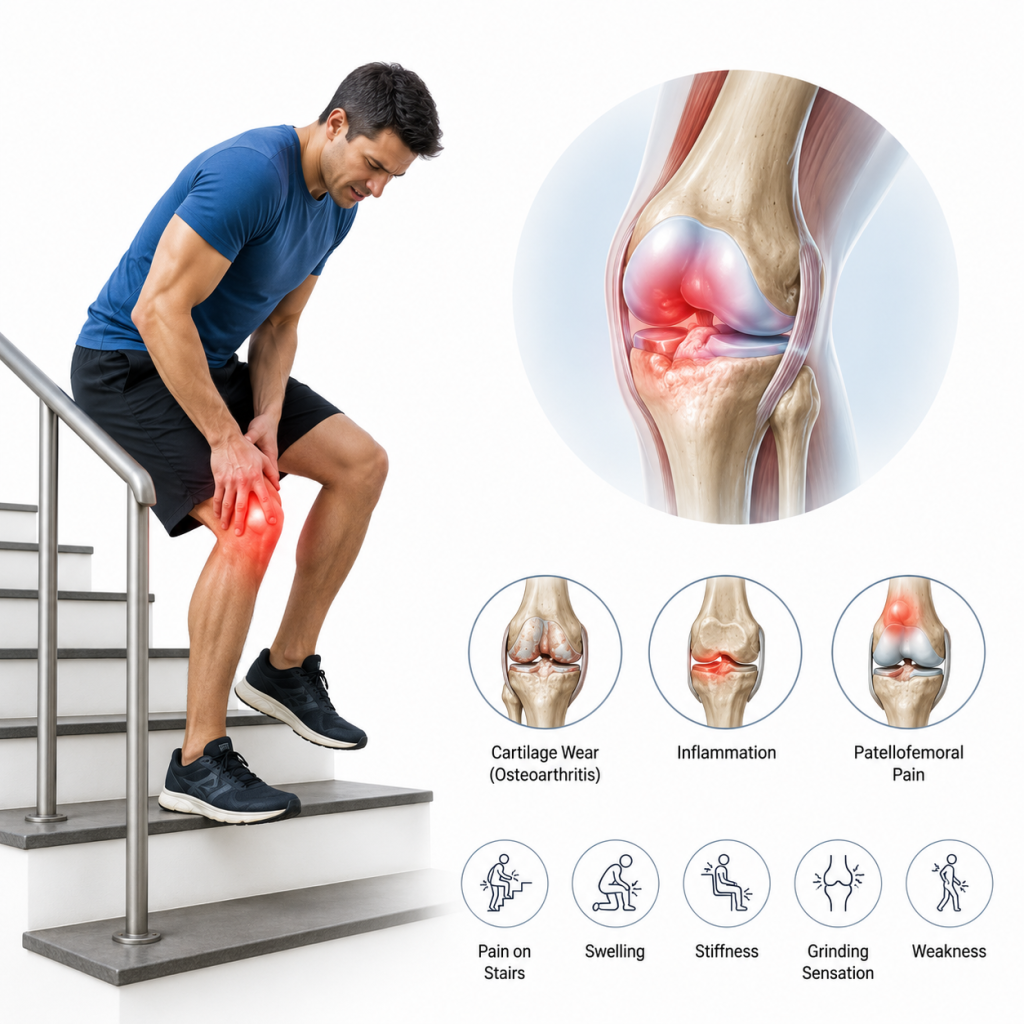
1. Patellofemoral Pain Syndrome (Most Common)
Pain occurs around or behind the kneecap.
- worsens while climbing stairs
- feels like pressure or discomfort
- common in young adults and active individuals
2. Early Joint Degeneration (Cartilage Wear)
The cartilage inside the knee starts thinning.
- pain during pressure activities
- stiffness after rest
- early stage of osteoarthritis
3. Muscle Weakness or Imbalance
Weak quadriceps or hamstrings fail to support the knee.
- instability while climbing stairs
- increased joint load
- fatigue-related discomfort
4. Meniscus Irritation or Minor Tear
The cartilage cushioning inside the knee gets affected.
- pain during bending
- clicking sensation
- discomfort on stairs
5. Ligament Strain
Overuse or improper movement can strain ligaments.
- pain during movement
- mild swelling
- reduced confidence while climbing
Early Warning Signs of Joint Degeneration
Knee pain on stairs should not be ignored when combined with these symptoms:
- stiffness after sitting for long periods
- mild swelling around the knee
- cracking or grinding sound
- reduced flexibility
- discomfort after physical activity
- weakness while climbing or descending
These are often early indicators of joint wear.
Knee Pain on Stairs vs Normal Knee Pain
| Feature | Knee Pain on Stairs | General Knee Pain |
|---|---|---|
| Trigger | High pressure movement | Can occur anytime |
| Early sign | Yes | Not always |
| Common cause | Cartilage stress | Injury / inflammation |
| Risk indicator | Joint degeneration | Varies |
| Progression | Gradual | Can be sudden |
What Is the “Figure 4 Test” for Knee Pain?
The Figure 4 test is a simple physical positioning test used to assess knee and hip joint discomfort.
- one leg is placed over the opposite knee
- the position forms a “4” shape
- discomfort may indicate joint or soft tissue issues
It is not a definitive diagnosis but helps identify areas of discomfort that require further evaluation.
Why Does Knee Pain Increase While Climbing Stairs?
Climbing stairs requires:
- deeper knee bending
- stronger muscle activation
- higher joint pressure
This combination exposes:
- cartilage wear
- muscle weakness
- joint misalignment
Descending stairs can sometimes cause even more discomfort due to controlled muscle contraction.
How to Reduce Knee Pain When Going Up Stairs
Improvement depends on the cause, but general measures include:
Strengthening Exercises
- quadriceps strengthening
- hamstring activation
- glute muscle strengthening
Movement Correction
- avoid sudden knee bending
- use support (handrails)
- maintain proper posture
Activity Modification
- reduce repeated stair use
- avoid overexertion
- take breaks during activity
Weight Management
Reducing body weight decreases stress on knee joints.
Exercises for Knee Pain on Stairs
Safe exercises focus on strengthening without increasing joint stress.
- straight leg raises
- seated knee extensions
- mini squats (controlled)
- step-ups (gradual progression)
Exercises should be performed with proper technique to avoid worsening symptoms.
What Is the 1 Mistake That Makes Knee Pain Worse?
Ignoring early symptoms and continuing high-stress activities.
Many people:
- continue climbing stairs frequently
- avoid strengthening exercises
- delay medical evaluation
This leads to worsening joint damage over time.
At What Age Do Knee Problems Start?
Knee issues can begin at any age depending on lifestyle and activity level.
- 20s–30s → sports injuries, muscle imbalance
- 30s–40s → early cartilage wear
- 40+ → increased risk of arthritis
Age is a factor, but lifestyle plays a bigger role.
Do Stair Climbers Hurt Your Knees?
Stair climbing machines can increase stress on knees if:
- used excessively
- done with poor posture
- done without proper strength
They are not harmful when used correctly but can aggravate existing issues.
Red Flag Symptoms That Need Medical Attention
Consult a doctor if you experience:
- persistent pain for weeks
- swelling that does not reduce
- difficulty bending or straightening knee
- instability or knee giving way
- pain even at rest
- severe pain during movement
What Diseases Start with Knee Pain on Stairs?
Knee pain during stair use can be an early sign of:
- osteoarthritis
- patellofemoral syndrome
- meniscus damage
- ligament issues
- cartilage degeneration
Early diagnosis helps prevent progression.
Can Vitamin Deficiency Cause Knee Pain?
Certain deficiencies can contribute to joint discomfort:
- Vitamin D → bone weakness
- Vitamin B12 → nerve-related symptoms
- Calcium → bone health
These are contributing factors, not the primary cause in most cases.
Why Patients Choose Shirdi Sai Hospital for Knee Evaluation
At Shirdi Sai Hospital, New BEL Road, knee pain is evaluated through a structured clinical approach to identify the exact cause rather than treating symptoms alone.
Patients choose the hospital because:
- detailed assessment of joint function and movement
- evaluation of cartilage, ligaments, and muscle balance
- identification of early degeneration signs
- guidance on treatment and lifestyle correction
- patient-focused care approach
The hospital is accessible for patients from Devasandra, RMV 2nd Stage, Sanjaynagar, Mathikere, Hebbal, and nearby areas.
Explore services:
https://www.shirdisaihospitalpvtltd.com/general-surgery-transplant-surgery/
https://www.shirdisaihospitalpvtltd.com/
When Should You See a Doctor?
Seek medical advice if:
- pain continues for more than 2–3 weeks
- symptoms worsen over time
- knee function is affected
- swelling or stiffness increases
- daily activities become difficult
Early consultation helps prevent long-term joint damage.
Frequently Asked Questions
Why does my knee hurt when climbing stairs but not walking?
Because stair climbing puts more pressure on the knee joint, revealing early joint stress or weakness.
How do I stop knee pain on stairs?
Strengthening exercises, proper movement, and reducing excessive load can help, but underlying causes should be evaluated.
Is knee pain on stairs a sign of arthritis?
It can be an early sign, especially when associated with stiffness and swelling.
Can knee pain go away on its own?
Mild cases may improve, but persistent pain should be assessed to prevent progression.
What is the best exercise for knee pain?
Strengthening exercises targeting quadriceps and supporting muscles are most effective.
Conclusion
Knee pain on stairs is often an early signal of joint stress and should not be ignored. While it may seem minor initially, it can indicate underlying issues such as cartilage wear, muscle imbalance, or early joint degeneration.
At Shirdi Sai Hospital, New BEL Road, early evaluation helps identify the cause and prevent further damage. Addressing symptoms at the right time can significantly improve joint health and avoid long-term complications.

Leave a Reply