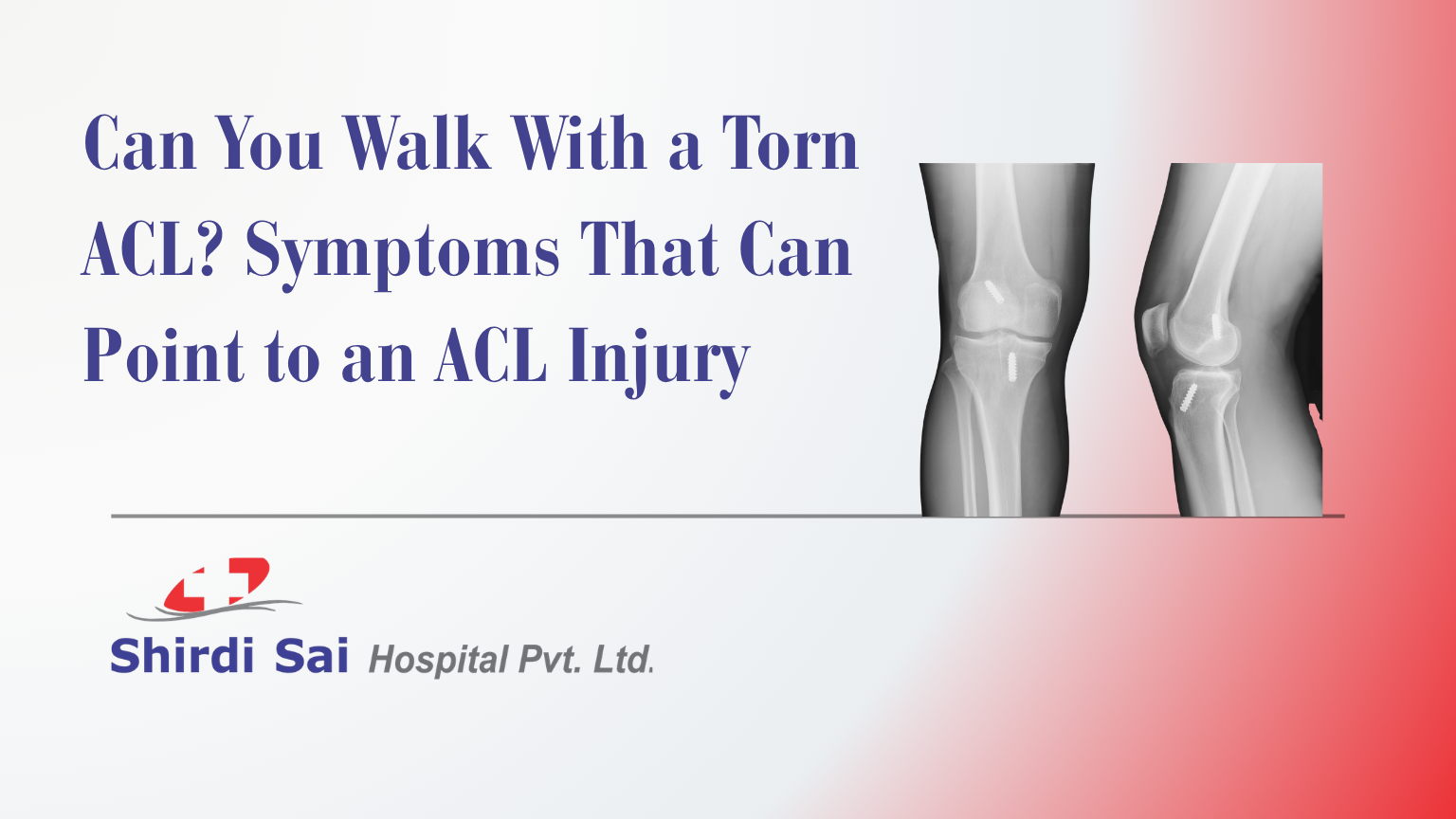
Yes, some people can still walk after tearing their ACL. Walking ability does not reliably show whether the ligament is intact. Immediately after the injury, pain and swelling may make weight-bearing difficult, but some patients begin walking more comfortably as these symptoms settle. The problem may become clearer when the knee turns, pivots or changes direction and feels unstable or gives way. A popping sensation, rapid swelling, reduced knee movement and recurrent instability can also suggest an ACL injury. An orthopaedic examination helps distinguish an ACL tear from meniscus, cartilage, ligament or bone injuries that can occur at the same time.
ACL Tear Symptoms at a Glance
Common symptoms after an ACL injury may include:
- hearing or feeling a pop during the injury
- pain immediately after the injury
- swelling that develops relatively quickly
- difficulty continuing the activity
- reduced knee movement
- difficulty bearing weight
- a feeling that the knee is unstable
- the knee giving way during turning or pivoting
Not every person develops every symptom.
Some people can walk after the injury.
Others struggle to bear weight because of pain and swelling.
Walking ability alone cannot confirm or exclude an ACL tear.
What Is the ACL?
ACL stands for anterior cruciate ligament.
It is one of the major ligaments inside the knee and connects the thigh bone to the shin bone.
The ACL helps control:
- forward movement of the shin bone
- rotational stability
- knee control during changes in direction
- landing
- stopping
- pivoting
An ACL injury can range from a sprain to a partial or complete tear.
The injury frequently occurs during movements that place sudden rotational or stopping forces through the knee.
Common mechanisms include:
- changing direction quickly
- pivoting while the foot remains planted
- suddenly slowing down
- landing awkwardly from a jump
- receiving a forceful blow to the knee
- losing balance during sport or physical activity
Mayo Clinic identifies sudden stopping, pivoting, changing direction, awkward landing and direct impact as common mechanisms of ACL injury.
Can You Really Walk With a Torn ACL?
Yes.
Some people remain able to walk despite an ACL tear.
Mayo Clinic specifically notes that some individuals continue walking after an ACL injury, even though instability may become more noticeable over time.
Several reasons explain why this can happen.
Walking does not place the same demand on the ACL as pivoting
Straight-line walking usually creates different knee forces from movements such as:
- cutting
- turning suddenly
- jumping
- landing
- changing direction
- playing pivoting sports
A person may therefore manage ordinary walking reasonably well but notice instability during more demanding movements.
Pain and swelling can improve
The first hours or days after injury may involve substantial discomfort and swelling.
As these symptoms settle, walking can become easier.
This improvement does not prove that the ligament has healed or remained intact.
Muscles can partly support knee stability
The muscles around the knee contribute to joint control.
A person with good strength and movement control may feel relatively stable during straightforward activities despite an ACL injury.
However, muscle strength does not anatomically replace a torn ACL.
Does Walking Mean the ACL Tear Is Only Partial?
No.
The ability to walk does not tell you whether an ACL injury is partial or complete.
A complete tear does not necessarily make every step impossible.
Doctors distinguish partial and complete ACL injuries by considering:
- how the injury happened
- symptoms
- physical examination
- knee stability
- imaging where appropriate
Do not use walking ability to estimate the grade of an ACL injury.
What Does an ACL Tear Usually Feel Like?
The experience varies between patients, but several patterns commonly occur.
A pop or popping sensation
Some people hear or feel a pop at the moment of injury.
This can occur when the ligament tears.
However, a pop does not prove an ACL injury.
Other knee injuries can also produce popping sensations.
The more useful question is what happened immediately afterward.
Sudden pain
ACL injury can cause significant pain.
The pain may prevent the person from continuing a sport or activity.
However, pain intensity varies.
A person should not rule out an ACL injury because the pain feels less severe than expected.
Rapid swelling
The knee may swell relatively quickly after an ACL tear.
Mayo Clinic lists rapid swelling among the characteristic symptoms of ACL injury.
Rapid swelling after trauma suggests that a significant internal knee injury may have occurred.
ACL injury is one possibility.
Fracture, kneecap dislocation and other internal injuries can also cause substantial swelling.
Reduced range of movement
Swelling and pain can make it difficult to fully bend or straighten the knee.
Some patients describe the knee as:
- tight
- stiff
- heavy
- difficult to move normally
Movement may improve as swelling decreases, but persistent limitation deserves assessment.
Instability or giving way
Instability is one of the most important ACL symptoms.
A person may feel as though:
- the knee shifts unexpectedly
- the knee cannot be trusted
- the leg gives way while turning
- the knee buckles during movement
Mayo Clinic identifies instability or giving way during weight-bearing as a typical ACL symptom.
When Does ACL Instability Become Most Noticeable?
Some patients do not notice significant instability while simply walking in a straight line.
They may notice it during:
- turning quickly
- stepping sideways
- descending stairs
- walking over uneven ground
- returning to running
- changing direction
- pivoting during sport
This can create a misleading situation.
A patient may think:
“My knee feels fine now because I can walk.”
Then the knee gives way when they try to return to sport.
This is why return to activity should depend on assessment and rehabilitation rather than walking ability alone.
Does an ACL Tear Always Cause Swelling?
No.
Rapid swelling is common, but not every ACL injury follows the same pattern.
The amount of swelling can depend on:
- injury severity
- whether bleeding occurs inside the joint
- associated injuries
- timing
- individual response
A lack of dramatic swelling does not completely rule out an ACL injury.
Similarly, swelling does not automatically mean the ACL has torn.
Meniscus injuries, fractures and other knee injuries can also cause swelling.
Can You Bend Your Knee With a Torn ACL?
Possibly.
An ACL tear does not necessarily prevent all bending and straightening.
Immediately after injury, pain and swelling may reduce movement significantly.
As swelling settles, the patient may regain much of their knee motion.
This does not establish whether the ligament has healed.
The ACL primarily contributes to stability rather than acting as the only structure that allows the knee to bend.
Can You Climb Stairs With a Torn ACL?
Some people can.
However, stairs can expose problems that feel less obvious during level walking.
A person may notice:
- weakness
- instability
- pain
- poor confidence
- difficulty controlling the knee while descending
The ability to climb stairs does not confirm or exclude an ACL injury.
Can an ACL Tear Happen Without Playing Sport?
Yes.
Sports commonly cause ACL injuries, but they are not the only cause.
A person may injure the ACL while:
- stepping awkwardly
- twisting during ordinary activity
- falling
- landing badly
- slipping
- experiencing a direct blow to the knee
Mayo Clinic notes that ACL injuries can result from both contact and non-contact mechanisms.
The movement pattern matters more than whether the injury happened during organised sport.
Can an ACL Tear Occur With Other Knee Injuries?
Yes, and this is clinically important.
An ACL tear can occur together with injury to:
- the meniscus
- cartilage
- other ligaments
- bone
Mayo Clinic notes that ACL injuries often involve other knee structures such as the meniscus, cartilage, other ligaments or bone.
Associated injuries may change:
- symptoms
- treatment
- weight-bearing instructions
- rehabilitation
- the decision about surgery
This is one reason patients should avoid diagnosing an isolated ACL tear from symptoms alone.
ACL Tear vs Meniscus Tear: Can Symptoms Overlap?
Yes.
Both injuries may follow a twisting mechanism.
A meniscus injury may cause:
- joint-line pain
- swelling
- catching
- clicking
- locking
- pain during twisting
An ACL injury may produce more noticeable instability or giving way.
However, the two injuries can occur together.
A person with locking, instability and swelling should not try to identify one structure at home.
Clinical examination and appropriate imaging may be necessary.
ACL Tear vs Knee Sprain: What Is the Difference?
The term “knee sprain” describes injury to a ligament.
An ACL injury is therefore one type of knee sprain.
However, people often use the word “sprain” to describe a relatively minor injury.
That can create confusion.
Ligament sprains are commonly graded according to severity and may range from stretching of the ligament to complete tearing.
This means:
“It is only a sprain”
does not automatically mean:
“It is a minor injury.”
The doctor needs to identify which ligament has been affected and how stable the knee remains.
Can an ACL Tear Be Mistaken for a Simple Knee Injury?
Yes.
A patient may initially assume the knee has:
- twisted slightly
- suffered a minor sprain
- been bruised
- become temporarily swollen
Symptoms may even begin improving after the first few days.
The need for assessment becomes stronger when:
- the injury involved a pivot or awkward landing
- a pop occurred
- the knee swelled rapidly
- the person could not continue the activity
- the knee repeatedly gives way
- the patient cannot confidently return to normal activity
What Should You Do Immediately After a Suspected ACL Injury?
Stop the activity that caused the injury.
Do not repeatedly twist, jump or pivot to test whether the knee feels stable.
For a mild-to-moderate knee injury without serious red flags, early measures may include:
- reducing activities that increase pain
- protecting the knee from another twisting injury
- using a wrapped cold pack for short periods where appropriate
- keeping the leg comfortable
- arranging assessment if swelling or instability is significant
Avoid:
- returning immediately to sport
- deep squats to “test” the knee
- repeatedly twisting the knee
- forceful manipulation
- copying another person’s rehabilitation exercises before diagnosis
The first goal is to avoid a second injury while the knee remains painful or unstable.
When Should You See an Orthopaedic Doctor?
Arrange an orthopaedic assessment when a knee injury causes:
- a pop followed by pain or swelling
- rapid swelling
- repeated giving way
- difficulty bearing weight
- reduced movement
- persistent pain
- difficulty returning to normal activity
- recurring swelling after activity
- instability during turning
- concern about an ACL injury
Mayo Clinic recommends prompt assessment when knee trauma causes signs or symptoms of ACL injury because the same injury can damage other structures in the knee.
When Does a Knee Injury Need Urgent Medical Care?
A suspected ACL tear itself does not always require emergency treatment.
However, serious injuries can occur at the same time.
Seek prompt or urgent medical assessment if:
- the knee looks visibly deformed
- you cannot bear weight after significant trauma
- the knee becomes severely swollen
- the knee cannot fully bend or straighten after injury
- the kneecap appears out of position
- an open wound accompanies the injury
- the foot becomes cold, pale or blue
- numbness develops below the knee
- severe pain follows major trauma
Mayo Clinic advises medical evaluation for severe injury-related knee pain, deformity and major loss of movement.
Do not attempt to force a visibly deformed knee back into position.
How Do Doctors Check for an ACL Tear?
Diagnosis begins with the injury history.
The orthopaedic doctor may ask:
- How did the knee move when the injury occurred?
- Did the foot remain planted?
- Did you hear or feel a pop?
- How quickly did swelling develop?
- Could you continue the activity?
- Can you walk?
- Does the knee give way?
- Does the knee lock or catch?
- Have you injured the same knee before?
Physical examination
The doctor may assess:
- swelling
- range of motion
- tenderness
- knee stability
- other ligaments
- meniscus-related signs
Specific examination techniques help assess ACL stability.
Doctors often compare the injured knee with the opposite side.
Do You Need an X-Ray for a Suspected ACL Tear?
An X-ray cannot show the ACL itself clearly because the ACL is soft tissue.
However, doctors may use an X-ray after a significant knee injury to look for:
- fracture
- avulsion injury
- bone alignment
- other bone abnormalities
This becomes especially relevant when the person cannot bear weight or has strong bone tenderness.
Do You Need an MRI to Confirm an ACL Tear?
MRI can help assess:
- the ACL
- menisci
- cartilage
- other knee ligaments
- associated soft-tissue injuries
However, the clinical examination remains important.
Doctors should interpret MRI findings alongside:
- symptoms
- instability
- physical examination
- activity requirements
The scan should support the diagnosis rather than replace clinical assessment.
Does an ACL Tear Always Need Surgery?
No.
An ACL tear does not automatically require reconstruction.
Treatment may involve:
- rehabilitation
- strengthening
- activity modification
- monitoring knee stability
- surgery in selected patients
The decision depends on factors such as:
- repeated instability
- activity goals
- work demands
- associated injuries
- response to rehabilitation
What Happens if You Keep Playing Sport With an Unstable ACL?
Returning to pivoting or cutting activities while the knee continues to give way may expose the knee to additional injury.
An unstable episode can affect other structures such as the meniscus or cartilage.
This does not mean every person with an untreated ACL tear will definitely develop further damage.
However, recurring instability is an important reason to seek reassessment before returning to demanding sport.
Can a Knee Brace Confirm or Fix an ACL Tear?
No.
A brace cannot diagnose whether the ACL has torn.
Bracing may have a role in selected treatment or rehabilitation plans, but it does not replace:
- clinical assessment
- strength rehabilitation
- movement training
- appropriate treatment planning
Do not buy a brace based only on an online symptom checklist and assume the injury has been treated.
Orthopaedic Evaluation for Suspected ACL Injury at Shirdi Sai Hospital
Shirdi Sai Hospital provides Orthopedics care at its New BEL Road facility.
The hospital’s current Orthopedics scope includes ACL tears, ACL reconstruction, rehabilitation, sports injuries, meniscus injuries and arthroscopy.
Patients with suspected ACL injuries may need assessment for:
- knee stability
- swelling
- associated ligament injury
- meniscus involvement
- fracture
- appropriate imaging
- rehabilitation
- treatment options
Learn more about the hospital’s Orthopedics services.
Patients with significant trauma or other urgent warning signs can use the hospital’s Emergency Medicine service.
What Should You Bring to an ACL Consultation?
Bring available:
- X-rays
- MRI scans and reports
- previous knee-treatment records
- earlier physiotherapy notes
- details of previous knee injuries
- current medicine list
Also be prepared to explain:
- how the injury occurred
- whether you heard a pop
- how quickly swelling appeared
- whether you could walk immediately afterward
- whether the knee now gives way
- which activities trigger instability
These details can help the doctor interpret imaging within the context of how the knee behaves.
Frequently Asked Questions
Can you walk with a completely torn ACL?
Yes. Some people can walk after a complete ACL tear, particularly after the initial pain and swelling settle. Walking does not prove that the ligament remains intact. Instability may become more apparent during turning, pivoting or changing direction.
What does walking with a torn ACL feel like?
Some people walk relatively normally in a straight line. Others feel pain, weakness or instability. A patient may notice the knee giving way during stairs, turning or uneven-ground walking rather than during every step.
Does an ACL tear always cause severe pain?
No. Significant pain can occur initially, but pain levels vary. Symptoms may improve even though the ACL remains injured. Knee stability and function provide important information alongside pain.
How quickly does the knee swell after an ACL tear?
ACL injuries often produce swelling relatively quickly after the injury. However, swelling patterns vary, and other knee injuries can also cause rapid swelling.
Can you bend your knee with a torn ACL?
Some patients can bend and straighten the knee despite an ACL tear. Swelling and pain may temporarily reduce movement. Preserved movement does not rule out ligament injury.
Do you need an MRI for an ACL tear?
MRI can help show the ACL and associated meniscus, cartilage or ligament injuries, but doctors also rely on the injury history and physical examination. Not every knee injury requires immediate MRI.
When should you see a doctor for a possible ACL tear?
Arrange an assessment when a knee injury causes a pop, rapid swelling, recurring instability, reduced movement or difficulty bearing weight. Major deformity, severe trauma, neurovascular symptoms or an open injury need more urgent care.
Take the Next Step
Being able to walk after a knee injury does not rule out an ACL tear.
Some patients regain comfortable straight-line walking after the initial pain and swelling settle but continue to notice instability during turning, pivoting, stairs or sport. A popping sensation, rapid swelling and repeated giving way can strengthen suspicion of an ACL injury, but symptoms alone cannot confirm the diagnosis.
Patients with suspected ACL injury can contact Shirdi Sai Hospital for an Orthopaedics consultation at New BEL Road.
Seek urgent assessment after major knee trauma when deformity, inability to bear weight, severe swelling, numbness or circulation changes occur.

Leave a Reply