Shirdi Sai Hospital

Tag: Hebbal

  • Can a Hernia Belt Cure a Hernia?

    Can a Hernia Belt Cure a Hernia?

    By Shirdi Sai Hospital

    A hernia belt cannot close the defect causing an adult groin hernia. It may provide temporary support or reduce discomfort for selected patients, but a flatter-looking bulge while wearing it does not mean that the hernia has healed.

    The decision about a belt should follow assessment. For example, a clinician may suggest one while discussing a longer-term plan. However, others need a different approach. Buying a stronger or tighter belt is not a substitute for understanding the hernia and its symptoms.

    If you rely on a hernia belt for comfort, arrange a surgical assessment so you understand its limits and your treatment options.

    Why can the bulge look smaller without being cured?

    An inguinal hernia involves tissue pushing through a weak area in the groin. For example, the bulge may vary with position, coughing or activity.

    However, external support can change how noticeable the bulge feels or looks. It does not, however, repair the opening in the tissue.

    Therefore, the swelling can return after you remove the belt. That change is not proof that the patient wore it incorrectly. It reflects the difference between supporting a hernia and repairing it.

    The same distinction applies when a bulge becomes smaller after lying down. A change in appearance is not a test of permanent healing.

    What can a belt or truss sometimes do?

    For example, a suitable device may temporarily ease discomfort from a hernia that reduces when you lie down. A clinician may discuss it while planning surgery or if the risks favour another approach.

    Before using one, get advice about whether it suits the hernia and how it should fit. Not every groin swelling is a hernia, and not every hernia is suitable for the same support.

    Therefore, a belt should have a clear purpose. Ask whether it is intended to improve comfort, help with a particular activity or support a temporary management plan.

    It should not come with a promise that prolonged use will make the defect disappear.

    Does feeling better mean the hernia is safe?

    Although less discomfort helps, it does not prove that the defect has healed or that complications are impossible.

    However, symptoms can change. A previously manageable hernia may become more painful, larger or difficult to reduce.

    Also, a belt should not encourage you to continue an activity that repeatedly causes significant pain. The response should be reassessment, not simply increasing the belt pressure.

    Tell the surgeon whether the device helps, causes skin irritation or allows the bulge to appear around it. As a result, those details may affect advice.

    Why not choose the tightest available belt?

    However, a very tight device is not automatically more effective. An unsuitable fit can cause discomfort, pressure or skin problems and may fail to support the correct area.

    Do not use pain as a sign that the belt is “working.” A device that makes the lump more painful or causes new symptoms needs review.

    A new painful or stuck swelling should not be forced into place to make a belt fit. Seek medical assessment.

    Online fitting instructions cannot establish that a particular hernia is appropriate for a truss. The first question is clinical suitability, not which product has the strongest compression.

    Can exercise or a belt replace repair?

    Similarly, exercises do not reliably close an established adult groin hernia. Activity advice should focus on what is safe and tolerable in the individual situation.

    A belt may help selected symptoms, but it does not turn an unsuitable activity into a safe one for every patient.

    That does not mean everyone with a hernia must stop all movement. Ask about walking, work, exercise and lifting in relation to your symptoms and treatment plan.

    Avoid extreme online claims in either direction: “all exercise will cause an emergency” and “stronger abdominal muscles will cure the hernia” are not useful rules for an individual patient.

    Does every hernia need an immediate operation?

    No. Some patients may be suitable for a period of observation after assessment. In contrast, a surgeon may recommend repair because of symptoms, progression or clinical risk.

    Observation and a belt are not the same thing. A monitored plan can include advice about symptoms, follow-up and what would change the recommendation.

    Even if pain is mild, a clinician must assess the lump before recommending observation. Age, sex, hernia type, examination and other health factors matter.

    Our guide to hernia surgery in New BEL Road explains the assessment and treatment pathway.

    What if you already had a repair?

    If a bulge appears after surgery, arrange a review rather than simply reusing an old belt.

    For example, the cause may be recurrence or another problem after surgery. The surgeon needs to understand the earlier operation and current findings.

    Bring the previous operation note if available. A belt cannot tell us whether the repair has recurred or which treatment would be appropriate.

    If you are considering repeat repair, the earlier operation can influence the next decision. A temporary improvement with support does not remove the need for that assessment.

    When should you see a doctor?

    Arrange assessment for a new groin lump, increasing discomfort, a bulge affecting work or daily activity, or a change in a known hernia.

    If a clinician has recommended a belt, ask when the hernia should be reviewed and what to do if the device stops helping.

    Seek urgent care for a suddenly painful, firm or stuck swelling, especially with vomiting, abdominal swelling, inability to pass stool or gas, fever or skin changes.

    Do not keep tightening the belt, forcefully push the lump back or wait for an online response during those symptoms.

    What should you ask at a consultation?

    A useful consultation should clarify the diagnosis and the purpose of any support device.

    Ask:

    • Is this definitely an inguinal hernia?
    • Is observation reasonable in my situation?
    • Would a belt help, and who should fit it?
    • Which activities need modification?
    • What symptoms should change the plan?
    • If the surgeon recommends repair, why and how urgently?

    Explain your work duties and any relevant health conditions.

    Choosing the next step

    A belt can be a comfort measure for selected patients. It is not a cure, and it should not delay assessment of changing symptoms.

    For a planned surgical consultation, you can contact Shirdi Sai Hospital on New BEL Road. Bring any previous reports and describe whether the swelling is new, longstanding or present after repair.

    Before using support to continue lifting, read about hernia symptoms during exercise. A belt does not remove the need to adjust painful activities.

    Frequently asked questions

    Can a hernia belt permanently cure a hernia?

    No. It does not close the underlying tissue defect.

    Why does the lump disappear while I wear it?

    External support can reduce the bulge’s prominence without repairing the weak area.

    Can I wear a tighter belt to avoid surgery?

    Do not increase pressure as a substitute for assessment. Suitability and fit need advice.

    Does everyone need a hernia belt?

    No. Some patients may use one selectively, while others need a different plan.

    Can I lift heavy weights if I wear one?

    A belt does not automatically make lifting safe. Discuss activity in relation to symptoms and treatment.

    Does a painless hernia need no follow-up?

    Not necessarily. A clinician should first assess the hernia and explain the review plan.

    What if the lump becomes painful and stuck?

    Seek urgent medical assessment. Do not force it back or rely on the belt.
  • Best Hospital for PCOS & PCOD Treatment in Bangalore – Shirdi Sai Multispeciality Hospital, New BEL Road

    Best Hospital for PCOS & PCOD Treatment in Bangalore – Shirdi Sai Multispeciality Hospital, New BEL Road

    Comprehensive Women’s Health & Gynecology Care

    Polycystic Ovary Syndrome (PCOS) and Polycystic Ovary Disorder (PCOD) are among the most common hormonal conditions affecting women of reproductive age. They can cause irregular periods, weight gain, acne, and even infertility if left untreated. At Shirdi Sai Multispeciality Hospital, New BEL Road, Bangalore, our expert gynecology team provides personalized care for PCOS & PCOD, making us one of the best hospitals in Bangalore for women’s health treatment.

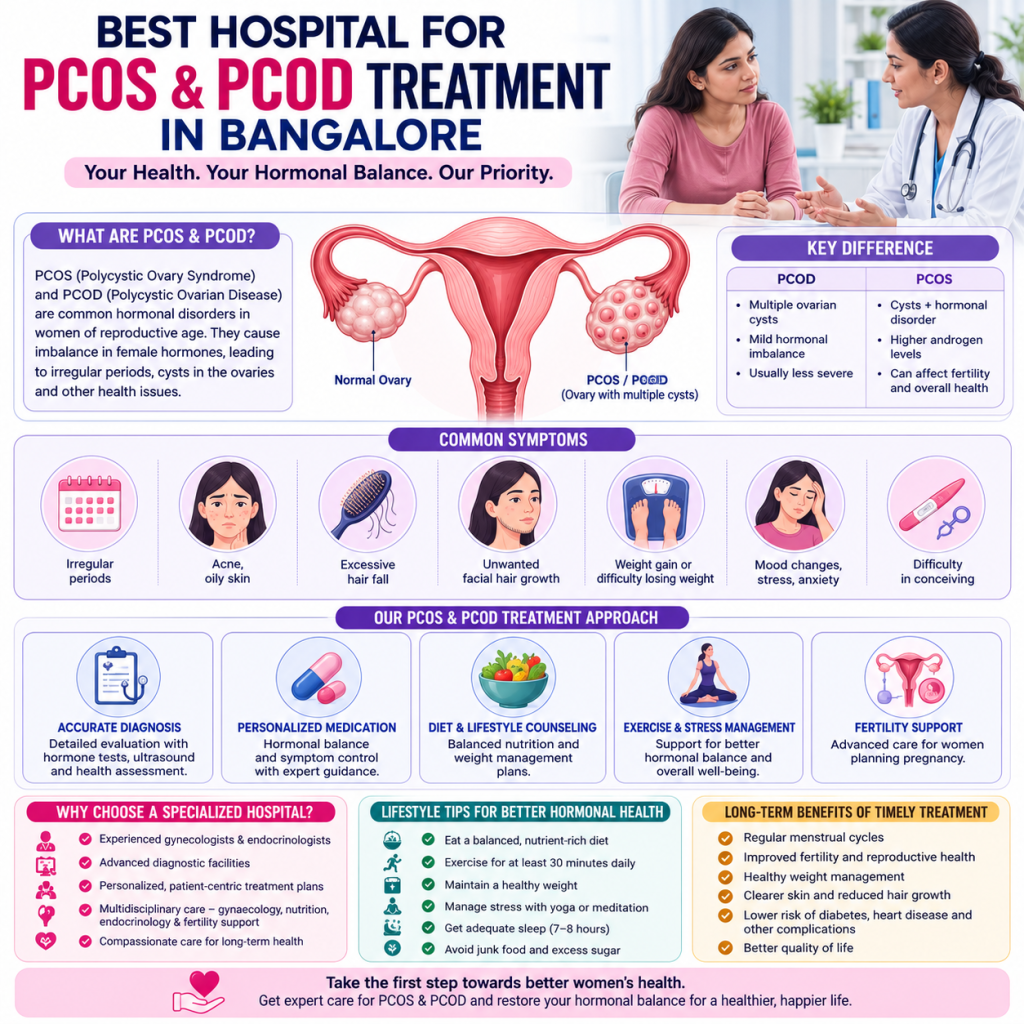
    Medical infographic illustrating the female reproductive system and explaining PCOS and PCOD, including symptoms, differences, treatment options, and lifestyle recommendations for better hormonal health.

    🔎 Understanding PCOS & PCOD

    • PCOD (Polycystic Ovary Disorder): Ovaries produce immature eggs, leading to irregular periods and hormonal imbalance.
    • PCOS (Polycystic Ovary Syndrome): A more severe metabolic disorder with higher androgen levels, insulin resistance, and fertility issues.

    ✅ Symptoms of PCOS & PCOD

    • Irregular or missed menstrual cycles
    • Excessive hair growth (face/body)
    • Acne or oily skin
    • Weight gain (especially around the abdomen)
    • Hair thinning on the scalp
    • Difficulty conceiving
    • Fatigue & mood swings

    ⚠️ Causes & Risk Factors

    • Hormonal imbalance (androgens & insulin resistance)
    • Genetic predisposition
    • Unhealthy diet & sedentary lifestyle
    • Stress and lack of exercise

    🩺 PCOS & PCOD Treatment at Shirdi Sai Hospital

    Our gynecology team uses a multi-disciplinary approach:

    • Lifestyle Management: Diet counseling, exercise plans, stress management
    • Medications: Hormonal therapy, insulin-sensitizing drugs, fertility medicines
    • Fertility Support: Ovulation induction & reproductive assistance
    • Cosmetic Solutions: For acne, excessive hair growth, and skin care
    • Long-term Monitoring: To reduce risks of diabetes, hypertension, and endometrial cancer

    💰 PCOS & PCOD Treatment Cost in Bangalore

    Patients often search: “How much does PCOS treatment cost in Bangalore?”

    At Shirdi Sai Hospital, we provide affordable packages:

    • Initial Consultation + Tests: ₹1,500 – ₹3,500 (approx.)
    • Monthly Treatment Plans: ₹3,000 – ₹7,500 (depending on medicines & counseling)

    (Costs vary per patient needs. Insurance may cover fertility treatments.)


    👩‍⚕️ Why Choose Shirdi Sai Hospital?

    • ✅ Expert gynecologists specializing in PCOS & PCOD
    • ✅ Comprehensive women’s health services under one roof
    • ✅ Personalized care plans for fertility, hormones, and lifestyle management
    • ✅ Located on New BEL Road – easily accessible from Hebbal, Malleshwaram, Yeshwanthpur, RT Nagar
    • ✅ Recognized as one of the top hospitals in Bangalore for PCOS treatment

    ❓ FAQs – PCOS & PCOD

    Q1. Which hospital is best for PCOS treatment in Bangalore?
    👉 Shirdi Sai Hospital, New BEL Road, is among the best hospitals for PCOS & PCOD care with expert gynecologists.

    Q2. Can PCOS be cured permanently?
    PCOS cannot be fully cured, but symptoms can be managed effectively with lifestyle changes and treatment.

    Q3. Does PCOS affect fertility?
    Yes. PCOS is a leading cause of infertility, but with proper treatment, many women conceive successfully.

    Q4. What is the difference between PCOS and PCOD?
    PCOD is milder (ovulation issue), while PCOS is more severe with hormonal imbalance and metabolic complications.

    Q5. How long does PCOS treatment take?
    Treatment is long-term and depends on individual response, but symptom control is possible within months.


    📞 Call to Action

    Take control of your health with expert PCOS & PCOD treatment at Shirdi Sai Multispeciality Hospital, New BEL Road, Bangalore.

    👉 [Book Appointment] | [Call Now]

  • Best Hospital for Enlarged Prostate (BPH) Treatment in Bangalore – Shirdi Sai Multispeciality Hospital, New BEL Road

    Best Hospital for Enlarged Prostate (BPH) Treatment in Bangalore – Shirdi Sai Multispeciality Hospital, New BEL Road

    Advanced Urology Care for Men’s Health

    Benign Prostatic Hyperplasia (BPH), commonly known as enlarged prostate, is a condition affecting men over 50. It causes frequent urination, weak urine flow, and discomfort, significantly affecting quality of life. At Shirdi Sai Multispeciality Hospital, New BEL Road, Bangalore, our expert urologists specialize in advanced laser and minimally invasive prostate treatments, making us one of the best hospitals in Bangalore for enlarged prostate care.

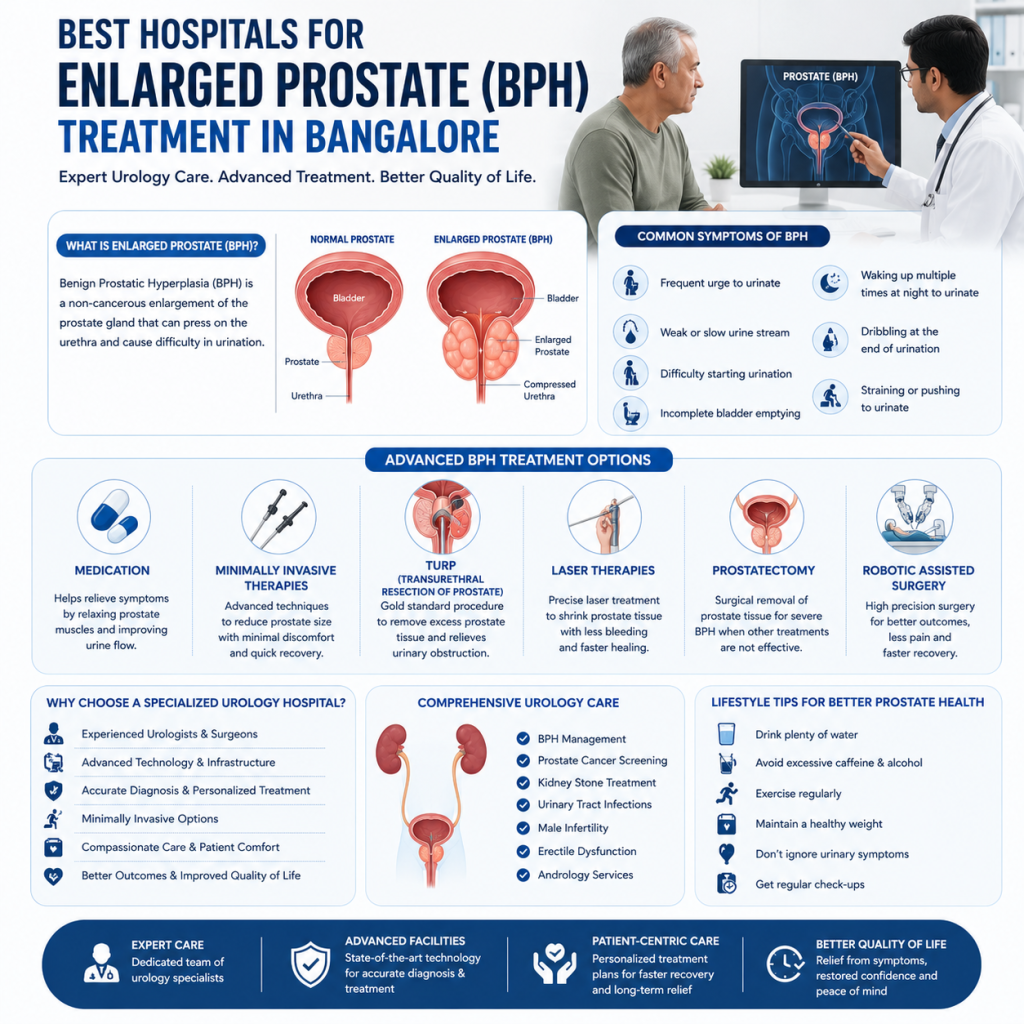
    Medical infographic illustrating benign prostatic hyperplasia (BPH), comparing a normal prostate with an enlarged prostate, highlighting common symptoms, treatment options, and prostate health tips.

    🔎 What is Enlarged Prostate (BPH)?

    BPH occurs when the prostate gland enlarges and presses against the urethra, blocking urine flow. While non-cancerous, untreated BPH can cause urinary retention, bladder damage, and kidney complications.


    ✅ Symptoms of Enlarged Prostate

    • Frequent urge to urinate, especially at night (nocturia)
    • Weak or interrupted urine flow
    • Difficulty starting urination
    • Incomplete emptying of bladder
    • Dribbling after urination
    • Urinary tract infections (UTIs)

    ⚠️ When Should You See a Doctor?

    Seek medical attention if you experience:

    • Complete inability to urinate
    • Blood in urine
    • Severe urinary frequency disrupting daily life
    • Recurrent infections

    🩺 Enlarged Prostate Treatments at Shirdi Sai Hospital

    Our urology team provides personalized treatment depending on severity:

    • Medications: To relax bladder muscles or shrink prostate
    • Minimally Invasive Procedures:
      • TURP (Transurethral Resection of Prostate) – Gold standard for BPH
      • Laser Prostate Surgery (HoLEP / GreenLight) – Minimal bleeding, faster recovery
      • UroLift System – Non-invasive option to relieve obstruction
    • Surgical Options: For severe or complicated BPH cases

    💰 Enlarged Prostate Treatment Cost in Bangalore

    Patients often ask: “What is the cost of prostate surgery in Bangalore?”

    At Shirdi Sai Hospital, we provide affordable packages:

    • Laser Prostate Surgery: ₹95,000 – ₹1,50,000 (approx.)
    • TURP Surgery: ₹70,000 – ₹1,10,000 (approx.)

    (Final cost depends on patient condition & procedure. Insurance accepted.)


    👨‍⚕️ Why Choose Shirdi Sai Hospital?

    • ✅ Experienced urologists with 15+ years of expertise
    • ✅ Advanced laser & endoscopic equipment
    • ✅ Quick recovery & minimal complications
    • ✅ Affordable, insurance-covered treatments
    • ✅ Located on New BEL Road – accessible from Hebbal, Malleshwaram, Yeshwanthpur, RT Nagar
    • ✅ Recognized among the top hospitals in Bangalore for prostate surgery

    ❓ FAQs – Enlarged Prostate (BPH)

    Q1. Which hospital is best for enlarged prostate treatment in Bangalore?
    👉 Shirdi Sai Hospital, New BEL Road, is among the best hospitals offering advanced BPH treatments.

    Q2. Is prostate enlargement cancer?
    No. BPH is non-cancerous, though symptoms may mimic prostate cancer, so evaluation is important.

    Q3. What is the recovery time after prostate surgery?
    Most patients recover in 1–2 weeks (laser) or 2–4 weeks (TURP).

    Q4. Is laser surgery better for BPH?
    Yes. Laser prostate surgery offers minimal bleeding, shorter hospital stay, and quick recovery.

    Q5. Does insurance cover prostate surgery in Bangalore?
    Yes. Most insurance providers cover TURP and laser prostate surgeries at Shirdi Sai Hospital.


    📞 Call to Action

    Take control of your urinary health with expert prostate treatments at Shirdi Sai Multispeciality Hospital, New BEL Road, Bangalore.