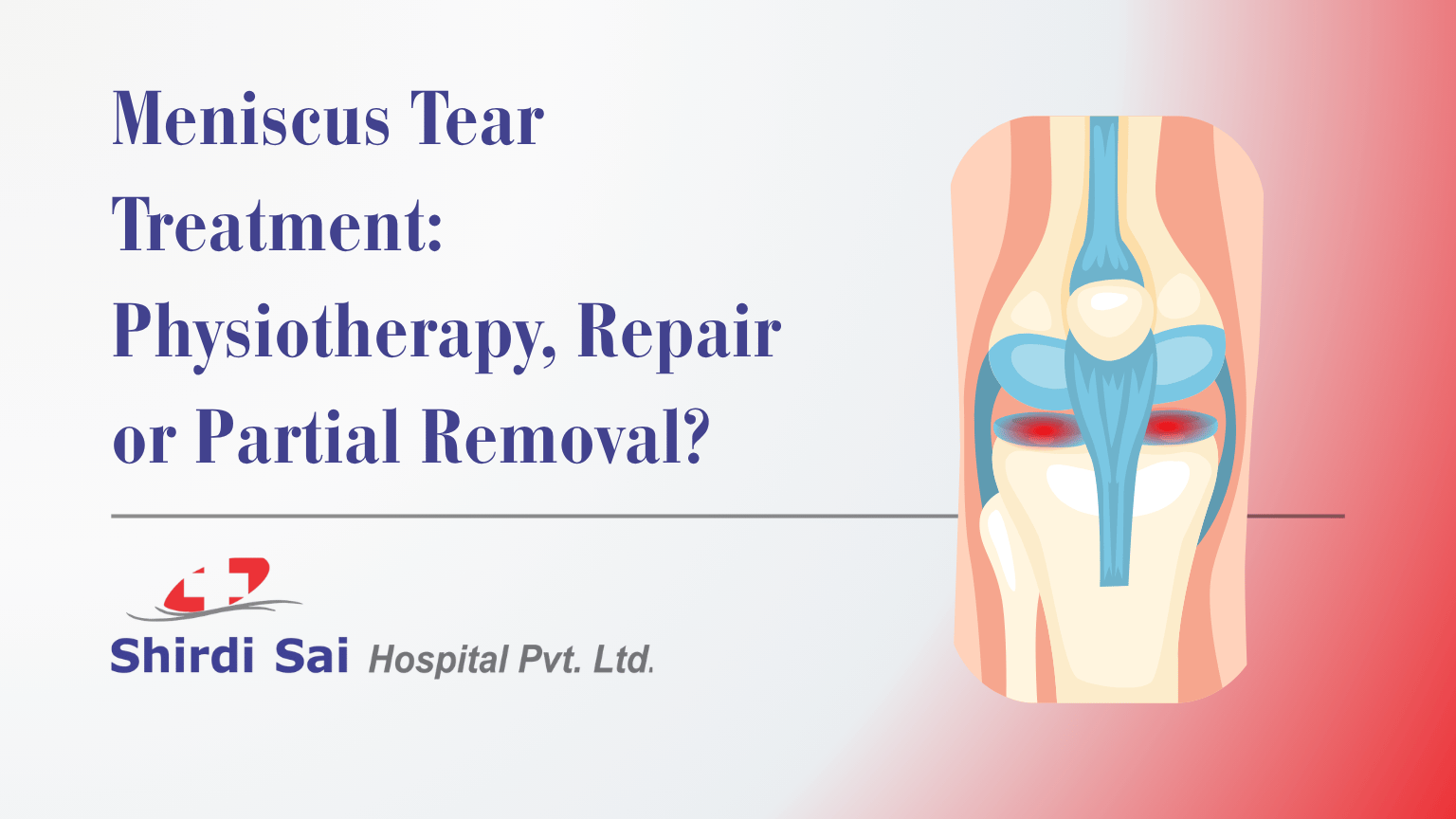
Meniscus tear treatment depends on the tear pattern, symptoms, knee movement and the health of the rest of the joint. Some patients improve with rehabilitation and activity changes. Others may need arthroscopic treatment, particularly when a displaced tear restricts movement or a repairable injury needs timely attention.
An MRI report alone does not decide the operation. At Shirdi Sai Hospital on New BEL Road, an orthopaedic assessment can help patients understand whether the scan findings explain their symptoms and which treatment options deserve discussion.
If knee pain or locking limits daily activity, request a knee assessment and bring any scan reports.
What does the meniscus do?
The knee contains two menisci, which are pads of cartilage between the thigh bone and shin bone. They help distribute load and contribute to joint stability.
For example, a tear can follow a twisting injury during sport or a sudden change of direction. Meniscal tissue can also change with age and wear, allowing a tear to develop during a relatively ordinary movement.
These situations are not identical. A recent traumatic tear in an otherwise healthy knee may need a different discussion from a degenerative tear in a knee affected by osteoarthritis.
The treatment decision should reflect that context rather than treating every report containing the word “tear” in the same way.
Does every meniscus tear cause symptoms?
No. Meniscal changes can appear on imaging without being the main source of pain. Instead, arthritis, a ligament injury or joint inflammation may contribute to the pain.
The clinician compares the location and pattern of symptoms with examination and imaging. A tear on the scan may be relevant, partly relevant or an incidental finding.
This does not mean ignoring a painful knee. It means checking that the proposed treatment addresses the problem affecting the patient.
For example, removing a small damaged portion of meniscus may not resolve pain mainly caused by arthritis. Therefore, ask the surgeon what improvement the operation could realistically provide.
What should an assessment cover?
The history helps distinguish a sudden injury from gradual symptoms. Tell the doctor whether the knee twisted, swelled, became stuck or started giving way.
The examination may assess joint-line tenderness, movement, swelling and ligament stability. The clinician then chooses imaging to answer the clinical question.
Although X-rays do not show a meniscus tear directly, they can reveal arthritis or other bone and joint changes. MRI can show meniscal and other soft-tissue structures in more detail.
Bring the actual images where available, not only a short report summary. Previous scans can also help establish whether the finding is new.
When may physiotherapy be appropriate?
Rehabilitation may be appropriate when symptoms, movement and the tear’s characteristics support a non-surgical approach. The plan can address pain, swelling, strength and confidence in using the knee.
Physiotherapy is not simply a period of waiting. It may involve graded exercise, improving muscle control and modifying activities that repeatedly aggravate symptoms.
Therefore, the programme should fit the diagnosis and stage of recovery. A painful swollen knee may need a different starting point from a knee that moves well but feels weak.
The aim is to improve function. Symptom improvement does not necessarily mean that every MRI change disappears, and a visible tear does not automatically mean rehabilitation has failed.
How is progress judged during rehabilitation?
Useful signs include improved walking, better knee movement, less swelling and greater ability to perform ordinary activities. The goals should relate to the patient’s work, sport and daily needs.
Keep a brief record of what remains difficult. Examples include climbing stairs, rising from a chair, kneeling, walking a particular distance or returning to a specific sport.
If progress is limited, review the diagnosis, exercise plan and associated joint problems. Do not simply repeat the same exercises indefinitely without reassessment.
However, a symptom flare does not automatically mean more tissue has torn. However, a new injury, worsening swelling or loss of movement needs clinical advice.
When should surgical assessment be more prompt?
A displaced tear can sometimes physically block the knee from straightening. This is different from a brief click or movement limited only by pain.
A genuinely locked knee needs prompt orthopaedic assessment. Do not try to force it straight or assume that all locking will resolve with exercise.
Recent tears that may benefit from repair also need an appropriate treatment discussion. Timing depends on the tear, symptoms and associated injuries.
Our guide to knee locking and catching explains the symptom distinction. After diagnosis, the next decision is whether rehabilitation or surgery best fits the tear.
What is meniscus repair?
Repair aims to preserve the meniscal tissue by securing a suitable tear so it has an opportunity to heal. Whether the surgeon can repair a tear depends on its pattern, location, tissue quality and the rest of the knee.
However, the surgeon cannot stitch every tear successfully. Some areas have a better blood supply than others, and degenerative tissue may not be suitable for the same approach as a recent injury.
The surgeon may also refine the plan after looking inside the knee during arthroscopy. Beforehand, ask which findings could change the proposed procedure.
Preserving useful tissue is an important goal, but repair still has risks, including failure to heal or the need for further treatment.
What is partial meniscectomy?
If repair is unsuitable, partial meniscectomy removes a damaged portion of the meniscus. The intention is to retain as much functioning tissue as reasonably possible.
It is different from removing the entire meniscus. It is also different from repairing the tear and protecting it while it heals.
Removing tissue can relieve symptoms in selected situations, but it changes the amount of meniscus available to share load through the knee. The long-term implications belong in the consent discussion.
Therefore, a shorter early recovery should not be the only reason for choosing removal over a suitable repair. The decision needs to consider both current symptoms and future joint function.
Is arthroscopy always helpful for a degenerative tear?
No. An MRI-reported degenerative tear does not automatically justify arthroscopic surgery. The knee may also have arthritis or other changes that contribute to symptoms.
An appropriate non-surgical plan is often an important part of care. Before deciding, ask what surgery could improve and why the clinician recommends it for your knee.
However, guidance for an isolated recent injury does not automatically apply to a long-standing tear related to wear.
Ask whether the problem is a displaced mechanical obstruction, a suitable repairable injury, persistent symptoms after appropriate care or pain largely related to another joint condition.
What if an ACL injury is present too?
The meniscus and anterior cruciate ligament can be injured together. If the knee is unstable, the surgeon must account for that when planning treatment and protecting a repair.
The surgeon may discuss combined treatment or a staged approach, depending on the findings. A plan for an isolated meniscus injury may not apply unchanged to a combined injury.
Our separate explanation of ACL physiotherapy versus surgery covers ligament-related decisions.
Bring details of previous giving-way episodes and any earlier ligament surgery to the consultation.
How do recovery plans differ?
Rehabilitation after repair can involve restrictions to protect healing tissue. Advice about weight-bearing, bending, squatting and return to sport may differ from advice after partial meniscectomy.
The operation name alone does not provide a complete timetable. The tear, repair method, associated procedures and the patient’s progress all matter.
Clarify whether you will need crutches or a brace and who will supervise rehabilitation. Ask when work duties, driving and exercise can be reconsidered.
Although pain may ease, the knee may not yet be ready for twisting sports or heavy loads. Follow the criteria and restrictions set by the treating team.
What are the limits and risks of surgery?
Arthroscopy still involves a procedure and anaesthesia. Possible problems include infection, bleeding, blood clots, stiffness, persistent symptoms and injury to nearby structures.
A repaired tear may fail to heal. Symptoms may continue if another joint problem contributes. After either repair or removal, some patients need further treatment.
The surgeon should explain which risks are particularly relevant and what improvement is realistic. No operation can guarantee a pain-free knee or a return to every previous activity.
Understanding these limits helps patients compare treatment options rather than assuming keyhole surgery is minor or risk-free.
What should you bring and ask?
Bring the MRI report and images, X-rays, earlier prescriptions and a medicine list. Explain what rehabilitation you have already completed and whether it helped.
Useful questions include:
- Does the tear explain my main symptoms?
- Is there arthritis or another injury as well?
- What would a structured rehabilitation trial involve?
- Is the tear potentially repairable?
- What might lead to partial removal instead?
- How would the recovery restrictions differ?
Also tell the team about work demands, caring responsibilities and sport goals.
When does knee pain need urgent care?
Seek urgent assessment for a knee that becomes physically stuck, inability to bear weight after significant injury, obvious deformity or a rapidly swollen joint.
A hot, swollen knee with fever needs prompt medical evaluation. New circulation changes or marked numbness after an injury also need urgent attention.
After surgery, follow the emergency instructions for fever, wound concerns, severe calf symptoms, chest pain or breathing difficulty.
Do not wait for a planned rehabilitation review if symptoms change substantially.
Meniscus assessment at Shirdi Sai Hospital
Our Orthopedics department provides a consultation route for knee injuries, movement problems and treatment planning on New BEL Road.
You can contact the hospital with your reports to confirm an orthopaedic appointment. Our orthopaedic team can discuss rehabilitation and surgery according to the tear and your symptoms.
If symptoms began after an injury, our guide to knee pain after a fall explains why the team also checks for other injuries.
Shirdi Sai Hospital is a 100-bed hospital on New BEL Road, established in 2004. When you contact us, our team can guide you to the relevant department and explain appointment arrangements.
Frequently asked questions
Does every meniscus tear need surgery?
No. Symptoms, movement, tear characteristics and other joint conditions guide the decision.
Can physiotherapy help if the tear is still visible on MRI?
Yes. Function and symptoms can improve without the scan returning to a completely normal appearance.
Is repair the same as partial meniscectomy?
No. Repair preserves and secures suitable tissue; partial meniscectomy removes a damaged portion.
Can the surgeon promise to repair every tear?
No. The surgeon checks the tear and tissue quality, including the findings during arthroscopy.
Does a locked knee need assessment?
Yes. A knee that is physically stuck needs prompt orthopaedic review.
Will surgery treat all pain in a knee with arthritis?
Not necessarily. Pain arising from arthritis or another problem may persist despite treatment of a tear.
Is recovery the same after repair and removal?
No. Repair may need specific protection while tissue heals. Follow the individual rehabilitation plan.