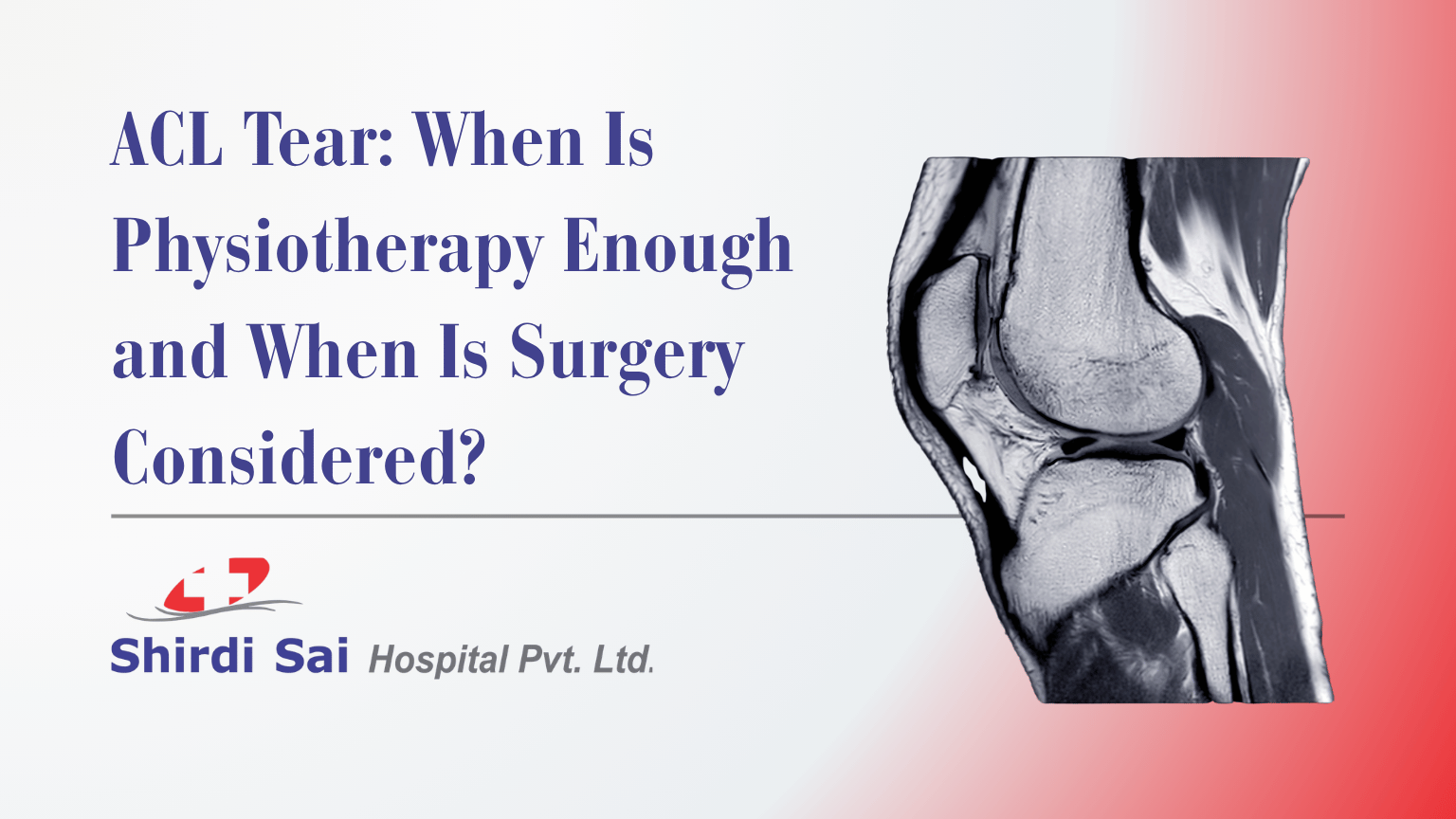
An ACL tear does not automatically mean you need surgery. Some people can regain useful knee function with structured physiotherapy, strength training and activity modification, particularly when the knee remains stable during everyday activities and no major associated injury changes the treatment plan. ACL reconstruction becomes more likely when the knee repeatedly gives way, the person wants to return to sports or work that requires pivoting and rapid direction changes, or the injury also affects structures such as the meniscus. An orthopaedic assessment helps determine which approach fits the injury, knee stability and the patient’s goals.
ACL Physiotherapy vs Surgery at a Glance
| Factor | Physiotherapy may be suitable | ACL reconstruction may be considered |
| Knee stability | Knee remains functionally stable | Knee repeatedly gives way |
| Activity goals | Walking, cycling or lower-demand activities | Pivoting, cutting or high-demand sports |
| Daily function | Patient manages routine activities without instability | Instability interferes with work or daily activities |
| Associated injury | No major associated injury changes treatment | Meniscus or other ligament injury may influence the decision |
| Response to rehabilitation | Strength, control and confidence improve | Instability continues despite appropriate rehabilitation |
| Patient preference | Patient accepts activity modification if needed | Patient wants to return to activities that require a stable pivoting knee |
| Treatment decision | Structured rehabilitation and monitoring | Reconstruction followed by rehabilitation |
Doctors do not decide treatment from MRI wording alone. They combine the scan with symptoms, physical examination, knee stability, associated injuries and the patient’s expected activity level.
What Is an ACL Tear?
The anterior cruciate ligament, or ACL, sits inside the knee and helps control forward movement and rotational stability.
The ligament connects the thigh bone to the shin bone and helps stabilise the knee during activities such as:
- changing direction
- stopping suddenly
- landing from a jump
- turning while the foot remains planted
- running
- participating in sports that require cutting or pivoting
An ACL injury may range from a ligament sprain to a complete tear.
ACL injuries can also occur together with:
- meniscus tears
- cartilage injuries
- medial collateral ligament injuries
- bone bruising
- other knee ligament injuries
These associated injuries can influence the treatment decision.
Does Every ACL Tear Need Surgery?
No.
A torn ACL on its own is not a reason to operate.
Some patients manage well with structured non-surgical treatment, especially when they:
- do not experience repeated knee instability
- do not participate in high-demand pivoting sports
- can perform daily activities safely
- respond well to physiotherapy
- can modify activities when necessary
- do not have associated injuries that make surgery more appropriate
The American Academy of Orthopaedic Surgeons notes that ACL treatment depends on individual needs, including injury severity, instability, activity level and other factors. Non-operative treatment remains an option for selected patients.
For most patients, the deciding question is whether the knee can give them the stability they need without reconstruction.
When Can Physiotherapy Be Enough for an ACL Tear?
Physiotherapy plays an important role in ACL treatment regardless of whether the patient eventually has surgery.
For selected patients, rehabilitation can form the main treatment.
A non-surgical approach may be reasonable when the patient has a stable or functionally manageable knee and does not need to return to activities that repeatedly place high rotational loads on it.
The knee does not keep giving way
Instability often matters more than pain when doctors discuss ACL reconstruction.
A patient may initially have pain and swelling after the injury, but those symptoms can improve.
The more important long-term issue is whether the knee:
- buckles
- shifts unexpectedly
- gives way while turning
- feels unreliable on uneven ground
- loses control during direction changes
A patient whose knee remains stable during required activities may have more scope for non-surgical management.
The patient’s activities place lower demands on the ACL
A person who mainly wants to:
- walk comfortably
- cycle
- swim
- perform gym exercises under guidance
- manage normal daily activities
may have different treatment needs from someone who regularly participates in football, basketball, badminton or another sport that involves rapid pivoting.
Age alone should not determine the decision.
An active older adult may place greater demands on the knee than a younger person with a relatively sedentary lifestyle.
Doctors therefore consider what the patient wants the knee to do, rather than making the decision only from age.
Rehabilitation restores strength and control
After an ACL injury, swelling and reduced activity can weaken the muscles around the knee.
Physiotherapy may work on:
- reducing swelling
- restoring knee movement
- strengthening the quadriceps
- strengthening the hamstrings
- improving hip and leg control
- balance
- coordination
- proprioception
- movement technique
- confidence in the injured leg
Strong muscles cannot replace the ACL anatomically, but improved muscle control can help some patients function more effectively.
The patient accepts activity modification when needed
A person who chooses non-surgical management may need to reconsider activities that repeatedly cause instability.
For example, walking and straight-line exercise may feel comfortable while rapid cutting or twisting continues to make the knee unreliable.
The treatment choice should match both the patient’s current activities and realistic future goals.
When Is ACL Surgery More Likely to Be Considered?
ACL reconstruction may become more appropriate when instability or functional demands make non-surgical management insufficient.
The knee repeatedly gives way
Repeated episodes of buckling during ordinary movement or sport suggest that the knee does not provide the stability the patient requires.
Examples include the knee giving way while:
- changing direction
- turning suddenly
- stepping sideways
- descending stairs
- playing sport
- walking on uneven ground
Persistent instability deserves orthopaedic reassessment even when pain has improved.
The patient wants to return to pivoting sports
The ACL plays an important role in rotational knee stability.
Sports that involve frequent:
- pivoting
- cutting
- sudden stopping
- jumping
- landing
- rapid direction changes
can place greater demands on an ACL-deficient knee.
A person hoping to return to these activities may discuss reconstruction with the orthopaedic surgeon.
The decision still depends on the full clinical assessment and should not rest on the sport alone.
The patient’s work demands a stable knee
Occupation can influence treatment just as strongly as sport.
A person whose work requires:
- repeated climbing
- rapid direction changes
- carrying loads
- working on uneven surfaces
- physically demanding movement
may need a different level of knee stability from someone whose occupation involves mostly seated work.
Doctors should consider occupational requirements when planning treatment.
The ACL tear occurs with another knee injury
ACL tears frequently occur with injuries to other structures.
The American Academy of Orthopaedic Surgeons notes that ACL injuries can occur together with meniscal, cartilage and other ligament injuries.
An associated injury may influence:
- whether surgery becomes appropriate
- the timing of treatment
- the rehabilitation plan
- activity restrictions
- expected recovery
An MRI can help identify these associated injuries when the doctor considers imaging clinically appropriate.
Rehabilitation does not control instability
A patient may complete an appropriate course of rehabilitation yet continue to experience instability.
At that stage, the orthopaedic surgeon may reassess:
- ligament function
- muscle strength
- movement control
- activity demands
- associated injuries
- rehabilitation quality
- patient goals
Ongoing instability does not settle the question on its own, but it is a good reason to revisit the treatment plan.
Can a Complete ACL Tear Be Treated Without Surgery?
Sometimes.
A complete ACL tear means the ligament has lost its normal continuity and function.
However, the MRI grade alone does not determine the treatment.
Doctors also assess:
- functional knee stability
- giving-way episodes
- activity level
- associated meniscus or cartilage injuries
- other ligament injuries
- patient expectations
- willingness to modify activities
- response to rehabilitation
Some people with complete tears can function well in selected activities after structured rehabilitation.
Others experience repeated instability and need reconstruction to meet their functional goals.
This is why two people with apparently similar MRI reports may receive different treatment recommendations.
Can a Partial ACL Tear Heal Without Surgery?
A partial ACL injury can sometimes respond to rehabilitation when enough functional stability remains.
The doctor considers:
- how much of the ligament remains functional
- knee stability during examination
- symptoms
- associated injuries
- activity demands
- response to rehabilitation
A “partial tear” is not always a minor injury.
Some partial injuries cause significant instability, while others remain functionally stable.
Clinical assessment matters more than relying only on the wording of the MRI report.
Does Walking Normally Mean the ACL Is Intact?
No. Many people can walk once the early pain and swelling settle, even with a complete ACL tear, so walking ability does not prove the ligament is intact. Problems usually show up during turning, twisting, running, jumping or changing direction.
We cover this symptom in more detail in our article on whether you can walk with a torn ACL. This page focuses on the treatment decision.
What Does Physiotherapy for an ACL Tear Involve?
The exact programme depends on the injury and the patient’s stage of recovery.
A physiotherapist may work on several areas.
Swelling control
Early swelling can restrict knee movement and interfere with muscle activation.
Initial rehabilitation may focus on reducing swelling while protecting the injured knee.
Restoring movement
Regaining the ability to straighten and bend the knee appropriately forms an important part of rehabilitation.
The therapist adjusts exercises according to pain, swelling and injury severity.
Strength
Rehabilitation usually targets muscles that support the knee, including:
- quadriceps
- hamstrings
- gluteal muscles
- calf muscles
Strengthening should progress according to the patient’s tolerance and clinical plan.
Balance and proprioception
Ligament injuries can affect the body’s awareness of joint position.
Balance and neuromuscular exercises help improve movement control.
Functional training
Later rehabilitation may include:
- walking control
- stair training
- squatting
- controlled direction changes
- running progression
- sport-specific drills where appropriate
Patients should not copy advanced ACL exercises from another person’s rehabilitation programme.
Exercise selection and progression should match the individual injury.
Does Physiotherapy Make the ACL Grow Back?
Physiotherapy primarily aims to improve the function of the knee.
It can strengthen muscles, restore movement, improve balance and help the patient control the knee more effectively.
Patients should not interpret successful rehabilitation as proof that a completely torn ACL has returned to normal anatomy.
Treatment success depends on function and stability, not only on whether symptoms feel better.
What Is ACL Reconstruction?
ACL reconstruction is an operation that creates a new ligament using graft tissue.
Rather than simply stitching most complete ACL tears back together, surgeons commonly reconstruct the ligament with a graft.
The exact graft and technique depend on:
- patient factors
- knee anatomy
- surgeon assessment
- activity requirements
- associated injuries
- previous knee procedures
ACL reconstruction aims to restore functional knee stability.
It does not eliminate the need for rehabilitation.
Rehabilitation remains a major part of treatment before and after surgery.
Is Arthroscopy Used for ACL Reconstruction?
ACL reconstruction commonly involves arthroscopic techniques.
Arthroscopy uses a camera and small surgical instruments to allow the surgeon to inspect and treat structures inside the knee.
The Orthopedics department at Shirdi Sai Hospital offers arthroscopy and ACL reconstruction, along with rehabilitation.
The surgeon determines whether arthroscopy and ACL reconstruction are appropriate after evaluating the individual knee.
Does an ACL Tear Need Immediate Surgery?
Not every ACL tear needs immediate reconstruction.
The early treatment phase often focuses on:
- controlling swelling
- restoring knee movement
- improving muscle activation
- assessing associated injuries
Operating on a very swollen, stiff knee can complicate recovery in some circumstances.
However, the timing changes when associated injuries create a more urgent treatment need.
The orthopaedic surgeon determines timing according to:
- knee swelling
- range of motion
- meniscus injury
- other ligament damage
- locking
- instability
- activity needs
- overall clinical condition
Patients should not delay assessment simply because surgery does not always happen immediately.
Early evaluation helps establish the correct diagnosis and treatment plan.
What Happens If You Do Not Have ACL Surgery?
The outcome varies considerably between patients.
Some people function well with rehabilitation and suitable activity modification.
Others continue to experience:
- knee giving way
- reduced confidence
- difficulty returning to sport
- problems with turning or pivoting
- limitations at work
- recurrent swelling
Repeated episodes of instability can also expose other structures in the knee to further injury.
This does not mean every person who avoids surgery will develop additional damage.
The individual risk depends on knee stability, activities, associated injuries and behaviour.
The goal of follow-up is to determine whether non-surgical management provides enough stability for that particular patient.
Can ACL Surgery Prevent Arthritis?
ACL reconstruction primarily aims to improve stability and function.
Patients should not view surgery as a guaranteed way to prevent future osteoarthritis.
The risk of later joint degeneration depends on several factors, including:
- the original knee injury
- meniscus damage
- cartilage injury
- repeated instability
- body weight
- activity
- subsequent injuries
Treatment decisions should therefore focus on current knee stability, associated damage and functional goals rather than a promise of preventing arthritis.
How Do Doctors Diagnose an ACL Tear?
An orthopaedic assessment usually starts with the story of the injury.
The doctor may ask:
- What movement caused the injury?
- Did you hear or feel a pop?
- How quickly did the knee swell?
- Could you continue walking?
- Does the knee give way?
- Have you returned to sport?
- Has the knee locked?
- Have similar injuries occurred before?
Physical examination
The orthopaedic doctor examines:
- swelling
- tenderness
- range of movement
- ligament stability
- meniscus-related signs
- the uninjured knee for comparison
Specific examination manoeuvres help assess ACL stability.
X-ray
An X-ray does not show the ACL directly.
Doctors may use X-rays to identify:
- fractures
- avulsion injuries
- other bone abnormalities
MRI
MRI provides detailed information about ligaments, menisci, cartilage and other soft tissues.
The American Academy of Orthopaedic Surgeons notes that MRI can help determine ACL injury severity and identify injuries to other knee structures.
The doctor should interpret MRI findings together with symptoms and examination.
A scan should support the clinical decision, not replace it.
What Should You Do After a Suspected ACL Injury?
After an acute knee injury:
- stop the activity that caused the knee to give way
- avoid repeatedly testing whether the knee can twist
- protect the knee from another injury
- arrange an assessment when significant swelling or instability develops
- follow medical advice about weight-bearing and activity
- avoid returning to sport simply because the pain has settled
Do not attempt forceful stretches or advanced strengthening immediately after a significant knee injury without assessment.
When Does a Knee Injury Need Urgent Medical Assessment?
Seek prompt medical care after a knee injury if:
- you cannot bear weight
- the knee appears visibly deformed
- the knee locks and cannot move normally
- swelling develops rapidly after significant trauma
- severe pain continues
- the foot becomes cold, pale or blue
- numbness develops below the injury
- an open wound accompanies the injury
- the injury follows major trauma
ACL injuries themselves do not always require emergency treatment.
However, serious fractures, dislocations, vascular injuries or other trauma can produce similar symptoms.
Patients with significant acute trauma can use the hospital’s emergency medicine service or the nearest appropriate emergency facility.
Orthopaedic Evaluation for ACL Tears at Shirdi Sai Hospital
Shirdi Sai Hospital provides Orthopedics services at its New BEL Road location.
The Orthopedics team at Shirdi Sai Hospital manages:
- ACL tears
- ACL reconstruction
- rehabilitation
- sports injuries
- arthroscopy
- meniscus tears
- surgical and non-surgical orthopaedic treatment
An ACL assessment may help determine:
- whether symptoms fit an ACL injury
- how stable the knee remains
- whether another ligament may also be injured
- whether the meniscus may be involved
- whether imaging will change management
- whether structured rehabilitation remains appropriate
- whether reconstruction should be discussed
- how the treatment choice fits work and activity goals
Patients with previous X-rays, MRI scans or physiotherapy records can bring them to the consultation for review.
Learn more through the hospital’s Orthopedics services, or read an ACL reconstruction case study from the hospital’s orthopaedic team.
Questions to Ask During an ACL Consultation
Useful questions include:
- Is my ACL partially or completely torn?
- How stable is my knee during examination?
- Is my meniscus also injured?
- Can I try rehabilitation before deciding on surgery?
- What activities should I avoid while rehabilitating?
- What signs would suggest that physiotherapy is not enough?
- Does my work or sport make reconstruction more appropriate?
- If I choose non-surgical treatment, how will you assess progress?
- If I need reconstruction, what should I achieve before surgery?
- What rehabilitation will I need after treatment?
The aim is to understand why the doctor recommends a particular pathway for your knee rather than choosing treatment solely from the MRI report.
When to See an Orthopaedic Doctor
Arrange an orthopaedic consultation when:
- the knee swells after twisting or pivoting
- you heard or felt a pop during the injury
- the knee repeatedly gives way
- you cannot confidently change direction
- you have an MRI showing an ACL tear
- you want to return to sports after an ACL injury
- physiotherapy has improved pain but instability remains
- another doctor has recommended ACL reconstruction and you want to understand the treatment decision
- a previous knee injury continues to affect work or daily activities
For major trauma, deformity, inability to bear weight, severe swelling, numbness or circulation changes, seek urgent assessment rather than waiting for a routine appointment.
Frequently Asked Questions
Can an ACL tear heal without surgery?
Some people with ACL tears can regain useful knee function without reconstruction through structured physiotherapy and activity modification. Suitability depends on knee stability, symptoms, associated injuries and the activities the person wants to return to.
Is physiotherapy enough for a complete ACL tear?
It can be enough for selected patients who achieve good functional stability and do not need high-demand pivoting activities. Other patients continue to experience instability and may benefit from discussing reconstruction with an orthopaedic surgeon.
When does an ACL tear need surgery?
Surgery becomes more likely when the knee repeatedly gives way, instability limits daily life or work, the patient wants to return to pivoting sports, or associated injuries influence the treatment plan. Doctors consider the whole clinical picture rather than MRI findings alone.
Can I walk normally with a torn ACL?
Some people can walk relatively normally after the initial pain and swelling improve. Walking ability does not rule out a complete ACL tear. Instability may become more noticeable during turning, running or changing direction.
Does every athlete with an ACL tear need reconstruction?
No. Sport type, level of competition, knee stability, associated injuries and future goals all influence the decision. Athletes who need repeated pivoting and cutting movements may have stronger reasons to consider reconstruction.
What happens if I do not have ACL surgery?
Some patients function well with rehabilitation. Others experience persistent instability or difficulty returning to desired activities. Regular reassessment helps determine whether non-surgical treatment continues to meet the patient’s needs.
Can I decide about ACL surgery from my MRI report?
No. MRI provides important information about the ACL and associated knee injuries, but the treatment decision also depends on examination findings, instability, symptoms, activity requirements and treatment goals.
Summary
An ACL tear does not automatically require reconstruction, and physiotherapy does not automatically suit every ACL injury.
The most important factors include knee stability, giving-way episodes, associated meniscus or ligament injuries, work requirements, sporting goals and the patient’s response to structured rehabilitation.
An orthopaedic assessment can help determine whether rehabilitation remains appropriate or whether ACL reconstruction deserves consideration.
Patients with a suspected or confirmed ACL injury can arrange an orthopaedic consultation at Shirdi Sai Hospital on New BEL Road.
Seek urgent medical assessment after major knee trauma when you cannot bear weight, the knee looks deformed, severe swelling develops, or numbness or circulation changes occur.
External Medical References
The role of knee stability, activity level, associated injuries and MRI in ACL treatment decisions follows patient guidance from the American Academy of Orthopaedic Surgeons (OrthoInfo): ACL injuries.
Evaluation, rehabilitation and reconstruction guidance: Mayo Clinic: ACL injury diagnosis and treatment.
Patient information about reconstruction surgery: NHS: What is ACL surgery?