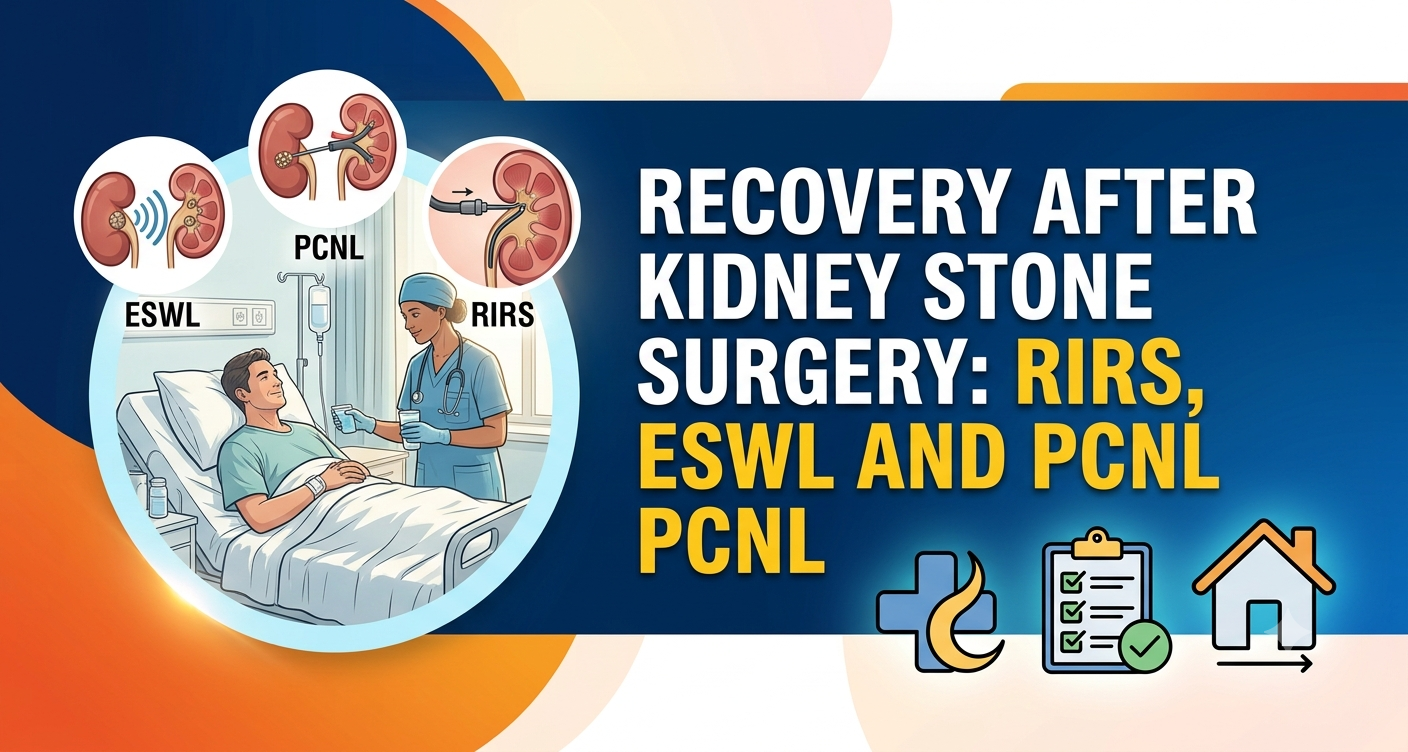
Recovery after kidney stone surgery depends on the procedure, stone burden, presence of infection, use of a ureteric stent and the patient’s general health. ESWL usually involves no surgical incision, while RIRS reaches the kidney through the urinary passage. PCNL uses a small tract through the back and generally requires a longer recovery. Temporary burning during urination, blood-tinged urine, urinary frequency, soreness and tiredness may occur after treatment. However, fever, inability to pass urine, heavy bleeding, worsening pain or repeated vomiting need prompt medical review. Patients near New BEL Road can consult the urology team at Shirdi Sai Hospital for individual recovery and follow-up advice.
Kidney Stone Surgery Recovery at a Glance
Recovery should be guided by the discharge instructions given for the specific procedure.
| Procedure | How the stone is treated | What recovery may involve |
| ESWL | Shock waves are directed at the stone from outside the body | Passing stone fragments, mild soreness, blood-tinged urine and short-term urinary discomfort |
| Ureteroscopy or RIRS | A scope passes through the urethra and bladder into the ureter or kidney | Burning urination, urinary frequency, mild bleeding and possible ureteric stent symptoms |
| PCNL | The kidney is reached through a small tract made through the back | Incision soreness, hospital monitoring, urine drainage tubes in selected cases and a more gradual return to activity |
A shorter or less invasive procedure does not guarantee a symptom-free recovery. Likewise, a small stone may still require a stent or follow-up treatment if swelling, residual fragments or obstruction remain.
What Affects Recovery After Kidney Stone Surgery?
Patients undergoing the same procedure may recover at different rates.
Important factors include:
- The type of procedure
- Stone size, number and location
- Whether the stone was completely cleared
- Whether infection was present
- Swelling or blockage in the ureter
- Placement of a ureteric stent
- Use of a urinary catheter or nephrostomy tube
- Kidney function
- Anaesthesia and pain-control requirements
- Age and general health
- Diabetes, bleeding concerns or other medical conditions
- Whether another treatment session is planned
The recovery instructions given by the treating urologist should take priority over a general online timeline.
What to Expect During the First Day
After the procedure, the medical team may monitor:
- Blood pressure and pulse
- Pain and nausea
- Urine output
- Ability to pass urine
- Amount and colour of urinary bleeding
- Temperature
- The condition of any catheter, stent or drainage tube
- Recovery from anaesthesia
Before discharge, patients should understand:
- Which medicines to take
- How much fluid to drink
- What activity is permitted
- Whether a stent or tube is present
- When the stent or tube will be removed
- When follow-up is required
- Which symptoms need urgent attention
Do not leave without knowing whether a ureteric stent has been placed. Stents are temporary and require a clear follow-up plan.
Common Symptoms After Kidney Stone Treatment
Some temporary symptoms may occur as the urinary tract recovers.
Blood in the urine
Urine may look pink or lightly blood-stained after ESWL, ureteroscopy, RIRS or PCNL. The appearance may vary with activity, hydration and whether a stent is present.
Contact the treating team promptly if:
- The urine becomes heavily blood-stained
- Large blood clots are passed
- Bleeding is increasing rather than settling
- Urine flow becomes difficult
- Bleeding occurs with faintness or marked weakness
The amount of bleeding that is expected differs between procedures. Follow the instructions given at discharge.
Burning during urination
Temporary burning may occur after instruments, a catheter or a stent have passed through the urinary tract.
Burning should be reviewed when it:
- Is becoming more severe
- Continues beyond the expected period
- Occurs with fever or chills
- Is accompanied by cloudy or foul-smelling urine
- Occurs with increasing lower abdominal or back pain
These symptoms may require urine testing for infection.
Frequent or urgent urination
Some patients feel the need to pass urine more often after a urinary procedure. This may result from temporary irritation or a ureteric stent.
The sensation can be uncomfortable, but it should not be managed by taking antibiotics without medical advice.
Flank, back or bladder discomfort
Discomfort may be felt in the side, lower back, lower abdomen or bladder area. It may be related to the procedure, passing fragments or a stent.
Pain that becomes severe, does not improve with prescribed medicine or occurs with fever, vomiting or reduced urine output needs prompt assessment.
Tiredness
Fatigue can occur after anaesthesia, interrupted sleep, pain, infection or hospital treatment. Resume activity gradually rather than trying to return immediately to a full routine.
Marked weakness, breathlessness, faintness or confusion should not be treated as ordinary postoperative tiredness.
Recovery After ESWL
Extracorporeal shock wave lithotripsy, commonly called ESWL or SWL, uses focused shock waves to break a suitable stone into smaller fragments.
There is no surgical cut in the skin. However, the fragments still need to move through the urinary tract.
What may be expected after ESWL?
Patients may notice:
- Mild soreness around the treated side
- Pink or blood-tinged urine
- Bruising or skin tenderness
- Burning during urination
- Frequent urination
- Cramping as fragments move
- Small stone particles in the urine
- Tiredness after sedation or pain medicine
The stone may not disappear immediately after treatment. Fragments can pass over time, and some patients require follow-up imaging or another treatment session.
Passing stone fragments
Fragments may cause intermittent discomfort as they move from the kidney into the ureter and bladder.
The urologist may advise:
- Suitable pain medicine
- Fluid intake according to the patient’s health
- Straining the urine to collect fragments
- Follow-up imaging
- Medicine to support fragment passage in selected cases
Do not take unprescribed medication to force fragments to pass.
Activity after ESWL
Many patients can begin light movement soon after treatment if they feel well. However, driving, work, exercise and heavy lifting should follow the discharge instructions.
Avoid driving while affected by:
- Sedation
- Anaesthesia
- Strong pain medicine
- Dizziness
- Significant pain
Contact the doctor if discomfort becomes severe or is accompanied by fever, vomiting or difficulty urinating.
Recovery After Ureteroscopy or RIRS
Ureteroscopy is used to reach stones in the ureter. Retrograde intrarenal surgery, or RIRS, uses a flexible scope to reach stones inside the kidney.
Both approaches pass through the urethra and bladder without an external surgical incision.
Patients comparing these procedures with other options can read the hospital’s guide to RIRS, ESWL and PCNL for kidney stone treatment.
What may be expected after RIRS?
Temporary symptoms may include:
- Burning while passing urine
- Blood-tinged urine
- Urinary frequency
- Urgency
- Mild lower abdominal discomfort
- Flank discomfort
- Tiredness after anaesthesia
- Pain linked to a ureteric stent
Some patients may be discharged after observation, while others need longer monitoring. Discharge timing depends on urine flow, pain, infection risk, bleeding and general recovery.
Has the whole stone been removed?
During RIRS, the urologist may remove pieces or break the stone into very small fragments. Some fragments may pass naturally after the procedure.
The amount of residual stone cannot be judged from symptoms alone. Follow-up imaging may be needed to check:
- Stone clearance
- Remaining fragments
- Urinary obstruction
- Kidney swelling
- Stent position
- The need for another treatment session
Pain relief does not always confirm complete clearance.
Recovery After PCNL
Percutaneous nephrolithotomy, or PCNL, reaches the kidney through a small tract created through the skin of the back.
It is generally considered for larger or more complex kidney stones. Since the kidney is accessed through an incision and tract, recovery may be more involved than after ESWL or RIRS.
What may be expected after PCNL?
Recovery may include:
- Soreness around the back incision
- Blood in the urine
- Tiredness
- Pain during movement
- Hospital monitoring
- A urinary catheter
- A ureteric stent
- A nephrostomy tube in selected cases
- Dressing and wound care
- Repeat blood tests or imaging
Not every patient will have all of these tubes or tests. The surgical findings and urine drainage determine what is required.
Hospital recovery after PCNL
Before discharge, the team may check:
- Pain control
- Urine output
- Bleeding
- Kidney function
- Temperature
- Ability to eat and drink
- Ability to walk safely
- The incision or tube site
- Whether further treatment is required
Discharge should be based on clinical readiness rather than a fixed recovery promise.
Activity after PCNL
Patients are usually advised to increase activity gradually. The treating team may place temporary limits on:
- Heavy lifting
- Strenuous exercise
- Long journeys
- Driving
- Physically demanding work
- Swimming until the wound has healed
The exact restriction depends on the operation, wound condition and follow-up findings.
What Is a Ureteric Stent?
A ureteric stent is a thin, flexible tube placed between the kidney and bladder. It helps urine drain when swelling, stone fragments or recent treatment may obstruct the ureter.
A stent may be placed after RIRS, ureteroscopy, ESWL or PCNL, although it is not needed in every case.
Common stent symptoms
While a stent is present, patients may experience:
- Frequent urination
- Urgency
- Burning
- Bladder pressure
- Blood in the urine
- Discomfort in the kidney area while urinating
- Pelvic or groin discomfort
- Symptoms that increase after physical activity
These symptoms can be troublesome, but their severity varies.
Stent removal
The stent may have:
- A thread for planned removal
- A scheduled cystoscopic removal
- A removal date decided by the urologist
Do not pull or remove a stent unless the treating team has specifically instructed you to do so.
Keep a written record of:
- The date it was inserted
- The expected removal date
- The planned removal method
- The hospital contact pathway
A temporary stent should not be forgotten. Contact the urology team if the removal plan is unclear.
When stent symptoms need medical review
Seek advice if:
- Fever or chills develop
- Pain becomes severe
- Urine cannot be passed
- Heavy bleeding or clots occur
- Vomiting prevents fluid intake
- The stent appears to move or come out
- The removal string is accidentally pulled
- Symptoms suddenly become much worse
How Much Water Should You Drink?
Fluid intake after stone treatment should be individualised.
Many patients are advised to drink enough fluid to keep urine flowing and reduce concentration. However, excessive water intake may not be appropriate for people with:
- Heart failure
- Reduced kidney function
- A prescribed fluid restriction
- Low sodium levels
- Severe vomiting
- Complete urinary obstruction
Rather than forcing large amounts at once, drink steadily according to the discharge plan.
Contact the treating team when:
- You cannot keep fluids down
- Urine output is falling
- Drinking increases severe pain
- Swelling or breathlessness develops
- You have been told to restrict fluids
What Can You Eat After Kidney Stone Surgery?
There is no single recovery diet for every patient.
During the first stage of recovery, choose foods that are easy to tolerate, particularly after anaesthesia or nausea.
Options may include:
- Light meals
- Rice or soft foods
- Dal and cooked vegetables
- Curd when tolerated
- Fruit
- Soups that are not excessively salty
- Regular balanced meals as appetite returns
Avoid making major long-term dietary restrictions until the stone type and medical history have been reviewed.
Should calcium be avoided?
Do not remove all calcium-containing foods simply because the stone was described as a calcium stone. Dietary advice depends on stone composition, urine testing, kidney function and the patient’s overall diet.
Unnecessary restriction may lead to an unbalanced diet and may not reduce recurrence.
Salt and packaged food
A high-salt diet may contribute to the risk of certain stones. During long-term prevention, the doctor or dietitian may recommend reducing:
- Excess table salt
- Pickles
- Papad
- Salty snacks
- Highly processed food
- Packaged soups or sauces
The prevention plan should be personalised rather than based on a generic list copied from the internet.
Medicines After Stone Surgery
Discharge medicines depend on the procedure and clinical findings.
They may include:
- Pain-relieving medicine
- Medicine for bladder or stent symptoms
- Antibiotics when clinically indicated
- Medication to support passage of fragments
- Treatment for nausea
- Other regular medicines
Take each medicine according to the prescribed dose and duration.
Do not:
- Start leftover antibiotics
- Double a missed dose without advice
- Take another person’s prescription
- Stop blood-thinning medicine without instruction
- Combine several pain medicines without checking their ingredients
- Continue medicine beyond the advised duration without review
Contact the doctor if a medicine causes rash, facial swelling, breathing difficulty, severe dizziness, persistent vomiting or another concerning reaction.
When Can You Return to Work?
Return to work depends on:
- ESWL, RIRS, ureteroscopy or PCNL
- Pain and urinary symptoms
- Presence of a stent
- Anaesthesia recovery
- Physical demands of the job
- Travel requirements
- Ability to access a toilet
- Heavy lifting or prolonged standing
- Other medical conditions
Someone doing desk-based work may return sooner than a person whose job involves lifting, driving, climbing or prolonged physical activity.
Do not rely on a fixed online timeline. Ask the treating team for advice based on the procedure and job demands.
When Can You Drive?
Avoid driving until:
- The effects of anaesthesia or sedation have passed
- You are no longer taking medicine that impairs alertness
- You can sit comfortably
- You can turn and brake safely
- Pain does not distract you
- The treating team has not advised a longer restriction
Stent discomfort, urinary urgency and strong pain medicine can make driving unsafe even when the surgical procedure was short.
When Can You Exercise?
Walking may be encouraged during recovery when the patient feels steady. It can support mobility and reduce the effects of prolonged bed rest.
More demanding activity should resume gradually.
Ask for guidance before returning to:
- Running
- Gym workouts
- Cycling
- Swimming
- Yoga involving strong abdominal strain
- Contact sports
- Heavy lifting
- Repetitive bending
Temporary blood in the urine may increase after activity when a stent is present. Rest and follow the discharge instructions. Seek advice when bleeding is heavy, persistent or associated with clots or reduced urine flow.
When Can Sexual Activity Resume?
Sexual activity may be resumed when the patient feels comfortable and the treating team has not advised a restriction.
Consider delaying it when there is:
- Significant pain
- Heavy bleeding
- A catheter or nephrostomy tube
- An exposed stent-removal thread
- Fever or suspected infection
- A healing PCNL wound
- Specific postoperative restrictions
Ask the urology team when the instructions are unclear.
Wound and Tube Care After PCNL
Patients with a back incision, dressing or nephrostomy tube should receive specific written instructions.
General precautions may include:
- Keeping the dressing clean and dry
- Washing hands before touching the site
- Avoiding pulling or twisting the tube
- Checking for leakage
- Observing for increasing redness or swelling
- Keeping the drainage bag below kidney level when instructed
- Recording urine output when requested
- Attending the planned tube-removal appointment
Contact the treating team if:
- The tube stops draining
- The tube falls out
- Urine leaks continuously around it
- The site becomes increasingly red, swollen or painful
- Pus or a strong smell develops
- Fever or chills occur
Do not clamp, flush or reposition a nephrostomy tube unless trained and instructed to do so.
Follow-Up After Kidney Stone Surgery
Follow-up is part of treatment rather than an optional extra.
The urologist may review:
- Recovery symptoms
- Urine flow
- Stent or tube removal
- Urine-test results
- Kidney function
- Stone analysis
- Follow-up imaging
- Residual fragments
- Hydronephrosis
- Prevention of future stones
The timing depends on the procedure and findings.
For more information about diagnosis and treatment pathways, read about kidney stone treatment at Shirdi Sai Hospital.
Will Another Procedure Be Needed?
One procedure does not always clear every stone.
Further treatment may be considered when:
- The original stone burden was large
- Several stones were present
- A stone was difficult to reach
- Residual fragments remain
- ESWL did not break the stone adequately
- Urinary blockage continues
- A planned staged procedure was discussed
- Infection limited the initial treatment
- The first step involved drainage rather than stone removal
Needing another session does not necessarily mean the earlier procedure failed. Some stones are intentionally treated in stages to reduce risk.
Preventing Another Kidney Stone
Recovery also provides an opportunity to investigate why the stone formed.
Prevention may include:
- Stone analysis when a fragment is available
- Urine testing
- Blood tests
- Review of fluid intake
- Review of salt and food habits
- Assessment of recurring urinary infections
- Review of supplements and regular medicines
- Metabolic evaluation for recurrent or high-risk stones
A prevention plan should reflect the stone type and the patient’s medical condition.
Generic remedies should not replace clinical evaluation. Some products marketed as stone-cleansing medicines may interact with prescriptions or be unsuitable for kidney disease.
When to Seek Urgent Medical Care
Contact the treating team or seek urgent assessment if recovery is accompanied by:
- Fever or chills
- Inability to pass urine
- Very low urine output
- Heavy or increasing urinary bleeding
- Large blood clots
- Severe pain not controlled by prescribed medicine
- Repeated vomiting
- Inability to keep fluids down
- Fainting, confusion or marked weakness
- Breathlessness or chest pain
- Increasing redness, swelling or pus at a PCNL wound
- A nephrostomy tube that has stopped draining or fallen out
- A stent that appears to have moved
- Rapidly worsening symptoms
Fever after a urinary procedure may indicate infection and should not be managed only with leftover antibiotics.
Patients with severe or rapidly worsening symptoms can seek assessment through the hospital’s emergency medicine service.
Urology Follow-Up on New BEL Road
Shirdi Sai Hospital provides urology care at its New BEL Road location. The hospital’s published urology scope includes kidney and ureteric stone evaluation, treatment planning and follow-up. (Shirdi Sai Hospital)
Patients recovering after ESWL, RIRS, ureteroscopy or PCNL can learn more about the hospital’s urology services.
A follow-up consultation may help clarify:
- Whether current symptoms are expected
- When normal activity may resume
- How a stent or tube will be removed
- Whether follow-up imaging is required
- Whether fragments remain
- Whether preventive tests are appropriate
- When another treatment session may be considered
Shirdi Sai Hospital is located at No. 519, 2nd Main, Nethravathi Street, Devasandra, New BEL Road, Bengaluru, Karnataka 560054. The contact page confirms the hospital address and appointment pathway. (Shirdi Sai Hospital)
Frequently Asked Questions
How long does recovery take after kidney stone surgery?
Recovery depends on whether the patient underwent ESWL, RIRS, ureteroscopy or PCNL. ESWL and endoscopic procedures may allow an earlier return to light activities, while PCNL generally requires more gradual recovery. Pain, a stent, infection and the patient’s work also affect the timeline.
Is blood in urine normal after kidney stone surgery?
Light blood staining may occur temporarily after kidney stone treatment, especially when a ureteric stent is present. Seek medical advice if bleeding becomes heavy, increases, contains large clots or causes difficulty passing urine.
Why does urination burn after RIRS?
Temporary burning may result from irritation caused by instruments, a catheter or a stent. Contact the doctor if burning is worsening or occurs with fever, chills, cloudy urine or increasing pain.
How long does a stent stay after stone surgery?
The duration depends on the reason for placement, swelling, stone fragments and the procedure performed. Patients should receive a specific removal date or follow-up plan rather than relying on a general online timeline.
Can I go to work with a ureteric stent?
Some people can perform light or desk-based work with a stent, while others experience urgency, pain or blood in the urine that makes work difficult. The decision should consider symptoms, travel, toilet access and physical job demands.
What should I eat after kidney stone surgery?
Begin with foods that are easy to tolerate and return gradually to a balanced diet. Long-term restrictions should depend on stone analysis, urine findings and medical advice. Do not automatically avoid all calcium-containing food.
When should I go to the hospital after kidney stone surgery?
Seek urgent care for fever, chills, inability to urinate, heavy bleeding, large clots, severe worsening pain, repeated vomiting, very low urine output or a problem with a stent or nephrostomy tube.
Take the Next Step
Recovery after kidney stone surgery is influenced by the procedure, stone burden, urinary drainage and the presence of a stent or tube. Temporary urinary discomfort may occur, but worsening symptoms should not be dismissed as a normal part of healing.
Patients who need non-emergency follow-up can arrange a urology consultation at Shirdi Sai Hospital on New BEL Road.
Seek urgent care for fever, inability to pass urine, heavy bleeding, uncontrolled pain, repeated vomiting or rapidly worsening symptoms.