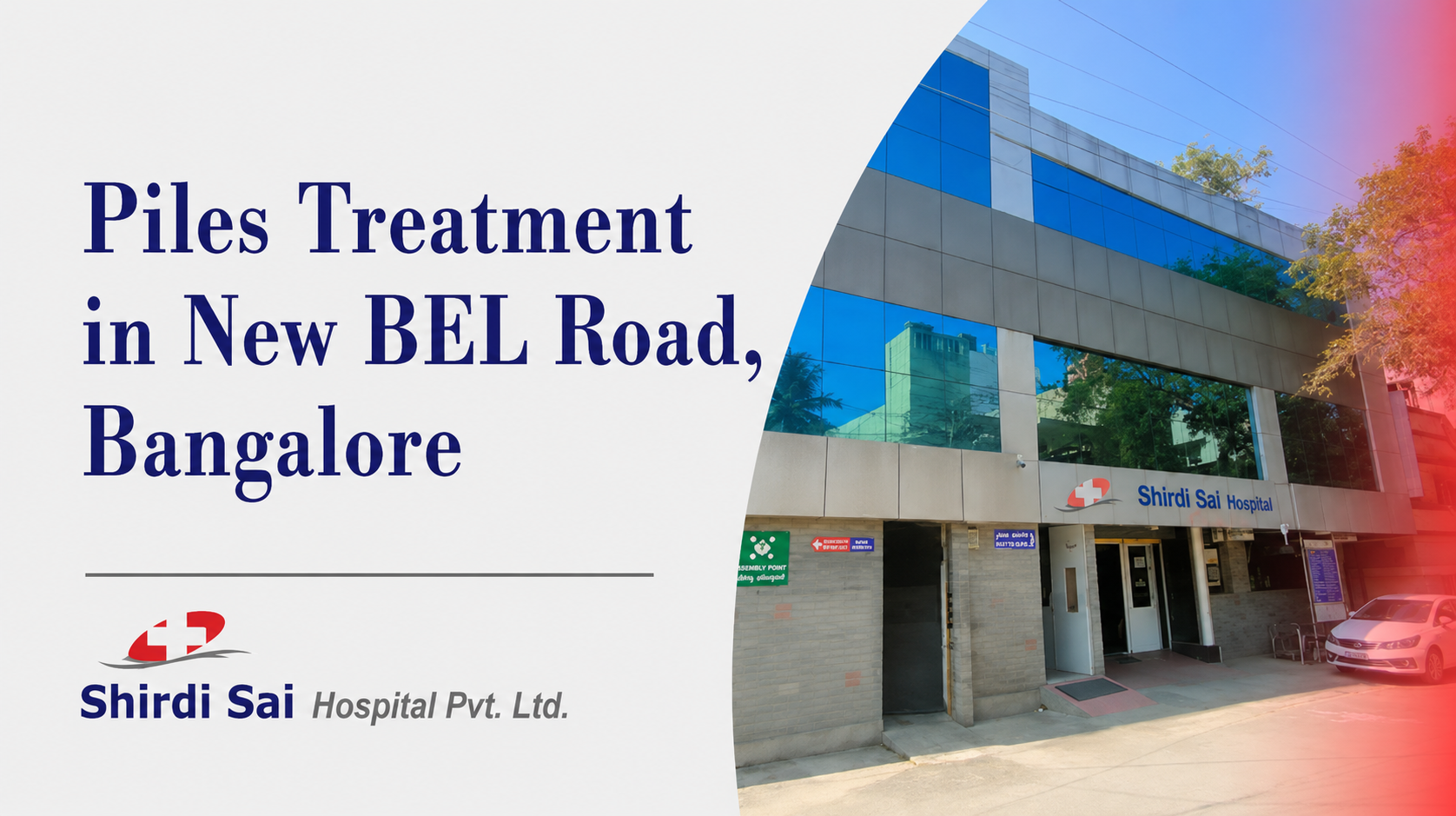
Patients looking for piles treatment in New BEL Road can consult the General Surgery team at Shirdi Sai Hospital for assessment of bleeding during bowel movements, anal swelling, itching, discomfort or a lump near the anus. Piles, also called haemorrhoids, can be internal or external and do not require the same treatment in every patient. Mild symptoms may improve with bowel-habit changes and prescribed medicines. Persistent bleeding, prolapse, thrombosis or advanced symptoms may require a procedure or surgery. Rectal bleeding should not automatically be assumed to be piles, so an examination is important before treatment is selected.
What Are Piles?
Piles or haemorrhoids are enlarged and inflamed vascular tissues around the anus or inside the lower rectum. They may develop when pressure in this area increases because of straining, constipation, diarrhoea, pregnancy, ageing or prolonged time spent on the toilet.
Haemorrhoidal tissue is normally present and contributes to bowel control. It becomes a medical concern when it enlarges, bleeds, prolapses, becomes painful or interferes with daily activities.
Internal piles
Internal piles develop inside the rectum. They may cause:
- Bright red bleeding during or after bowel movements
- Tissue protruding during stool passage
- Mucus discharge
- Irritation or itching
- A feeling of incomplete cleaning
- Discomfort when the tissue remains outside
Internal piles are often less painful unless they prolapse, become trapped or develop another complication.
External piles
External piles develop beneath the skin around the anus. They may cause:
- A tender or swollen lump
- Itching or irritation
- Pain while sitting
- Discomfort during bowel movements
- Sudden severe pain when a blood clot forms
A thrombosed external haemorrhoid occurs when a clot develops within the swollen tissue. It can cause a firm, painful lump and may require timely assessment, particularly when pain is severe or the diagnosis is uncertain.
What Are the Grades of Internal Piles?
Doctors may grade internal piles according to how far they prolapse.
| Grade | Typical description |
| Grade I | Enlarged internal piles that do not protrude outside |
| Grade II | Prolapse during straining and return inside without assistance |
| Grade III | Prolapse and require gentle manual reduction |
| Grade IV | Remain outside and cannot be reduced |
The grade helps guide treatment, but it is not the only consideration. Bleeding, discomfort, external disease, thrombosis, bowel habits, previous treatment and the patient’s overall health also influence the recommendation.
Common Symptoms of Piles
Possible symptoms include:
- Bright red blood on toilet paper
- Blood coating the stool
- Drops of blood in the toilet
- Itching around the anus
- Swelling or a lump near the anus
- Mucus discharge
- Discomfort after passing stool
- Tissue protruding during bowel movements
- Difficulty cleaning the area
- Sudden pain from a thrombosed external pile
Not every person experiences all these symptoms. Piles can also exist without causing noticeable discomfort.
Is Rectal Bleeding Always Caused by Piles?
No. Piles are a common cause of rectal bleeding, but bleeding may also be associated with an anal fissure, bowel inflammation, infection, polyps, diverticular disease or colorectal cancer. A patient should not repeatedly treat bleeding with piles creams without confirming its cause.
Arrange medical evaluation when bleeding:
- Happens repeatedly
- Continues despite basic treatment
- Is mixed throughout the stool
- Is accompanied by bowel-habit changes
- Occurs with unexplained weight loss
- Is associated with weakness or possible anaemia
- Occurs alongside abdominal pain
- Begins without a previous piles diagnosis
- Appears dark, maroon or black
- Is heavy enough to cause dizziness or faintness
The doctor may recommend further bowel evaluation depending on the patient’s age, symptoms, family history and examination findings.
Piles, Fissure or Fistula: What Is the Difference?
These conditions affect the anal region but require different treatment pathways.
| Condition | What it is | Common symptom pattern |
| Piles | Enlarged haemorrhoidal tissue inside or around the anus | Bright red bleeding, itching, swelling or prolapse |
| Anal fissure | A tear in the lining of the anal canal | Sharp or burning pain during and after stool passage |
| Anal fistula | An abnormal tract between the anal canal and nearby skin | Recurrent swelling, pus discharge, wetness or a small external opening |
Symptoms can overlap. Pain should not automatically be labelled as piles, and pus discharge should not be managed with haemorrhoid creams. A clinical examination helps determine which condition is present.
When Should You Consult a General Surgeon?
Consider arranging a consultation when you have:
- Repeated bleeding during bowel movements
- A lump or swelling near the anus
- Tissue protruding during stool passage
- Pain that is not improving
- Recurring itching or mucus discharge
- A painful external lump
- Symptoms continuing after a week of basic care
- Recurrent symptoms after earlier treatment
- Difficulty distinguishing piles from a fissure or fistula
- A previous piles diagnosis with new or worsening symptoms
A general surgeon can evaluate the anal and rectal region, confirm the likely cause and discuss whether bowel-habit measures, medication, an office procedure or surgery may be appropriate.
How Are Piles Diagnosed?
Symptom and medical-history review
The doctor may ask about:
- The colour and amount of bleeding
- Pain during or after passing stool
- Constipation or diarrhoea
- Straining during bowel movements
- Tissue protruding from the anus
- Anal swelling, itching or discharge
- Weight loss or appetite changes
- Current medicines
- Blood-thinning medicines
- Pregnancy or recent childbirth
- Previous piles treatment
- Family history of bowel disease or colorectal cancer
Physical examination
The doctor may examine the skin around the anus for external piles, thrombosis, fissures, fistula openings, swelling or another visible cause.
A digital rectal examination may be performed when clinically appropriate. During this examination, the doctor carefully checks the anal canal and lower rectum using a gloved, lubricated finger.
Anoscopy or proctoscopy
A short viewing instrument may be used to examine the anal canal and lower rectum. This can help identify internal piles and assess prolapse or bleeding.
Further bowel evaluation
A colonoscopy or another investigation may be considered when the bleeding pattern is unusual, the diagnosis is uncertain, symptoms suggest another bowel condition or age and family history make further evaluation appropriate.
Not every patient with piles symptoms requires a colonoscopy. The decision should follow clinical evaluation.
Can Piles Improve Without Surgery?
Yes. Mild piles symptoms may improve when constipation and straining are addressed. Initial care may focus on producing soft, regular stools and reducing pressure during bowel movements.
The doctor may advise:
- Increasing dietary fibre gradually
- Drinking an appropriate amount of fluid
- Avoiding prolonged straining
- Not delaying the urge to pass stool
- Reducing time spent sitting on the toilet
- Remaining physically active where medically suitable
- Using a fibre supplement when advised
- Taking a stool softener when prescribed
- Using short-term topical treatment for itching or discomfort
- Taking warm sitz baths for symptom relief
Fluid advice needs to be individualised for patients with kidney, heart or other conditions that require intake restrictions.
Creams, ointments and suppositories may relieve mild itching, pain or swelling, but they do not correct advanced prolapse. Prolonged unsupervised use can also delay diagnosis of another condition.
When Is a Procedure Considered?
A procedure may be discussed when symptoms continue despite appropriate bowel management, or when internal piles repeatedly bleed or prolapse.
Possible options include:
Rubber-band ligation
A small band is placed around the base of a suitable internal haemorrhoid. This reduces its blood supply so that the treated tissue shrinks.
Banding is used for selected internal piles. It is not a treatment for every external pile and may require follow-up or repeat treatment.
Sclerotherapy
A solution is injected into selected haemorrhoidal tissue to promote shrinkage. Its suitability depends on the piles pattern and clinical assessment.
Infrared or coagulation-based treatment
Energy may be applied to selected internal haemorrhoids to reduce their blood supply. The exact procedure and suitability depend on the available service and the surgeon’s recommendation.
Office procedures can still cause discomfort, bleeding or recurrence. They should not be promoted as risk-free or permanently curative.
What Is Laser Treatment for Piles?
Laser treatment uses focused energy during selected haemorrhoid procedures. The technique may be used to shrink haemorrhoidal tissue or control blood vessels depending on the particular method.
“Laser piles treatment” is not one uniform procedure, and it is not automatically the correct option for every grade or pattern of piles. External disease, large prolapse, combined internal and external piles, previous treatment and other anal conditions can affect suitability.
Shirdi Sai Hospital’s current website lists laser piles surgery, rubber-band ligation and sclerotherapy within its proctology content. The exact procedure currently available, its indications, anaesthesia plan and expected recovery should be reconfirmed before publication and again for each patient.
Avoid claims such as:
- Completely painless
- No risk of recurrence
- Guaranteed permanent cure
- No bleeding
- No hospital stay for every patient
- Return to work within a fixed number of days
Clinical outcomes and recovery vary with the procedure and the individual patient.
When Is Piles Surgery Recommended?
Surgery may be considered when:
- Internal piles have significant or persistent prolapse
- Large external piles cause ongoing symptoms
- Internal and external piles occur together
- Bleeding continues despite other treatment
- Office procedures have not controlled symptoms
- The piles repeatedly become thrombosed
- Symptoms significantly affect daily life
- Another procedure is unlikely to provide suitable control
Large external haemorrhoids and symptomatic grade III or IV prolapse are among the situations in which haemorrhoidectomy may be considered.
Haemorrhoidectomy
Haemorrhoidectomy removes selected haemorrhoidal tissue. It may be recommended for larger, combined or advanced piles.
This can offer effective symptom control, but postoperative pain, bleeding, infection, urinary difficulty and other complications are possible. Recovery is generally longer than after an office procedure.
Stapled haemorrhoidopexy
This procedure repositions prolapsing internal haemorrhoidal tissue and reduces its blood supply. It is not suitable for every piles pattern, particularly when significant external disease is present.
Haemorrhoidal artery ligation
The surgeon identifies and ties off arteries supplying the haemorrhoidal tissue. It may be combined with repair of prolapse in selected patients.
Laser or other energy-based procedures
Energy-based procedures may be considered for selected patients. Their suitability depends on the grade, external component, prolapse, available technique and surgeon’s assessment.
Comparing Piles Treatment Pathways
| Treatment pathway | May be considered for | Main limitation |
| Bowel-habit and dietary measures | Mild symptoms associated with constipation or straining | May not control advanced prolapse |
| Prescribed topical or oral treatment | Short-term symptom relief and stool management | Does not remove every structural problem |
| Rubber-band ligation | Selected internal piles | Not appropriate for most external piles |
| Injection or coagulation treatment | Selected internal piles | Symptoms may recur or need repeat treatment |
| Laser or energy-based procedure | Selected piles based on technique and anatomy | Not automatically suitable or superior for every patient |
| Haemorrhoidectomy | Large, combined, recurrent or advanced piles | Recovery and postoperative discomfort may be greater |
| Other prolapse procedures | Selected prolapsing internal piles | Suitability depends on the piles pattern |
The best option is the one that fits the confirmed diagnosis, symptom severity, anatomy, previous treatment and patient health.
What Happens Before a Piles Procedure?
The surgical team may review:
- The piles type and grade
- Bleeding pattern
- Constipation or diarrhoea
- Blood-test results when required
- Current medicines
- Blood-thinning treatment
- Diabetes and blood-pressure control
- Pregnancy status where relevant
- Previous anorectal surgery
- Anaesthesia suitability
- Other bowel symptoms
- Need for colon evaluation
Patients should not stop blood thinners, diabetes medicines or other prescribed medication without instructions from the treating clinician.
Recovery After Piles Treatment
Recovery depends on the procedure, extent of treatment and the patient’s bowel habits and health.
The care plan may include:
- Prescribed pain relief
- Stool softening
- Dietary guidance
- Warm-water sitz baths
- Wound or dressing care
- Hygiene instructions
- Avoidance of straining
- Temporary activity restrictions
- Follow-up examination
Some discomfort, spotting or swelling may occur after treatment. Haemorrhoidectomy generally requires a longer recovery than an office-based procedure. Pain should not be dismissed, and the expected pattern should be discussed before treatment.
Seek medical advice after a procedure if there is:
- Heavy or increasing bleeding
- Fever
- Increasing swelling or discharge
- Severe pain not controlled by prescribed medication
- Inability to pass urine
- Persistent vomiting
- Faintness or marked weakness
- Difficulty passing stool despite following instructions
Can Piles Return After Treatment?
Symptoms can recur after medical, office-based or surgical treatment. Recurrence risk may be influenced by constipation, repeated straining, diarrhoea, toilet habits, pregnancy and the original type or severity of piles.
Long-term bowel care may include:
- Adequate dietary fibre
- Appropriate fluid intake
- Regular physical activity
- Avoiding prolonged toilet sitting
- Prompt management of constipation or diarrhoea
- Following the surgeon’s postoperative advice
No responsible piles page should guarantee that recurrence is impossible.
What Affects the Cost of Piles Treatment?
The cost depends on the patient’s diagnosis and treatment pathway rather than the word “piles” alone.
Factors may include:
- Consultation and examination
- Required blood tests
- Anoscopy or other diagnostic evaluation
- Type of office procedure or surgery
- Anaesthesia
- Operating-room requirements
- Consumables and equipment
- Medicines
- Admission or observation needs
- Treatment of associated fissure or fistula
- Follow-up care
A written patient-specific estimate should be provided only after evaluation. Do not reuse the fixed prices currently displayed on the older combined page unless the hospital reconfirms them for the present publication date.
When Do Piles Symptoms Need Urgent Care?
Seek prompt medical assessment for:
- Heavy or continuous rectal bleeding
- Dizziness, faintness or marked weakness
- Black or tar-like stool
- Severe anal pain with fever
- Rapidly increasing swelling
- Pus discharge
- A very painful, firm external lump
- Prolapsed tissue that cannot be reduced and is becoming increasingly painful
- Severe abdominal pain with rectal bleeding
- Bleeding while taking anticoagulant medication
- Rapid deterioration after a procedure
Signs of significant gastrointestinal bleeding or shock require emergency medical care.
Shirdi Sai Hospital lists 24-hour emergency care at its New BEL Road facility. During heavy bleeding, fainting or another serious emergency, seek the nearest appropriate emergency department without delaying care to travel to a particular hospital.
Piles Treatment at Shirdi Sai Hospital, New BEL Road
Shirdi Sai Hospital’s General Surgery service evaluates piles, fissure, fistula and other anorectal concerns. Its current published content describes medical management, office-based procedures and surgical pathways, including laser treatment for selected cases. Suitability and current procedure availability should be confirmed through a surgical consultation.
The hospital is located at:
Shirdi Sai Hospital Pvt. Ltd.
No. 519, 2nd Main, Nethravathi Street
Devasandra, New BEL Road
Bengaluru, Karnataka 560054
Patients from New BEL Road, Devasandra, Mathikere, RMV Extension, Sanjay Nagar and nearby areas may contact the hospital for a planned consultation. Travel time should not be stated as fixed because routes and traffic conditions vary.
What to Bring to Your Consultation
Bring the following when available:
- Previous prescriptions
- Blood-test reports
- Colonoscopy or endoscopy reports
- Records of earlier piles procedures
- Hospital discharge summaries
- A list of current medicines
- Details of blood-thinning medicines
- Allergy information
- Diabetes or blood-pressure records
- A brief note describing bleeding, pain and bowel habits
Patients can also note whether bleeding is bright red or dark, whether there is prolapse and whether symptoms improve after bowel-habit changes.
Book a Piles Consultation in New BEL Road
For a planned general surgery consultation, call +91 8088511289 and briefly explain:
- The main symptom
- How long it has been present
- Whether bleeding occurs
- Whether a lump or prolapse is present
- Whether there is severe pain or discharge
- Whether treatment has already been tried
The hospital’s address and phone number are confirmed on its current contact page.
For heavy bleeding, faintness, fever with severe anal pain or rapid deterioration, seek urgent hospital assessment rather than waiting for a routine appointment or website response.
Frequently Asked Questions
Can piles be treated without surgery?
Mild piles symptoms may improve with fibre, appropriate fluid intake, bowel-habit changes, stool-softening treatment and short-term symptom relief. Persistent bleeding or prolapse may require an office procedure or surgery.
Is rectal bleeding always caused by piles?
No. Rectal bleeding can also occur with fissures, bowel inflammation, polyps and colorectal cancer. Recurrent or unexplained bleeding should be evaluated rather than treated on assumption.
Is laser treatment suitable for every piles patient?
No. Suitability depends on the piles type, grade, prolapse, external component, previous treatment and the specific laser technique available. A surgeon should compare it with non-surgical procedures and conventional surgery.
Does piles surgery cause pain?
Discomfort can occur after any piles procedure. Pain is generally more significant after haemorrhoidectomy than after many office-based treatments, but individual experiences and recovery requirements vary.
What is the difference between piles and fissure?
Piles are enlarged haemorrhoidal tissues that may bleed, swell or prolapse. A fissure is a tear in the anal lining and commonly causes sharp or burning pain during and after bowel movements. Examination is needed when symptoms overlap.
When should piles be treated urgently?
Heavy bleeding, faintness, black stool, severe pain with fever, pus discharge or rapidly worsening swelling requires prompt assessment. A very painful external lump may represent a thrombosed haemorrhoid.
How can I book piles treatment in New BEL Road?
Call Shirdi Sai Hospital on +91 8088511289 and ask for the General Surgery consultation pathway. Confirm current surgeon and procedure availability before visiting the New BEL Road facility.