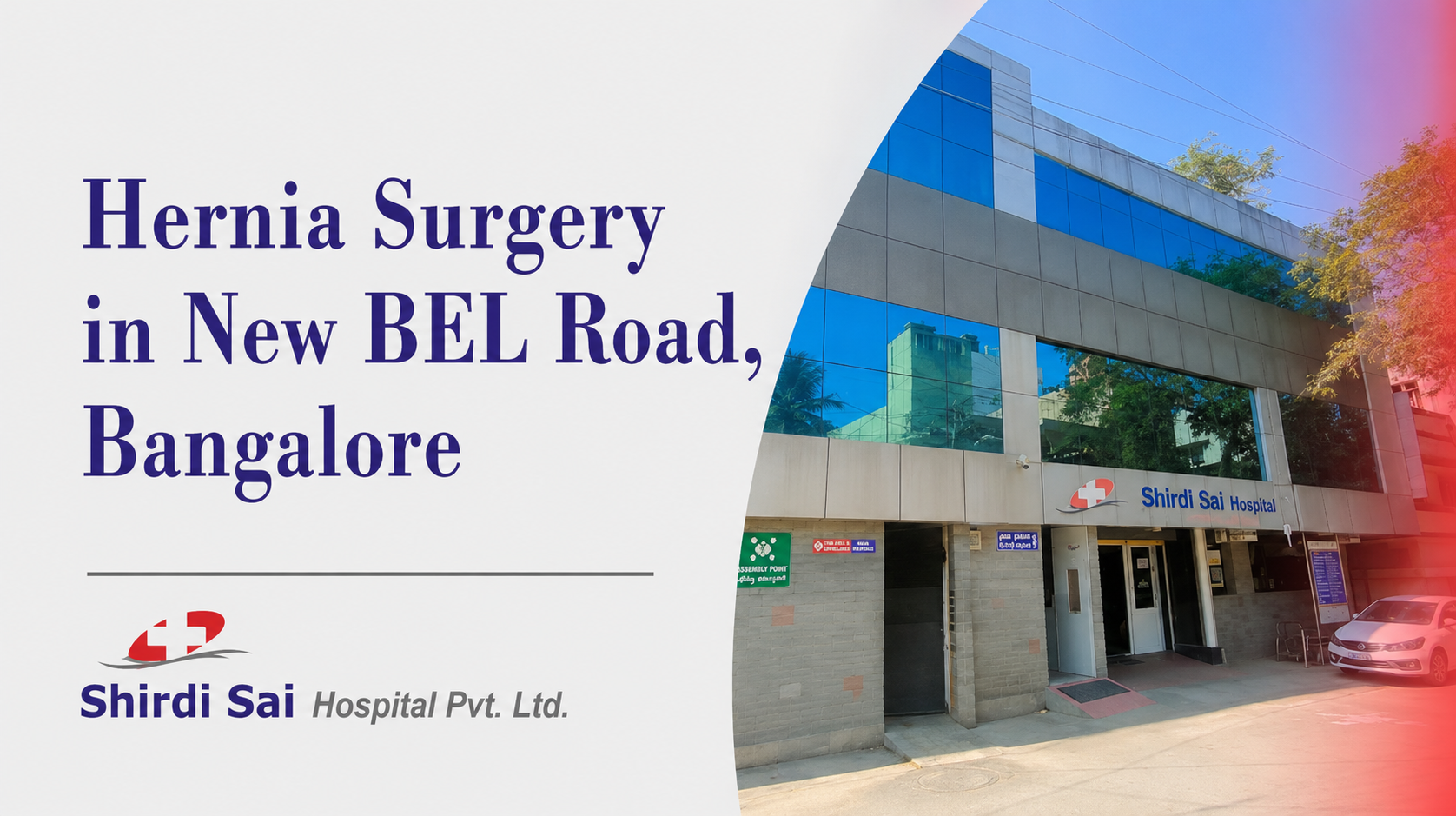
Shirdi Sai Hospital provides evaluation and surgical care for abdominal-wall and groin hernias at its New BEL Road facility. A hernia occurs when tissue pushes through a weak area in the surrounding muscle or connective tissue, often producing a bulge in the groin, near the navel or around an earlier surgical scar. Treatment depends on the hernia type, symptoms, size, previous operations and the patient’s overall health. Some minimally symptomatic inguinal hernias may be monitored under medical guidance, while painful, enlarging, irreducible or complicated hernias may require open or laparoscopic repair.
What Is a Hernia?
A hernia develops when internal tissue, abdominal fat or part of the bowel pushes through a weak area in the abdominal wall. It may appear as a visible or noticeable swelling that becomes more prominent while standing, coughing, lifting or straining. Some hernias become less noticeable when a person lies down.
A hernia is a structural problem. Medicines may relieve associated discomfort or address factors such as constipation, but they do not close an abdominal-wall defect. The need and timing of surgery depend on the type of hernia and its symptoms.
Common Types of Hernia
Inguinal hernia
An inguinal hernia appears in the groin where abdominal tissue pushes through a weak area in the lower abdominal wall. It may cause a bulge, heaviness, burning or discomfort that becomes more noticeable while standing, coughing or lifting.
Umbilical hernia
An umbilical hernia develops at or close to the belly button. In adults, it may gradually enlarge or become uncomfortable. Adult umbilical hernias are unlikely to close by themselves, although the decision about surgery still depends on clinical assessment.
Incisional hernia
An incisional hernia develops through an area weakened by a previous abdominal operation. The bulge may appear along or near the surgical scar and can become more noticeable during coughing, standing or physical effort.
Femoral hernia
A femoral hernia occurs in the upper thigh near the groin. Because femoral hernias can have a greater tendency to become trapped, timely surgical evaluation is important when one is suspected. The diagnosis may sometimes resemble an inguinal hernia.
Ventral or abdominal-wall hernia
A ventral hernia develops through the front abdominal wall. This category can include primary abdominal-wall hernias and hernias associated with earlier surgical incisions.
A hiatus hernia occurs internally where part of the stomach moves through the diaphragm. Its symptoms and treatment pathway differ from abdominal-wall and groin hernias, so it should be evaluated separately.
What Are the Symptoms of a Hernia?
A hernia does not always cause pain. Some patients first notice a small bulge during bathing, changing clothes, coughing or exercising.
Possible symptoms include:
- A lump in the groin, abdomen or near the belly button
- Swelling around an earlier abdominal surgery scar
- A bulge that becomes larger while coughing or straining
- Heaviness or dragging in the groin
- Burning or aching around the swelling
- Discomfort while standing for long periods
- Pain while lifting, bending or exercising
- A bulge that reduces or disappears while lying down
- Increasing difficulty pushing the swelling back in
- Groin swelling extending towards the scrotum in some men
Symptoms alone cannot determine the hernia type or whether surgery is immediately required. A clinical examination helps distinguish a hernia from enlarged lymph nodes, muscle injuries, cysts and other causes of a lump.
When Should You Consult a General Surgeon?
Arrange a general surgery consultation when you notice a new groin or abdominal swelling, even when it is not painful.
Evaluation is particularly important when:
- The bulge is gradually increasing in size
- Pain or discomfort affects daily activities
- The swelling appears during coughing or physical effort
- The hernia no longer reduces when lying down
- You have had an earlier hernia repair
- A swelling has appeared around an old surgical scar
- You are uncertain whether the lump is a hernia
- Symptoms interfere with work, exercise or sleep
- You are considering surgery and need to compare treatment options
Selected men with minimally symptomatic inguinal hernias may be advised to undergo monitored observation rather than immediate surgery. This approach is not appropriate for every patient or every hernia type, and symptoms may progress over time.
How Is a Hernia Diagnosed?
Medical history
The surgeon may ask:
- When the swelling was first noticed
- Whether its size changes while standing or lying down
- What activities cause discomfort
- Whether the swelling can be gently reduced
- Whether nausea, vomiting or constipation is present
- Whether there has been previous abdominal surgery
- Whether an earlier hernia has been repaired
- Whether the patient has a persistent cough
- Whether work involves frequent lifting
- Which medicines the patient currently takes
Physical examination
Many groin and abdominal-wall hernias can be identified through examination. The doctor may examine the area while the patient is standing and may ask the patient to cough or gently strain so that the bulge becomes easier to assess.
The examination may help assess:
- Hernia location
- Approximate size
- Tenderness
- Whether it reduces
- Skin changes
- Previous surgical scars
- Signs of obstruction or another complication
Imaging when required
Imaging is not necessary for every clearly identifiable hernia. An ultrasound, CT scan or MRI may be recommended when the examination is inconclusive, the hernia is recurrent or complex, or the surgeon needs more information for treatment planning.
Does Every Hernia Require Immediate Surgery?
No. The treatment decision depends on the type of hernia, symptoms and risk of complications.
A period of monitored observation may be considered for selected adults with an inguinal hernia that causes few or no symptoms. Patients following this approach should understand which changes require reassessment.
Surgery may be recommended when:
- The hernia causes pain or activity-related discomfort
- The swelling is enlarging
- The hernia affects work or routine movement
- It is difficult or impossible to reduce
- The hernia has returned after earlier treatment
- There is concern about bowel obstruction
- The hernia becomes trapped
- The type of hernia has a higher complication risk
- The patient prefers planned repair after discussing the benefits and limitations
A painless hernia still deserves evaluation. Lack of pain does not establish that the hernia is harmless or that it will remain unchanged.
Patients can also read the hospital’s guidance on a painless hernia and when it needs evaluation.
Hernia Surgery Options
The two main approaches for repairing a groin or abdominal-wall hernia are open surgery and laparoscopic surgery. The chosen approach depends on the hernia location, size, whether it is present on one or both sides, previous operations, recurrence, anaesthesia suitability and the surgeon’s assessment.
Open hernia repair
During open repair, the surgeon makes an incision over or close to the hernia. The protruding tissue is returned to its appropriate position, and the weak area is repaired.
A mesh may be used to reinforce the abdominal wall. In selected situations, tissue repair using stitches may be considered instead. The appropriate repair depends on the hernia and individual patient factors.
Open surgery may be considered for:
- Selected first-time groin hernias
- Certain large or complex hernias
- Some patients who are not suitable for laparoscopic surgery
- Emergency hernias
- Cases where the surgeon needs direct access to the affected area
Laparoscopic hernia repair
Laparoscopic surgery uses a camera and instruments inserted through several small abdominal incisions. The hernia is repaired from inside the abdominal wall, commonly with mesh reinforcement. General anaesthesia is generally used for laparoscopic inguinal hernia repair.
A laparoscopic approach may be considered for:
- Selected inguinal hernias
- Hernias on both sides
- Some recurrent groin hernias
- Patients for whom a minimally invasive approach is clinically appropriate
- Certain ventral or incisional hernias
Smaller incisions do not mean that laparoscopic repair is automatically better for every patient. Previous abdominal surgery, hernia complexity, anaesthesia risk and the surgeon’s assessment can affect suitability.
Shirdi Sai Hospital’s general surgery information lists hernia treatment and laparoscopic surgical care within its current service scope. Patients should confirm the recommended procedure after surgical evaluation.
Open Versus Laparoscopic Hernia Surgery
| Consideration | Open repair | Laparoscopic repair |
| Access | One incision close to the hernia | Several small abdominal incisions |
| Anaesthesia | May use local, spinal or general anaesthesia depending on the case | Usually performed under general anaesthesia |
| View of the repair | Direct view through the incision | Camera view from inside the abdominal wall |
| Possible uses | Selected primary, large, complex or emergency hernias | Selected bilateral, recurrent or suitable primary hernias |
| Recovery | Depends on the repair, work and patient health | May permit an earlier return to some activities in suitable patients |
| Limitations | Larger local incision | Not suitable for every patient or hernia |
| Final decision | Based on examination and surgical assessment | Based on examination and surgical assessment |
Neither approach is universally superior. Current groin-hernia guidelines support individualised selection based on the patient, hernia characteristics and available surgical expertise. (PubMed Central (PMC))
Is Mesh Always Used in Hernia Surgery?
Mesh is frequently used to reinforce the weak area during adult hernia repair. It can be placed through an open or laparoscopic approach. Some repairs may instead use the patient’s tissue and sutures, depending on the hernia, contamination risk, patient factors and the surgeon’s judgement.
Before surgery, patients may ask:
- Why mesh is being recommended
- Where the mesh will be positioned
- Whether a non-mesh repair is appropriate
- What complications are possible
- What signs should be reported after surgery
- Whether an earlier mesh repair affects the new operation
Mesh use should not be described as risk-free or compulsory in every case. The surgeon should explain its intended role and alternatives for the individual repair.
What Happens Before Hernia Surgery?
Preoperative preparation depends on the procedure, anaesthesia plan and the patient’s health.
The care team may review:
- The type and location of the hernia
- Previous abdominal operations
- Current medicines and supplements
- Blood-thinning medicines
- Diabetes and blood-pressure control
- Heart, lung or kidney conditions
- Previous reactions to anaesthesia
- Smoking and tobacco use
- Blood-test or imaging findings
- Signs of infection or bowel obstruction
Patients should not stop prescribed medicines without instructions from the treating doctor. The hospital will provide fasting guidance and arrival instructions when surgery is scheduled.
What Happens During Hernia Repair?
Although the exact steps differ, hernia repair generally involves:
- Providing the appropriate anaesthesia.
- Accessing the hernia through an open incision or laparoscopic ports.
- Returning the protruding tissue to the abdominal cavity.
- Examining the affected area when required.
- Closing or reinforcing the weak area.
- Placing mesh when clinically appropriate.
- Closing the incisions and applying dressings.
If trapped bowel is found during emergency surgery, further treatment may be required depending on its blood supply and condition.
Recovery After Hernia Surgery
Recovery varies with the hernia type, surgical approach, complexity of repair, occupation, pain level and general health. Patients should follow the instructions given for their operation rather than relying on a standard online timeline.
After surgery, temporary symptoms may include:
- Incision discomfort
- Bruising or swelling
- Groin or genital swelling after some inguinal repairs
- Abdominal bloating after laparoscopic surgery
- Tiredness
- Temporary numbness around the incision
Gentle movement is commonly encouraged, but the timing of work, driving, exercise and lifting should be confirmed with the treating team. Recovery after inguinal hernia repair may take several weeks, and physically demanding work may require a longer period away than desk-based work.
Activity after surgery
The surgeon may provide individual guidance about:
- Walking
- Climbing stairs
- Driving
- Returning to office work
- Lifting children or household objects
- Gym activity
- Abdominal exercises
- Returning to manual work
- Sexual activity
- Sports
Pain, wound healing and the type of repair influence these decisions. Do not resume strenuous lifting merely because the skin incision appears healed.
Risks and Limitations of Hernia Surgery
Hernia surgery is commonly performed, but all operations carry potential risks.
These may include:
- Bleeding
- Wound infection
- Bruising or fluid collection
- Difficulty passing urine
- Persistent numbness
- Ongoing groin discomfort or pain
- Injury to nearby structures
- Blood clots
- Anaesthesia-related complications
- Mesh-related problems
- Recurrence of the hernia
The likelihood and relevance of each risk depend on the hernia, surgical approach and patient’s health. Patients should discuss their individual risk profile before providing consent.
When a Hernia Needs Urgent Hospital Assessment
Seek urgent medical care when a known or suspected hernia is accompanied by:
- Sudden or severe pain
- A bulge that becomes hard or very tender
- A swelling that previously reduced but no longer goes back
- Increasing redness or skin discolouration
- Abdominal bloating
- Nausea or repeated vomiting
- Fever or chills
- Inability to pass stool or gas
- Rapid deterioration or confusion
These symptoms may indicate that tissue has become trapped, the bowel is obstructed or the blood supply is affected. A strangulated hernia requires emergency surgical assessment.
Shirdi Sai Hospital lists 24-hour emergency care at its New BEL Road facility. In a serious or rapidly worsening emergency, seek the nearest appropriate emergency department without delaying care to reach a particular hospital.
Hernia Surgery at Shirdi Sai Hospital, New BEL Road
Shirdi Sai Hospital’s General Surgery department includes evaluation and surgical treatment for hernias and other abdominal conditions. Its published service information also describes laparoscopic techniques within the general surgery pathway. The appropriate technique, anaesthesia, admission plan and recovery guidance depend on surgical evaluation.
The hospital is located at:
Shirdi Sai Hospital Pvt. Ltd.
No. 519, 2nd Main, Nethravathi Street
Devasandra, New BEL Road
Bengaluru, Karnataka 560054
Patients from New BEL Road, Devasandra, Mathikere, RMV Extension, Sanjay Nagar and nearby parts of North Bengaluru may contact the hospital for a planned surgical consultation. No fixed travel time should be stated because routes and traffic vary.
What to Bring to a Surgical Consultation
Bring the following when available:
- Previous consultation notes
- Ultrasound or CT reports
- Scan images or CDs
- Records from an earlier hernia operation
- Hospital discharge summaries
- A list of current medicines
- Details of blood-thinning medicines
- Information about medicine allergies
- Recent blood-test reports
- Details of diabetes, heart or lung conditions
A previous scan is helpful but may not replace a current examination.
Book a Hernia Surgery Consultation in New BEL Road
For a planned general surgery consultation, call +91 8088511289 and briefly explain:
- Where the swelling is located
- How long it has been present
- Whether it is painful
- Whether it reduces while lying down
- Whether there has been an earlier abdominal operation
- Whether vomiting, constipation or fever is present
Confirm current surgeon availability and appointment details before travelling.
To avoid confusion with similarly named hospitals, confirm that the listing shows Shirdi Sai Hospital Pvt. Ltd., Devasandra, New BEL Road, Bengaluru 560054.
For a painful irreducible swelling, vomiting, abdominal distension, fever or rapidly worsening symptoms, seek urgent hospital assessment rather than waiting for an online enquiry response.
Frequently Asked Questions
Can a hernia heal without surgery?
An adult abdominal-wall or groin hernia generally does not close through medicines, exercise or a support belt. Selected minimally symptomatic inguinal hernias may be monitored under medical supervision, but surgery is the method used to repair the structural defect.
When is hernia surgery usually recommended?
Surgery may be recommended when a hernia causes pain, increases in size, affects daily activity, becomes difficult to reduce, returns after previous treatment or carries concern for obstruction or strangulation. The timing depends on the hernia type and clinical findings.
Is laparoscopic hernia surgery better than open surgery?
Not for every patient. Laparoscopic surgery uses several small incisions and may support an earlier return to some activities in suitable cases. Open surgery may be more appropriate for other hernias or patients. The surgeon should recommend an approach after reviewing the hernia and medical history.
Does every hernia repair require mesh?
No. Mesh is commonly used in adult hernia surgery, but selected repairs may be performed using stitches and the patient’s tissues. The decision depends on the hernia type, repair method, contamination risk and individual clinical factors.
Is a painless hernia safe to ignore?
No. A painless bulge can still represent a hernia and should be evaluated. Some patients may be advised to monitor it, but that decision should follow an examination rather than an assumption that absence of pain means absence of risk.
How long does recovery take after hernia surgery?
Recovery commonly takes several weeks, but the timeline varies according to the operation, hernia complexity, occupation and general health. The surgeon should provide individual instructions regarding work, driving, lifting and exercise.
What symptoms make a hernia an emergency?
Sudden severe pain, a hard or irreducible bulge, redness, vomiting, abdominal swelling, fever or inability to pass stool or gas requires urgent medical assessment. These symptoms may indicate obstruction or loss of blood supply to trapped tissue.