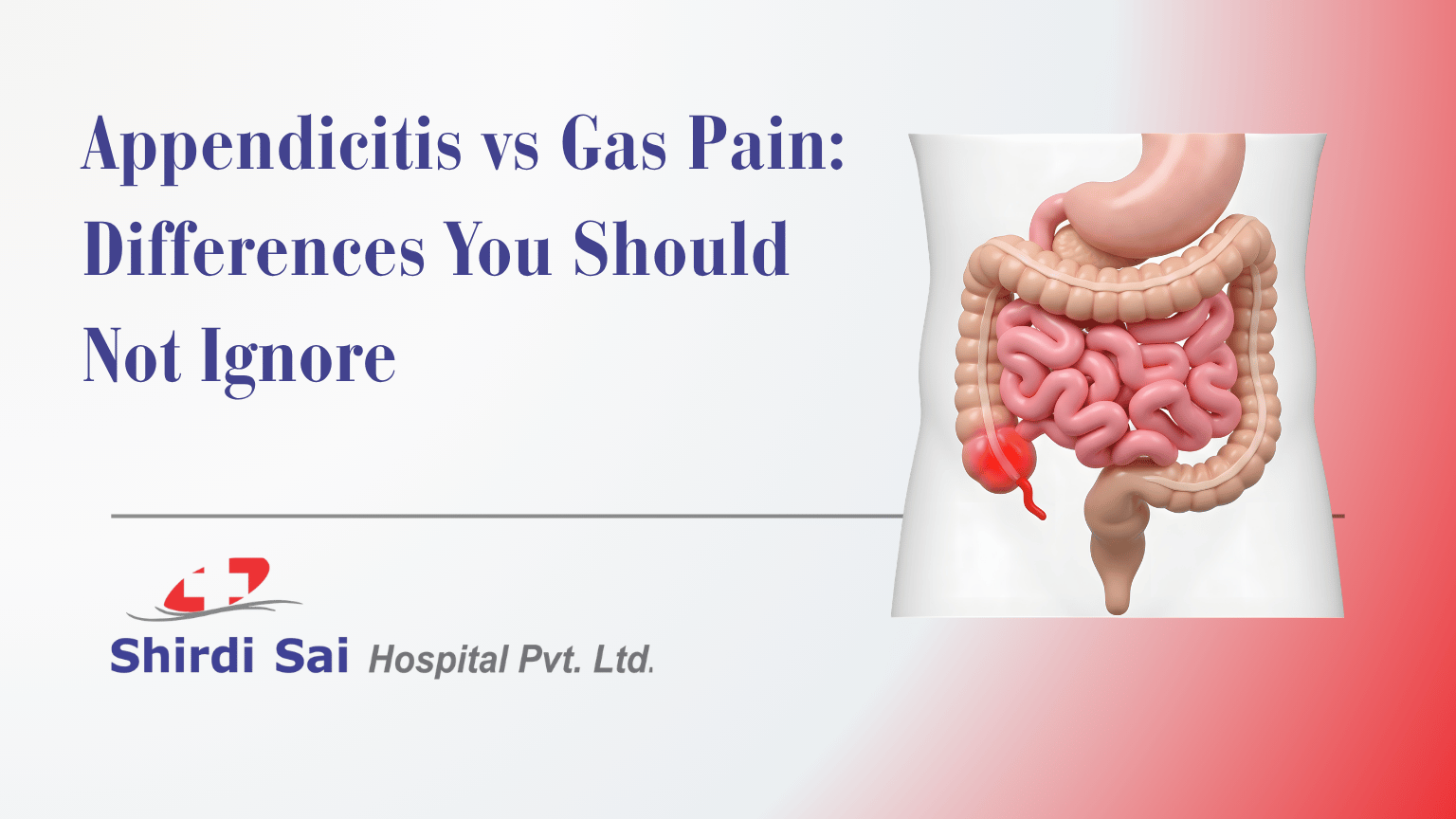
Gas and appendicitis can both cause abdominal pain, bloating and discomfort, which is why early appendicitis is sometimes mistaken for indigestion or trapped gas. Gas pain is more likely to feel crampy, shift around the abdomen and sometimes improve after passing gas or having a bowel movement. Appendicitis pain more often becomes steadily worse, may begin near the belly button and later move towards the lower right abdomen, and can occur with nausea, loss of appetite or fever. These patterns are helpful clues, not a home diagnosis. Persistent or worsening right-sided abdominal pain should be medically assessed.
Appendicitis vs Gas Pain at a Glance
| Feature | Gas pain may | Appendicitis may |
| Pain location | Occur in different areas of the abdomen | Often begin near the belly button and move towards the lower right abdomen |
| Pain pattern | Feel crampy, sharp, shifting or intermittent | Become increasingly steady or severe |
| Relief | Sometimes improve after passing gas or stool | Usually does not reliably improve after passing gas |
| Bloating | Common | Can occur |
| Appetite | Usually unaffected unless bloating is significant | Loss of appetite can occur |
| Nausea or vomiting | Possible with digestive upset | Can occur, often alongside worsening pain |
| Fever | Not expected from ordinary gas | May develop |
| Movement | May change as gas moves | Pain may worsen with walking, coughing or sudden movement |
| Medical assessment | Needed if severe, persistent or associated with other symptoms | Prompt assessment is important when appendicitis is suspected |
This comparison can help you describe your symptoms. It cannot confirm or rule out appendicitis at home.
What Does Gas Pain Usually Feel Like?
Gas is a normal part of digestion.
It forms when air is swallowed or when bacteria in the bowel break down food that has not been fully digested earlier in the digestive tract.
When gas becomes trapped, it may cause:
- abdominal cramping
- bloating
- a feeling of fullness or pressure
- brief sharp pains
- rumbling in the abdomen
- belching
- passing more gas than usual
- discomfort that changes location
The pain may be felt on either side of the abdomen and can sometimes be surprisingly sharp.
Gas trapped on the right side can also resemble pain from conditions affecting organs in that area, including the appendix.
Does gas pain move around?
It can.
Because gas travels through the bowel, discomfort may shift from one part of the abdomen to another.
Some people notice temporary relief after:
- passing gas
- belching
- having a bowel movement
- changing position
However, improvement after passing gas does not prove that the entire episode was caused by gas.
A person can have digestive gas and another abdominal condition at the same time.
What Does Appendicitis Pain Usually Feel Like?
Appendicitis is inflammation of the appendix, a small pouch connected to the large bowel.
A commonly described pattern is pain that begins around the belly button or central abdomen and then moves towards the lower right side.
The pain may become more noticeable over several hours.
Possible features include:
- pain that steadily gets worse
- increasing tenderness in the lower right abdomen
- pain that worsens with walking or movement
- discomfort when coughing
- nausea
- vomiting
- reduced appetite
- fever
- abdominal bloating
- constipation or diarrhoea in some people
Not everyone develops all of these symptoms.
More importantly, not everyone with appendicitis develops the textbook pattern.
Children, older adults and pregnant women, for example, may sometimes experience less typical symptoms or pain in a different location.
Where Is Appendix Pain Usually Located?
The appendix is generally located in the lower right part of the abdomen.
However, appendicitis pain may not begin there.
For many people, discomfort initially develops around the centre of the abdomen, particularly near the belly button. As inflammation progresses, the pain may become more localised towards the lower right side.
This change in location is an important clue, but it is not present in every case.
Some people experience:
- right-sided pain from the beginning
- more generalised abdominal discomfort
- pain in a slightly different location because of the position of the appendix
- less typical symptoms during pregnancy
This is why an abdominal pain diagram cannot reliably diagnose appendicitis.
Can Appendicitis Feel Like Gas?
Yes.
Early appendicitis can sometimes feel like indigestion, bloating or trapped gas.
A person may initially experience:
- vague central abdominal discomfort
- bloating
- cramping
- nausea
- difficulty passing gas
- a feeling that something they ate caused the problem
The difference may become clearer as symptoms evolve.
With ordinary gas, pain often shifts or settles.
With appendicitis, pain may become increasingly persistent, localised and uncomfortable.
If pain continues to worsen instead of settling, particularly when it becomes concentrated in the lower right abdomen, it should not continue to be treated as gas without medical evaluation.
How Can You Tell Gas Pain From Appendicitis?
There is no single symptom that allows a safe home diagnosis.
Doctors consider several features together.
Gas pain often changes location
Gas can move through the bowel, so discomfort may appear in different parts of the abdomen over time.
Appendicitis pain is more likely to become increasingly focused, often in the lower right abdomen.
Gas may improve after passing wind
Gas discomfort can sometimes become noticeably better after belching, passing wind or having a bowel movement.
Appendicitis pain usually continues despite these changes.
However, this difference is not absolute.
Do not use passing gas as a test to rule out appendicitis.
Appendicitis often becomes progressively worse
Gas pains may come and go.
Appendicitis more commonly causes pain that increases over several hours rather than repeatedly disappearing completely.
Worsening pain is particularly important when it is accompanied by nausea, fever or appetite loss.
Movement may make appendicitis pain worse
Walking, coughing or sudden movements may increase discomfort when the lining of the abdomen becomes irritated.
People with appendicitis may therefore prefer to remain still.
Gas discomfort can also change with movement, so this sign is not diagnostic on its own.
Fever is not a feature of simple gas
Ordinary intestinal gas does not cause fever.
Abdominal pain together with fever deserves medical attention because infection or inflammation may be present.
Does Appendicitis Always Cause Fever?
No.
Fever may occur with appendicitis, but it may be absent early in the illness.
Waiting for a fever before seeking care can therefore be misleading.
Other symptoms may be more important, including:
- steadily worsening abdominal pain
- pain moving to the lower right abdomen
- increasing abdominal tenderness
- nausea or vomiting
- loss of appetite
The absence of one symptom cannot reliably exclude appendicitis.
Does Appendicitis Pain Come and Go?
Appendicitis pain is often described as progressive rather than repeatedly appearing and disappearing.
Early discomfort may initially feel vague or intermittent, but as inflammation develops, the pain often becomes more persistent.
Gas pain is more likely to fluctuate as gas moves through the bowel.
Still, pain pattern alone cannot safely rule out appendicitis.
If abdominal pain keeps returning, becomes localised or steadily worsens over several hours, medical assessment is appropriate.
Can You Still Pass Gas If You Have Appendicitis?
Sometimes.
Being able to pass gas does not rule out appendicitis.
Difficulty passing gas can occur in appendicitis, but it is not present in every patient.
Similarly, constipation or diarrhoea may occasionally accompany appendicitis.
Avoid using bowel movements or gas passage as a home test for the condition.
What Other Conditions Can Feel Like Appendicitis?
Right lower abdominal pain does not automatically mean the appendix is inflamed.
Several conditions can produce similar symptoms, including:
- stomach or intestinal infections
- constipation
- urinary tract infections
- kidney stones
- inflammatory bowel conditions
- ovarian cysts
- pelvic inflammatory disease
- ovulation-related pain
- ectopic pregnancy
- other abdominal or pelvic conditions
This is particularly important for women because reproductive, urinary and digestive conditions can overlap considerably in how they feel.
A doctor may need to consider several possibilities before reaching a diagnosis.
When Should You Stop Assuming It Is Gas?
Consider medical evaluation rather than continuing to self-treat for gas if abdominal pain:
- persists instead of settling
- becomes steadily worse
- becomes focused in the lower right abdomen
- repeatedly wakes you from sleep
- makes walking or movement increasingly painful
- occurs with fever
- occurs with repeated nausea or vomiting
- is accompanied by marked loss of appetite
- causes significant abdominal tenderness
- feels noticeably different from previous episodes of gas or indigestion
You do not need to wait until every classic appendicitis symptom appears.
When Does Abdominal Pain Need Urgent Medical Care?
Seek urgent medical assessment if abdominal pain is severe, rapidly worsening or accompanied by concerning symptoms such as:
- severe lower right abdominal pain
- significant tenderness when the abdomen is touched
- repeated vomiting
- inability to keep fluids down
- fever with worsening abdominal pain
- a swollen or unusually rigid abdomen
- fainting or feeling close to fainting
- marked weakness or confusion
- blood in vomit or stool
- significant pain during a possible pregnancy
- difficulty breathing or chest pain
Severe abdominal pain should not be managed only with gas tablets, laxatives or repeated home remedies while waiting to see whether it passes.
What Should You Avoid Doing If Appendicitis Is Possible?
When abdominal pain is worsening or appendicitis is a possibility, avoid trying to prove the diagnosis yourself.
In particular:
- do not repeatedly press hard on the painful area
- do not rely on internet “appendix tests”
- do not use laxatives simply because you think constipation is causing the pain
- do not keep eating heavy meals to see whether the pain improves
- do not delay assessment because you can still pass gas
- do not assume that temporary relief means the condition has resolved
Pain medicines may also change how symptoms feel without addressing the underlying cause.
If pain is significant or progressing, the safer step is clinical evaluation.
How Is Appendicitis Diagnosed?
There is no single symptom that confirms appendicitis.
A doctor will usually begin by asking:
- when the pain started
- where it started
- whether the location has changed
- whether the pain is worsening
- whether movement or coughing affects it
- whether nausea or vomiting is present
- whether you have an appetite
- whether there has been fever
- whether your bowel or urinary habits have changed
A physical examination can help identify areas of tenderness.
Depending on the findings, further evaluation may include:
- blood tests
- urine testing
- pregnancy testing when relevant
- ultrasound
- CT imaging in selected cases
The choice of investigation depends on age, symptoms, pregnancy status, examination findings and clinical judgement.
What Happens If Appendicitis Is Confirmed?
Management depends on the individual clinical situation.
Appendicitis often requires urgent hospital treatment.
Surgical removal of the appendix, called an appendectomy, is a common treatment. Antibiotics are also part of treatment in appropriate situations, and selected cases may be managed differently depending on clinical findings and specialist assessment.
The important step for someone with possible appendicitis is not deciding which treatment they need at home.
It is getting the diagnosis assessed promptly.
Shirdi Sai Hospital’s General Surgery services include assessment and surgical care for abdominal conditions such as appendicitis.
Why Waiting for “Classic” Appendix Pain Can Be Misleading
Online descriptions often make appendicitis sound very predictable:
pain near the belly button, then right-sided pain, then fever and vomiting.
That pattern can happen, but real symptoms are not always so orderly.
Some people:
- do not develop fever initially
- have mild nausea rather than vomiting
- experience diarrhoea rather than constipation
- feel pain in a less typical location
- never notice a clear movement of pain from the centre to the right side
A changing or worsening abdominal pain pattern therefore matters more than matching every item on a checklist.
Gas Pain Usually Settles. Worsening Pain Deserves Attention.
Gas is common and often temporary. It may cause bloating, cramping and sharp abdominal discomfort that moves around and improves as gas passes.
Appendicitis is different because the pain commonly becomes more persistent and may increasingly localise to the lower right abdomen. Nausea, appetite loss, fever and pain with movement can add to the concern, although none of these symptoms occurs in every case.
The safest rule is simple: do not continue treating persistent or worsening abdominal pain as gas just because the symptoms began after a meal or initially felt like indigestion.
If abdominal pain is persistent or changing and you need an assessment, you cancontact Shirdi Sai Hospital on New BEL Road, Bengaluru. Severe or rapidly worsening symptoms should be assessed urgently.
Frequently Asked Questions About Appendicitis vs Gas Pain
1. How do I know if my stomach pain is gas or appendicitis?
Gas pain is more likely to feel crampy, shift around the abdomen and sometimes improve after passing gas or having a bowel movement. Appendicitis pain more often becomes progressively worse and may move towards the lower right abdomen. Because the symptoms can overlap, worsening or persistent right-sided pain needs medical assessment.
2. Can appendicitis feel like trapped gas?
Yes. Early appendicitis may initially cause vague abdominal discomfort, bloating or cramping that resembles gas or indigestion. If the pain becomes increasingly persistent, moves towards the lower right abdomen or occurs with nausea, appetite loss or fever, seek medical advice promptly.
3. Does appendix pain go away after passing gas?
Appendicitis pain generally does not reliably disappear after passing gas. However, being able to pass gas does not rule out appendicitis. Avoid using this as a home diagnostic test.
4. Where does appendicitis pain usually start?
A common pattern begins with discomfort around the belly button or middle of the abdomen, followed by pain that becomes more localised towards the lower right side. Not everyone experiences this typical progression.
5. Can gas cause pain on the lower right side?
Yes. Gas can become trapped in different parts of the bowel and may cause right-sided abdominal pain. Persistent, localised or worsening lower right pain should nevertheless be medically assessed because appendicitis and several other conditions can produce similar symptoms.
6. Does appendicitis always cause vomiting and fever?
No. Some people with appendicitis do not initially have vomiting or fever. Increasing abdominal pain, tenderness, appetite loss and changes in pain location may still be important. No single absent symptom can safely exclude appendicitis.
7. When should I go to the hospital for suspected appendicitis?
Seek prompt medical care for steadily worsening or severe abdominal pain, particularly when it becomes focused in the lower right abdomen or occurs with fever, repeated vomiting, significant tenderness or marked weakness. Severe or rapidly worsening abdominal pain requires urgent assessment.

Leave a Reply