Piles, fissure, and fistula are three different anorectal conditions, but they are often confused because all can cause pain, discomfort, swelling, or bleeding near the anus. Piles are swollen veins in or around the anus. A fissure is a small tear in the anal lining, usually causing sharp pain during bowel movements. A fistula is an abnormal tunnel between the anal canal and nearby skin, often causing pus discharge, swelling, or repeated infection.
At Shirdi Sai Hospital, New BEL Road, many patients come with bleeding, pain while passing stool, itching, swelling, or discharge and are unsure whether they have piles, fissure, or fistula. This guide explains the key differences, symptoms, causes, treatment options, and when to consult a doctor.
What Are Piles?
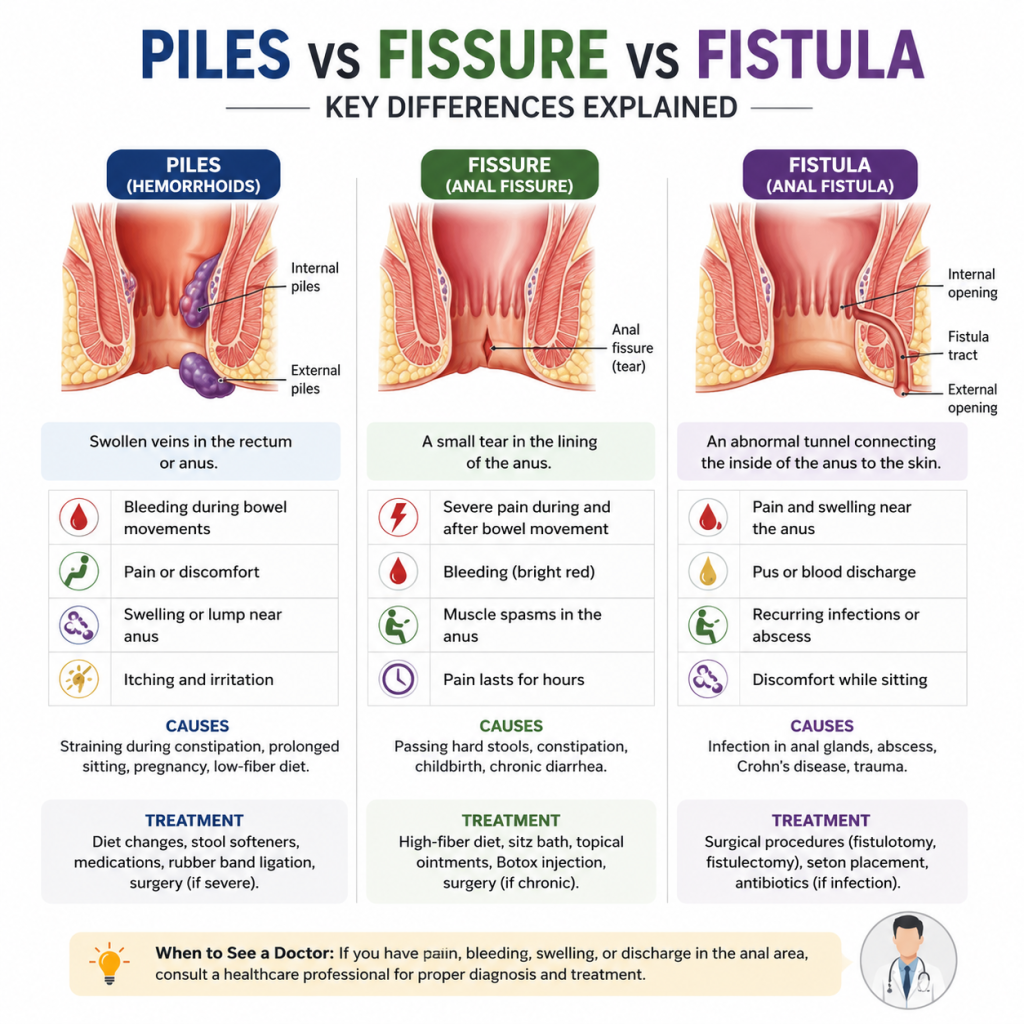
Piles, also called hemorrhoids, are swollen blood vessels in or around the anus and lower rectum. They can be internal or external.
Piles may cause:
- bleeding during bowel movements
- itching around the anus
- swelling or lump near the anus
- discomfort while sitting
- pain if external piles become swollen or clotted
- mucus discharge in some cases
- feeling of incomplete stool passage
Piles are commonly linked to constipation, straining during bowel movements, prolonged sitting on the toilet, pregnancy, obesity, and low-fibre diet.
Not every bleeding episode is piles. Rectal bleeding should be evaluated properly, especially if it is recurrent, heavy, or associated with weight loss, weakness, change in bowel habits, or severe pain.
What Is an Anal Fissure?
An anal fissure is a small tear or cut in the lining of the anus. It usually occurs when hard stool, constipation, repeated straining, or diarrhoea injures the anal lining.
A fissure commonly causes:
- sharp pain during stool passage
- burning pain after passing stool
- small amount of bright red blood
- spasm or tightness around the anus
- fear of passing stool due to pain
- constipation due to stool-holding behaviour
Fissure pain is often described as a cutting or glass-like pain during bowel movement. Pain may continue for minutes to hours after passing stool.
A fissure may be acute or chronic. Acute fissures can improve with early care, stool softening, and medical treatment. Chronic fissures may need further evaluation and procedure-based treatment if they do not heal.
What Is an Anal Fistula?
An anal fistula is an abnormal tunnel that forms between the anal canal and the skin near the anus. It usually develops after an anal abscess or infection.
A fistula may cause:
- repeated pus discharge near the anus
- swelling or boil-like opening near the anal area
- pain during sitting or passing stool
- foul-smelling discharge
- itching or skin irritation
- repeated abscess formation
- fever if infection is active
Unlike piles or fissures, a fistula usually does not heal permanently with only home remedies. It often needs proper surgical evaluation and treatment planning.
If symptoms suggest fistula, patients should not delay consultation because repeated infection can make the tract more complex.
Piles vs Fissure vs Fistula: Main Difference
| Feature | Piles | Fissure | Fistula |
|---|---|---|---|
| What it is | Swollen veins near anus or rectum | Tear in anal lining | Abnormal tunnel from anal canal to skin |
| Main symptom | Bleeding, swelling, itching | Sharp pain during stool | Pus discharge, swelling, repeated infection |
| Pain pattern | Usually mild unless thrombosed | Severe cutting pain during/after stool | Persistent or recurring pain with discharge |
| Bleeding | Common | Common, usually small streaks | Less common unless inflamed |
| Discharge | Mucus may occur | Usually no pus | Pus or foul-smelling discharge |
| Lump/swelling | Common | Skin tag may occur in chronic fissure | External opening or swelling may occur |
| Common cause | Straining, constipation, pregnancy, sitting long | Hard stool, constipation, trauma | Previous abscess or infection |
| Home care response | Mild cases may improve | Acute cases may improve | Usually needs medical/surgical treatment |
| Risk if ignored | Worsening bleeding, thrombosis, prolapse | Chronic fissure, spasm, repeated pain | Recurrent abscess, complex tract |
This table gives a clear overview, but proper diagnosis requires clinical examination.
How to Know Whether It Is Piles, Fissure or Fistula
You can suspect the difference based on symptoms, but you should not self-diagnose.
Piles are more likely if you have:
- painless bleeding during stool
- itching
- swelling or lump near anus
- discomfort while sitting
- symptoms after constipation or straining
Fissure is more likely if you have:
- sharp pain while passing stool
- burning pain after stool
- small bright red bleeding
- fear of bowel movement due to pain
- history of hard stool or constipation
Fistula is more likely if you have:
- pus discharge near anus
- repeated boil or swelling near anus
- foul smell
- pain with discharge
- recurrent abscess
- small opening near anal skin
If you are unsure, consult a general surgery team for evaluation. Shirdi Sai Hospital’s General Surgery department evaluates anorectal complaints such as piles, fissure, fistula, hernia, appendix-related problems, and other surgical conditions: https://www.shirdisaihospitalpvtltd.com/general-surgery-transplant-surgery/
Which Is More Painful: Piles or Fissure?
A fissure is often more painful during bowel movements because it is a tear in the anal lining. Patients usually describe the pain as sharp, cutting, or burning.
Piles can cause pain when they are external, swollen, inflamed, or thrombosed. Internal piles may bleed without much pain.
Pain pattern helps:
- Sharp pain during stool: more suggestive of fissure
- Lump with pain while sitting: may suggest external piles
- Pus discharge with swelling: may suggest fistula
- Bleeding without severe pain: may suggest internal piles, but evaluation is still needed
Pain alone is not enough for diagnosis. Examination is important.
Which Is More Severe: Piles, Fissure or Fistula?
Severity depends on the stage, symptoms, infection, bleeding, and complications.
In general:
- mild piles may improve with lifestyle changes and medicines
- acute fissures may heal with proper early treatment
- fistulas often need procedure-based treatment because they involve an abnormal tract
A fistula can become more complex if ignored. Severe piles can prolapse or bleed repeatedly. Chronic fissure can cause persistent pain and sphincter spasm.
The most severe condition is the one that is persistent, infected, bleeding repeatedly, or affecting daily life.
Piles vs Fissure vs Fistula: Which Is Dangerous?
Most piles and fissures are not dangerous when treated early, but symptoms should not be ignored. Fistula can become complicated if it leads to repeated abscess formation or branching tracts.
Warning signs that need medical care include:
- heavy bleeding
- black stools
- repeated bleeding
- severe pain
- fever
- pus discharge
- swelling near anus
- inability to pass stool
- unexplained weight loss
- symptoms lasting more than a few days
- recurrent symptoms
Any rectal bleeding should be assessed because not all bleeding is due to piles or fissure.
Common Causes Behind Piles, Fissure and Fistula
Although symptoms overlap, causes differ.
Causes of Piles
Common causes include:
- constipation
- straining during stool
- prolonged sitting on toilet
- pregnancy
- obesity
- low fibre diet
- chronic diarrhoea
- heavy lifting in some cases
Causes of Fissure
Common causes include:
- hard stool
- constipation
- repeated straining
- diarrhoea
- anal trauma
- tight anal sphincter
- repeated irritation
Causes of Fistula
Common causes include:
- previous anal abscess
- infection near anal glands
- inflammatory bowel disease in some cases
- previous surgery or trauma in selected cases
A fistula usually develops after infection forms a pathway between the anal canal and skin.
Symptoms Comparison: Bleeding, Pain, Lump and Discharge
| Symptom | Piles | Fissure | Fistula |
| Bright red bleeding | Common | Common | Less common |
| Sharp cutting pain | Less common | Common | Can occur with infection |
| Lump near anus | Common in external piles | Possible skin tag in chronic fissure | Opening or swelling may be present |
| Itching | Common | Possible | Common due to discharge |
| Pus discharge | Not typical | Not typical | Common |
| Pain after stool | Possible | Common | Possible |
| Recurrent boil | Not typical | Not typical | Common |
| Constipation link | Strong | Strong | Can worsen symptoms but not main cause |
This comparison helps patients understand what symptom pattern they may have before consultation.
Is Piles Surgery 100% Successful?
No medical procedure should be described as 100% guaranteed. Piles treatment success depends on grade, technique, bowel habits, constipation control, lifestyle, and follow-up care.
Mild piles may improve with:
- fibre-rich diet
- hydration
- stool softeners if prescribed
- medicines
- sitz bath
- avoiding straining
Advanced or recurrent piles may need procedures such as rubber band ligation, stapled hemorrhoidopexy, laser treatment, or surgery, depending on the case and available facility.
Even after treatment, piles can recur if constipation, straining, prolonged toilet sitting, or low-fibre diet continue.
Is Fissure 100% Curable?
Many acute fissures heal with early treatment and stool-softening measures. Chronic fissures may need medicines, topical treatment, injections, or surgery depending on severity.
Fissure healing depends on:
- duration of symptoms
- constipation control
- sphincter spasm
- stool consistency
- treatment compliance
- whether it is acute or chronic
A fissure may recur if hard stools and straining continue. Early treatment gives better outcomes.
Is Fistula 100% Curable?
A fistula can often be treated successfully, but cure depends on the type of fistula, tract complexity, involvement of sphincter muscles, infection, previous surgery, and underlying conditions such as Crohn’s disease.
Fistula treatment may include:
- drainage of abscess if present
- fistulotomy in selected cases
- seton placement
- laser or other sphincter-saving procedures in selected cases
- staged surgery for complex fistulas
Fistula treatment must balance healing with preservation of bowel control. This is why proper evaluation is important.
What Is the First Stage of a Fistula?
A fistula often begins after an anal abscess. An abscess is an infected collection of pus near the anus. If the infection drains or forms a persistent tunnel, a fistula can develop.
Early signs may include:
- painful swelling near anus
- pus discharge
- small opening near anal skin
- recurrent boil-like swelling
- pain that improves after discharge
- foul smell
- itching or wetness near anus
Early fistula evaluation is important because untreated infection can recur.
Can You Live a Normal Life With a Fistula?
Some people live with fistula symptoms for months or years, but that does not mean it is safe to ignore. A fistula can cause repeated discharge, pain, swelling, abscess formation, and skin irritation.
Living normally becomes difficult when there is:
- frequent pus discharge
- repeated infection
- pain while sitting
- hygiene difficulty
- foul smell
- recurrent swelling
- fever during abscess flare-ups
Medical treatment helps prevent repeated infection and improves quality of life.
How to Stop a Fistula From Spreading
A fistula should be evaluated by a surgeon. Home remedies cannot close an established fistula tract.
To prevent worsening:
- do not squeeze or repeatedly press the swelling
- do not delay care if pus discharge continues
- manage constipation
- keep the area clean and dry
- avoid self-medication with antibiotics
- consult early if fever or swelling appears
- follow up after abscess drainage
Proper diagnosis may require physical examination and imaging in complex cases.
How Doctors Diagnose Piles, Fissure and Fistula
Diagnosis usually starts with a detailed history and clinical examination.
Doctors may ask about:
- bleeding pattern
- pain during stool
- constipation
- pus discharge
- swelling or lump
- fever
- bowel habits
- duration of symptoms
- previous abscess or surgery
- pregnancy history
- diabetes or other conditions
Evaluation may include:
- visual examination
- digital rectal examination when tolerated
- proctoscopy or anoscopy
- ultrasound or MRI for complex fistula in selected cases
- colonoscopy if bleeding pattern suggests another cause
Accurate diagnosis is essential because piles, fissure, and fistula need different treatment plans.
Treatment Options for Piles, Fissure and Fistula
Treatment depends on the diagnosis and severity.
| Condition | Conservative Treatment | Procedure or Surgery |
| Piles | Fibre, fluids, stool softeners, creams, sitz bath | Banding, laser, stapled surgery, hemorrhoidectomy depending on grade |
| Fissure | Stool softening, sitz bath, topical medicines, pain control | Botox or surgery in chronic/non-healing cases |
| Fistula | Infection control, hygiene, abscess drainage if needed | Fistulotomy, seton, laser or sphincter-saving procedures depending on tract |
Do not use piles creams repeatedly without diagnosis. If the problem is fissure or fistula, treatment needs a different approach.
Home Care That Helps Symptoms
Home care can help reduce strain and discomfort, especially in piles and fissure. It is supportive, not a replacement for diagnosis.
Helpful steps:
- drink enough water
- eat fibre-rich foods
- avoid straining
- avoid sitting too long on the toilet
- use warm sitz bath
- avoid delaying bowel movements
- stay physically active
- avoid frequent constipation
- take prescribed stool softeners if advised
High-fibre foods include:
- vegetables
- fruits
- oats
- dal
- whole grains
- beans
- nuts and seeds in moderation
If symptoms persist despite home care, consult a doctor.
What to Avoid If You Have Piles, Fissure or Fistula
Avoid habits that worsen pressure, pain, or infection.
Avoid:
- straining during stool
- sitting on the toilet for long periods
- ignoring constipation
- taking laxatives without guidance repeatedly
- spicy food if it worsens burning
- low-fibre diet
- delaying consultation for bleeding
- applying random creams repeatedly
- squeezing painful swelling near anus
- ignoring pus discharge
These conditions become harder to manage when diagnosis is delayed.
When to Consult a Doctor
Consult a doctor if you have:
- bleeding during stool
- severe pain during or after stool
- swelling or lump near anus
- pus discharge
- repeated boil near anus
- itching with wetness
- fever with anal swelling
- constipation with pain
- symptoms lasting more than a few days
- symptoms coming back repeatedly
- black stools
- unexplained weight loss
- bleeding in elderly patients
If you are consulting a hospital in Bangalore, especially around New BEL Road and nearby areas, timely evaluation can help identify whether symptoms are due to piles, fissure, fistula, or another condition.
At Shirdi Sai Hospital, symptoms such as bleeding, pain, lump, itching, and discharge are evaluated through the General Surgery department so the correct treatment pathway can be planned. Details are available here: https://www.shirdisaihospitalpvtltd.com/general-surgery-transplant-surgery/
Why Patients Choose Shirdi Sai Hospital for Piles, Fissure and Fistula Care
At Shirdi Sai Hospital, New BEL Road, anorectal symptoms are evaluated based on pain pattern, bleeding, swelling, discharge, bowel habits, constipation history, infection signs, and recurrence. The focus is to identify the exact condition rather than assuming every anal symptom is piles.
Patients from New BEL Road, Devasandra, RMV 2nd Stage, Sanjaynagar, Mathikere, Hebbal, and nearby areas visit Shirdi Sai Hospital for evaluation of piles, fissure, fistula, bleeding during stool, painful bowel movements, anal swelling, pus discharge, and recurrent anorectal symptoms.
Early evaluation helps reduce pain, prevent repeated infection, and avoid delayed treatment.
Frequently Asked Questions
How do I know if I have piles, fissure or fistula?
Piles often cause bleeding, itching, swelling, or a lump near the anus. Fissure usually causes sharp pain during stool with small bleeding. Fistula commonly causes pus discharge, swelling, and repeated infection near the anus.
Which is more painful, piles or fissure?
Fissure is often more painful during bowel movements because it is a tear in the anal lining. Piles can also be painful when external, swollen, or clotted.
Which is more severe, piles or fissure?
Severity depends on symptoms. Mild piles or acute fissure may improve with early care. Severe piles, chronic fissure, or recurrent bleeding need medical evaluation.
Is piles surgery 100% successful?
No treatment should be considered 100% guaranteed. Success depends on pile grade, procedure type, constipation control, lifestyle, and follow-up care.
Can piles be 100% cured?
Piles can be treated effectively, but recurrence is possible if constipation, straining, prolonged toilet sitting, or low-fibre diet continue.
Is fistula 100% curable?
Many fistulas can be treated successfully, but outcome depends on tract complexity, infection, sphincter involvement, previous surgery, and underlying disease.
How do you identify a fistula early?
Early fistula signs include pus discharge, a small opening near the anus, recurrent boil-like swelling, pain, itching, foul smell, or swelling that improves after discharge.
Conclusion
Piles, fissure, and fistula are different conditions and need different treatment approaches. Piles are swollen veins, fissure is a tear in the anal lining, and fistula is an abnormal tunnel usually linked to infection. Because symptoms overlap, self-diagnosis can delay the right treatment.
At Shirdi Sai Hospital, New BEL Road, patients with bleeding, pain, lump, swelling, itching, pus discharge, or recurrent anorectal symptoms are evaluated carefully. If symptoms persist, worsen, or return repeatedly, timely consultation can prevent complications and improve comfort.

Leave a Reply